DOJ will keep fighting for Arizona voter database after Trump-appointed judge tossed its case
Jun 03, 2026 | 2:46 pm ET
Description
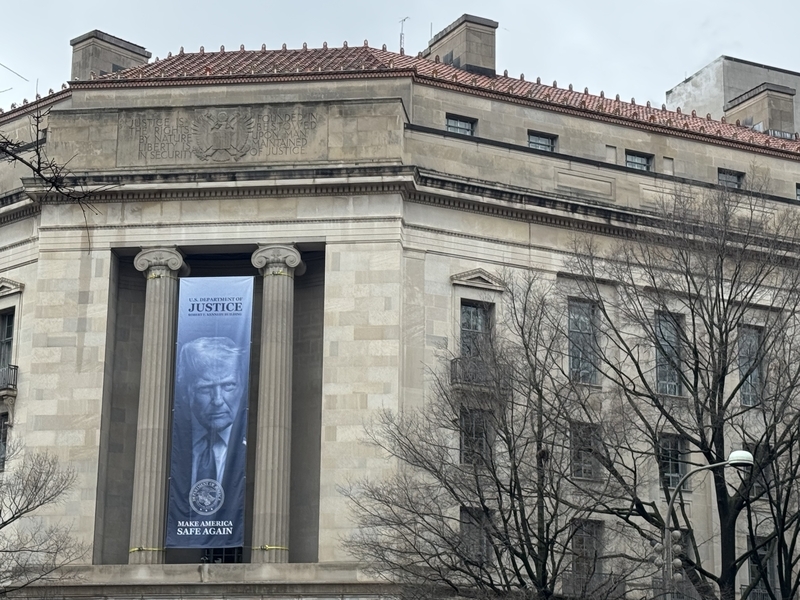
A banner showing President Donald Trump hangs on the Department of Justice on Feb. 20, 2026. (Photo by Shauneen Miranda/States Newsroom)
The Trump administration will appeal a federal judge’s ruling that barred it from demanding access to Arizona’s voter registration database, it wrote in a court filing on Wednesday.
In the filing, Jonathon P. Hauenschild, an attorney in the U.S. Department of Justice’s civil rights division, informed the trial court that an appeal would soon be filed with the 9th U.S. Circuit Court of Appeals.
In late April, Judge Susan Brnovich rejected the DOJ’s lawsuit against Arizona Secretary of State Adrian Fontes, writing that the federal government has no right to an unredacted copy of Arizona’s voter registration database. Brnovich, who was appointed to the bench in 2018 by President Donald Trump, dismissed the case with prejudice, barring the Trump administration from refiling with a different legal theory.
The Trump administration sued Fontes in January, after he refused several demands to turn over the state’s voter database. DOJ first asked Fontes to provide an unredacted electronic copy of Arizona’s voter registration rolls in July 2025. The next month, he told the Trump administration that state and federal privacy laws bar him from doing so.
The lawsuit alleged that the Civil Rights Act of 1960, which the DOJ describes as imposing a “sweeping obligation on election officials” to retain and preserve election records, granted then-Attorney General Pam Bondi “sweeping power to obtain these records.”
While DOJ framed the request for voter roll information in all 50 states as part of an effort to ensure compliance with federal voting laws, voting rights advocates and other critics said its true aim is creating a national voter database in order to ferret out undocumented immigrants.
In March, a DOJ attorney conceded to a court in Rhode Island that voter registration data collected from states — a number have voluntarily given the data to the Trump administration — is being shared with the U.S. Department of Homeland Security so it can scour voter rolls for noncitizen voters.
Trump has repeatedly, and falsely, claimed that there are tens of millions of undocumented voters — something he attempted to prove during his first term in an effort that failed to produce any evidence.
Multiple studies have found that noncitizen voting is vanishingly rare and poses no meaningful threat to election integrity. When the Bipartisan Policy Center analyzed data compiled by the Heritage Foundation, an especially conservative think tank, it “found only 77 instances of noncitizens voting between 1999 and 2023” and concluded that “there is no evidence that noncitizen voting has ever been significant enough to impact an election’s outcome.”
And Arizona voters in 2004 required that everyone provide proof of citizenship when they register to vote. (Arizona is the only state with such a law.)
In her order dismissing the case, Brnovich relied heavily on analysis from a federal judge in Michigan, who similarly dismissed DOJ’s attempt to get that state’s voter file.
Like that judge, Brnovich concluded that Arizona’s statewide voter registration list is not a record the state must preserve and produce on AG demand under federal law. That’s because the database is created by state elections officials, and the requirement in federal law to give DOJ voter records applies only to applications and similar records that voters submit to election officials.
And Brnovich also noted that the Trump administration’s argument would create an internal conflict in federal election law: One section in the Civil Rights Act creates a criminal penalty for “altering” documents that must be preserved and turned over to the DOJ, but the National Voter Registration Act and the Help America Vote Act require elections officials to regularly update the electronic voter database.
Attorney General Kris Mayes will defend against the appeal, spokesman Richie Taylor told the Arizona Mirror, and was confident that the trial court’s ruling would be upheld.
“Judge Brnovich’s ruling in this case couldn’t have been clearer,” Taylor said. “The Civil Rights Act does not authorize the DOJ’s demand for this private voter information and federal court after federal court has reached the same conclusion.”
Fontes likewise said the DOJ’s effort to appeal will be “legally futile.”
“The DOJ’s announcement that it plans to appeal a federal judge’s ruling that barred them from accessing Arizona’s voter registration database today is nothing more than ongoing political theater and further damage to Arizona taxpayers,” he said in a statement. “I want to make this clear to the Trump Administration: you can sue me as many times as you want, but I do not take my responsibilities as Arizona’s Chief Elections Officer lightly and it will take more than political threats and unfounded lawsuits to deter me from working to protect Arizona voters and their personal information.”
***UPDATED: This story has been updated with additional comments
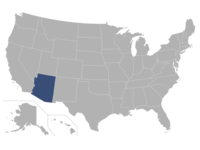
Phoenix, AZ