AI in therapy and food benefits. States grapple with new tech
This year, nearly every state has introduced some form of AI regulation legislation. That’s according to a database from the National Conference of State Legislatures, a nonpartisan public officials’ association.
Over in Michigan, the state is starting to use AI to process SNAP applications, and it’s sparking some concerns.
And in Pennsylvania, counseling experts are pushing for AI legislation in healthcare. This comes after some people have died by suicide after seeking out AI chatbots for assistance with their mental health.





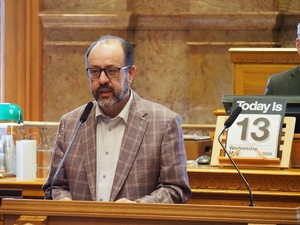
In Episode 29, you’ll hear from Michigan Advance reporter Kyle Davidson. He’s monitoring how state officials are using the AI to read food assistance applications and where lawmakers are trying to regulate AI elsewhere.
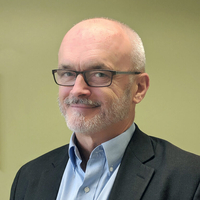
Then, you’ll hear from Curtis Taylor, the executive director of Authentic Wellness & Empowerment based in Eerie, Pennsylvania. He has been a vocal proponent of regulating AI chatbots in counseling and healthcare.
Finally, Evening Wrap newsletter author Danielle Gaines shares the top stories she’s watching.
Episode produced and edited by Mallory Cheng. Music for Stories From The States composed by David Singer.
Got questions? An episode idea? Email us at [email protected].
Subscribe to Stories From the States on Apple Podcasts, Spotify and Youtube.
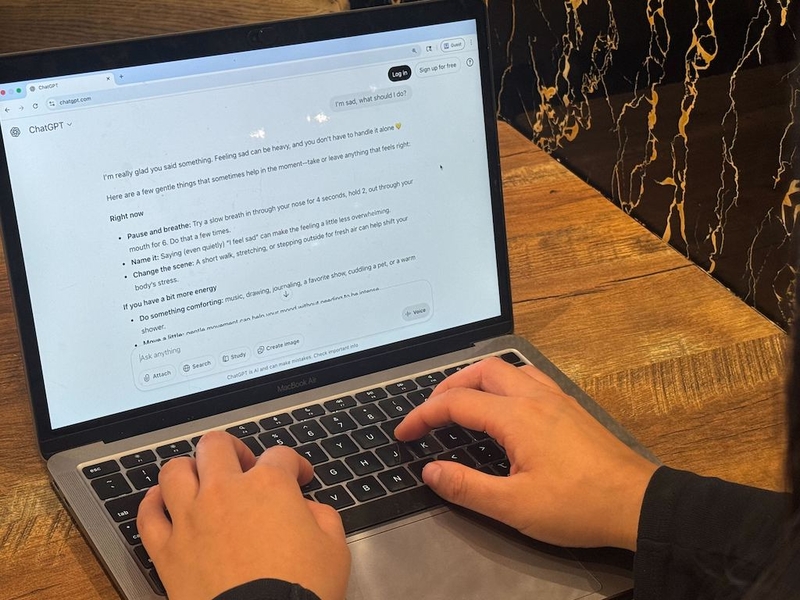
Photo: A young woman asks AI companion ChatGPT for help in January 2026 in New York City. States are pushing to prevent the use of artificially intelligent chatbots in mental health to try to protect vulnerable users. (Photo by Shalina Chatlani/Stateline)
Stories From The States is a production of States Newsroom, the nation’s largest state-focused nonprofit news organization, with reporting from every capital. At this pivotal moment in American democracy, our veteran journalists from all 50 states are reporting the consequences of government decision making. By zooming into one story each week, Stories From the States contextualizes and gives a human voice to what is happening now.
Transcript was created using an automated software.
Chris Fitzsimon
This is Stories From The States. I'm Chris Fitzsimon. Here at States Newsroom, we know there's a lot going on around the country in every state capital. So, thank you for being here. Today we're talking about how states are interacting with artificial intelligence. The Trump administration has warned states against burdensome regu...
Transcript was created using an automated software.
Chris Fitzsimon
This is Stories From The States. I'm Chris Fitzsimon. Here at States Newsroom, we know there's a lot going on around the country in every state capital. So, thank you for being here. Today we're talking about how states are interacting with artificial intelligence. The Trump administration has warned states against burdensome regulations, threatened illegal actions, and urge Congress to pursue nationwide laws and regulations that would usurp the states. This is happening as nearly every state this year has introduced some form of AI regulation. That's according to a database from the National Conference of State Legislatures. Over in Pennsylvania, they're talking about a bill that would limit AI from providing mental health services. One Pennsylvania counselor is a proponent of the regulation.
Curtis Taylor
But I do not want to see it getting monetized and subsidized by businesses or insurance companies or endorsed by the government as an alternative to counseling.
Chris Fitzsimon
Over in Michigan, they're starting to use AI in their work to process SNAP applications, and it's causing some concern. We'll hear from a reporter from the Michigan Advance in a moment.
Chris Fitzsimon
The state of Michigan is starting to use AI to help boost the number of SNAP cases it can review. The state is using an AI case reading tool to help employees go through cases line by line to make sure the department is making accurate determinations on payments, but some folks are wary about relying on AI, given Michigan's recent history of using an automated system to review unemployment cases that falsely accuse 1000s of people of fraud between 2013 and 2015. To help explain what's going on there in Lansing is Kyle Davidson. He's a reporter at the Michigan Advance. The Advance is an outlet with States Newsroom. Kyle, thank you for being with us.
Kyle Davidson
Thanks so much for having me on, Chris.
Chris Fitzsimon
Well, so what do the folks who are encouraging the state or with the state who want to use AI with SNAP? What tell us about how that would work, and what's the what's the purpose of that?
Kyle Davidson
Yeah, so when I was working on that story, that was one thing that it was a bit difficult to get some clarity there. Essentially, the argument that the state is using is that, you know, there are new federal requirements for the SNAP error rate, you know, and coming with that, there are going to be higher numbers of cases, so in order to bridge that gap, they've decided to incorporate a case reading tool there. As you mentioned, there is a lot of concern just looking back on how that worked with the unemployment, the unemployment system, and the number of cases there. So, as we're looking right now, I was not able to get a lot of clarity from the department. They have assured me that they are following both federal and state requirements there, but you know many states are kind of in early stages of looking at what their AI regulations look like, so there are still some questions remain as to how exactly this is being used and where in the process the human touch is here.
Chris Fitzsimon
Right. I guess for folks who are listening, 2013, 2015 and in computer or AI time is a lifetime ago. So, was it that certainly must have been a much different system?
Kyle Davidson
Yeah, absolutely, absolutely. And you know, to be fair, this was one of the things that I was talking about when I was reporting this story, and while working on, you know, other stories related to AI and state government, was kind of the discussion around the different types of systems used and the role here, and the issue with the previous system, the MiDAS system, which was used with unemployment, was the fact that they were kind of automating that process, letting the system have the last say in that discussion. I, you know, when talking with some of the attorneys who have either studied the case or who worked on those cases, you know, one of the things there that they mentioned, that through your constitutional due process rights, you need to have a human look at that somewhere in the process. You are guaranteed to have a human somewhere in that process, so you can't just go ahead and automate that decision away.
Chris Fitzsimon
Yeah, in the larger issue, does Michigan have any policies in place now with how state government uses AI?
Kyle Davidson
So they're looking into it. They're looking into it. There's actually a few in place. Our Civil Rights Commission actually has adopted a resolution, as well as set in place some guiding principles on the use of artificial intelligence within Michigan to make sure that any use of AI within the state is not discriminating against a particular class of people. The Department of Technology Management and Budget has also issued specific adoption and usage of artificial intelligence guidelines and responsibilities, so that's kind of their document, taking a look at. These are programs that are being used, providing some do's and don'ts of AI tool usage, talking a bit about data safety and security to make sure that people, any information that goes through these tools is safe, secure. We're not having data leaks, but beyond that, as far as state AI regulations, I mean, it is really on a case by case basis, and it's really on some specialized areas. A few years ago, we had a policy signed into law that regulates AI use in campaign ads. If you are going to use AI to generate campaign materials, you need to disclose that you can't be going and turning around and, you know, generating a video of your opponent saying nasty, horrible things, and not telling the voters that, hey, I made this using AI. But as far as state government, you know, we're beginning to see the early stages of that with a bill that actually just passed from the Communication and Technology Committee in the House, that is now currently over, sitting in the House Rules Committee.
Chris Fitzsimon
Are there predictable lines that the policymakers fall on, or is this sort of cross partisan lines, and it's more about safeguards and some folks who might be more suspicious of technology than others?
Kyle Davidson
Yeah, so that bill that I just mentioned was actually bipartisan, and I think one of the things that they are taking a look at here is just what is out there. The specific piece of legislation that I referenced is looking at creating a pilot program, essentially just to study what state departments are using AI for, and it doesn't really, you know, look at it in one way or another, it's not. This isn't inherently a bad thing. It's not that this is inherently a good thing. It's really just to kind of take a look at specific use cases and see, does this help departments? Does this carry any concerns about civil rights? Does it make departments more productive? Is it replacing employees within the department? And is that something we should be concerned about? That was some of the things that they're looking at here.
Chris Fitzsimon
It does seem like that the obvious tension is that one of the things that seems like AI could do would be, you know, scan massive data sets, and whether that's at, you know, Department of Motor Vehicles or it's in Human Services, as we were talking about SNAP decisions, or at least review. It does seem like it would, there would be some efficiencies, but I guess everyone understandably wants a human being in there and doesn't want to be either cut off of benefits or denied a license or whatever based on a machine.
Kyle Davidson
Yeah, and actually I had an interesting conversation with the director of the Science, Technology, and Public Policy program at the University of Michigan's Ford School for Public Policy, Molly Kleinman, and one of the things that we talked about was kind of how governments have adopted, you know, either local and state have adopted using AI tools to help them either write emails or do kind of customer service, to put it, you know, in general terms, and how that really can have a negative impact on trust with people, and you know, I suppose it does raise the question of, hey, if I can't be bothered to write an email or a press release, or whatever it may be, why should you be bothered to read it?
Chris Fitzsimon
You touched on another interesting aspect, which is the labor idea, that these are a lot of jobs that could be conceivably lost in state government and state agencies that could be taken over by AI. Michigan is a very heavily pro-labor state with a long history of that. How much of that is part of the debate?
Kyle Davidson
You know that actually was one of the things that came up. One of the members of the Communications and Technology Committee proposed an amendment as part of the pilot program legislation. So, currently in the form that passed out of the Communications and Technology Committee, there would be - it would create a governing board within the department of Technology Management and Budget, you know, and that would they be appointed by the governor, and there would be an individual with expertise in AI and or data science, an individual with expertise in ethics, civil rights, or privacy, and an individual who represents the private sector. One of the proposed amendments that came up in the bill that was actually voted down prior to heading to the rules committee was a proposal to instead of having someone from the private sector on that governing board to have someone representing labor on that board, and you know it was the while that the amendment was voted down, that was something that Jamie Greene, the chair of the committee who sponsored the bill, mentioned that she would be interested in having someone from organized labor as a fourth member on that board. So remains to be seen how that will play out, but that was definitely something that was on the minds of the lawmakers considering this bill.
Chris Fitzsimon
Was there anything. Covering this issue that has surprised you, that you didn't expect that you've run across?
Kyle Davidson
Yeah, it was one of those things where, when looking at tech and AI and things like that, it's really easy to kind of get into, you know, some of the philosophical things here. And while I was talking with Molly Kleinman, as I mentioned earlier, one of the things that we came up with is how easy it is to get into kind of the doom and gloom around technology. I mean, pick your favorite sci-fi movie, then you can probably think of some sort of AI tie or cautionary tale associated with it.
Chris Fitzsimon
Right.
Kyle Davidson
And while these are, you know, obviously major things that people concerns that people are having in our big part of the discussion around AI. One of the things that Molly mentioned was how this really takes away from a lot of the current issues with AI that we see. You know, we talked about essentially how AI is largely a marketing term for, you know, systems that we've had for some time, you know, machine learning, language learning, those things like that, and how these systems still have the issues that they had a decade ago. There are systems that have biases within their systems that can harm people, which creates concerns when you do apply it towards, you know, some sort of human-facing service, and those are issues that should be addressed.
Chris Fitzsimon
Yeah, it does seem like we have a ways to go before our policymakers catch up to the technology if they ever can.
Kyle Davidson
Yeah, certainly, and that was, you know, another part of the discussion that we have was just that it seems like a lot of what we do in terms of policymaking is really largely reactive, and again, part of that discussion was largely we are regulating AI products as we come, as they come out and are released by tech companies, rather than putting restrictions and requirements for those tech companies in place. So we're kind of stuck in this reactive frame that really leaves lawmakers behind the ball, as you know, we continue to see what technology can do as it comes down the pipeline.
Chris Fitzsimon
Well, we really appreciate you reporting on this for the your readers and helping us understand it on the podcast. Thank you very much.
Kyle Davidson
Thank you, Chris.
Chris Fitzsimon
To stay up to date on Kyle's reporting about AI regulation in Michigan, you can visit newsfromthestates.com. In Pennsylvania, a counseling expert is pushing for AI legislation in healthcare. This comes after some people have died by suicide after seeking out AI chat bots for help with their mental health. In a moment, we'll chat with Curtis Taylor. He's a counselor based near Erie, Pennsylvania, who's been a vocal proponent of regulating AI chatbots in counseling and healthcare. We'll be right back.
Chris Fitzsimon
I don't know about you, but the first thing in the morning, I like to have some coffee and try to catch up on all the news that I missed. One of my favorite new morning newsletters is Daybreak from States Newsroom. Daybreak gives you a quick 50 state snapshot on vital issues and how they're affecting state policies around the country. Start your day informed. Subscribe to Daybreak at statesnewsroom.com/subscribe.
Chris Fitzsimon
Across the country, people have died by suicide after seeking AI chat bot assistance with their mental health. States like Illinois and Nevada have completely banned the use of AI for behavioral health. New York and Utah have passed laws requiring chatbots to explicitly tell users they are not human. A handful of states have advanced laws restricting its use, and Pennsylvania could be next. Pennsylvania's House Bill 2100 would restrict AI chatbots and prohibit companies from providing mental health services to Pennsylvanians unless they're under the direction of a licensed therapist, in other words, a human. Pennsylvania is also suing an AI company to stop its chatbots from posing as doctors and offering medical advice, which violates its state medical licensing rules. One counselor in Erie, Pennsylvania, has been outspoken about the dangers of using AI to replace a human therapist, and he joins us now. Curtis Taylor is the executive director of Authentic Wellness and Empowerment. Curtis, thanks for being here.
Curtis Taylor
My pleasure. Thanks for having me.
Chris Fitzsimon
I think a lot of folks probably have heard a little bit about this topic without a lot of the specifics. Tell us, as a, as a therapist, what, what is your overriding concern?
Curtis Taylor
As you referenced in the introduction, there, my overriding concern is client safety, human safety. These AI chat bots aren't mandated reporters, they're not even human, right? And so they can, they can say a lot of things and. People can seek them out to provide advice or support in various ways, and sadly, unfortunately, we've, we've seen people pay, pay the ultimate price for that, you know, and commit crimes and commit suicide, and things of that nature, and so that's that's my biggest concern is human safety when it comes to people looking to and relying on these bots to give them good advice, and sometimes it's tragic.
Chris Fitzsimon
You had a client mention, I guess, an experience with the AI counseling app. Did that sort of accelerate your concern?
Curtis Taylor
Yes, it did. And it wasn't that the client themselves shared something that was overwhelmingly concerning, it was just sort of the deluge of thoughts of like oh wow, what does this mean, because myself, I had when I first heard about AI being used in counseling, it was about a year ago, and that was on the heels of I had just defended my PhD dissertation, and so all through my program I'd heard people talk about AI, and I was like, I'm not touching the stuff, I don't want to, you know, have AI do my dissertation for me, but then once I started growing my business, I started using AI to help me with a lot of things, and all of a sudden I'm in a counseling session, and the clients tell me that they downloaded an AI counseling app, and right away I was worried about safety, and right after that I started getting worried about, you know, what a lot of people worry about is like, is AI going to replace us, you know, and what would that look like, and so, yeah, they just mentioned it, how they download the app, and it was helping them, how do I have conversations with my children, and things like somewhat benign things, but it just opened up my mind to, like, oh, wow, and then also thinking to like, this thing's not licensed, it hasn't been vetted. Where are the limits? Where's the safety in this?
Chris Fitzsimon
Yeah, I haven't used it for therapeutic reasons, but even just, even just researching a state policy topic, the tone of AI was really struck the first time it happened, where it either praises you or points out things, and it does want to appear to have a personality, which I imagine is very.. I don't know if the word enticing is right, but appealing if you're someone who's struggling and wants somebody to talk to.
Curtis Taylor
Yeah, and that's something I noticed myself when I first started using AI. It was just hyper affirming. I've heard others use the word sycophant, where it just becomes like your biggest fan, like no idea you ever had was flawed. Everything was, wow, that's that's novel. You're really hitting on something, like not many people would think of it that way, but that's very insightful. And I called it out, I, as a counselor, I said, "Oh, you're being very Rogerian", which is, you know, human-centered, person-centered, universal positive regard, and so, as counselors, and part of our rapport building, you know, we're recognizing that people are doing things with good intentions, and we support that, but we're also using common sense and ethical and appropriate challenging, and I think that's something that AI isn't necessarily doing, or people aren't necessarily hoping that AI would do, you know, to challenge them while being affirming, like, oh, wow, like you're going through a really hard time, you know, what's that like? Tell me more, you know, as a general counseling thing, but AI could just start saying, like, 'oh, those people are all mean, and you're right to think they're against you, they probably are', like, it could very easily start pouring those ideas onto people.
Chris Fitzsimon
Yeah, we had a story. I don't know if you or followed it, but there was a shooting at Florida State University, and there was the shooter actually, the texts have come out where he was having a conversation before the shooting with AI, and we'll see what the legal system says, but just reading those texts, reading those chats was really disturbing, because, as you mentioned, there was no human saying, "Hold on, you know, that's a dangerous to yourself, that could be dangerous to others", or whatever. The caution, the caution gene doesn't seem to be embedded in computers.
Curtis Taylor
No. Yeah, I think, think that's well put. It'll just kind of play in anything, you know. And people on social media who do funny things with AI, you know? It'll say, like, 'Time me, I'm gonna, I'm gonna run a mile, start now'. And it's like, 'Okay, I finished', you know. And they'll say it, like, literally five seconds in between, and the AI will just make up a number. It's like, 'Oh, that's pretty good, you did it in eight minutes'. It's like, 'No, I didn't'. AI doesn't know, you know. And I think, for myself, right, I started using it as a, as a 40 some year old man with my PhD, and so I really treat AI as like a graduate assistant, and and it's very helpful in that regard. But just overall, in general, people can use it for anything, right? Like a literal partner in crime, and like I don't know if I shared it right, it's not a mandated reporter, like it's not saying, like, "Whoa, tap the brakes. Like, are you being serious right now", right? And they wouldn't know if you're being serious or not, and you could lie to them, right? But with a human, right, you can sniff that out and be like, well, I have to take these kinds of things seriously. I'm telling someone.
Chris Fitzsimon
I guess that I'm not endorsing this view at all, but I guess there are people who either don't want to talk to you human, can't afford. To talk to a human, don't have access to a human, and I'm sure there are folks who would say here's something where somebody could at least vent or put their thoughts in a place. So, what do you say to folks who were worried about the over regulation or making this inaccessible to people who need help?
Curtis Taylor
Right. Yeah, and, and like, when I spoke with the Democratic Policy Committee in Pennsylvania. The first thing I shared was I'm not anti-AI, like, like this is this is helpful, right? And it can be in some sense, and not a friend in the same way a human friend is, but it's a conversation mate, you know, it's someone to dialog with and brainstorm. I do it, you know. So, yeah, I don't want to see AI, you know, thrown, thrown out like the baby with the bathwater kind of thing, you know. I have reservations about it, of course, but I think some people are like staunchly against it, and sort of in my mind that's almost like saying, like, you know, I want to, you know, jokingly say to them, like, we'll get back on your horse and forget about cars, you know, like we've technologically we're moving this direction, right, but I think, like, we're saying, like, the over regulation, like, there's definitely a place for it. I use it, my counseling, but I also think, too, we can't police it, because you know, just like counseling is more than just talking with a friend, AI could be like a friend, right? It can't be your counselor, it can't be a lot of things, but it could be like 'I'm nervous, I'm about to walk in and talk with my mom. Give me like 10 tips of like how to do this'. Sure, do that right, but don't go to it when you're in crisis. Don't definitely don't monetize it as counseling help, you know. But it's, it could be a conversation, mate. Like, absolutely, it is that. It will be that. I think it should be that to a lot of people in a lot of circumstances.
Chris Fitzsimon
What should policy makers do? Like, how can we.. it sounds like, like every other technology, the internet, or whatever, there's good and bad. As a, as a professional in this world, what do you tell those policy folks in Pennsylvania? How do we.. how do we navigate this in a smart way?
Curtis Taylor
Um, well, and I've been talking with the policy folks, and I really specifically appreciate Representative Ryan Bizzarro. He's the representative of Pennsylvania's third district. He's the representative in Mill Creek, Pennsylvania, where my office is, just outside Erie, and he's been very attentive in his policy committee as well. And the big thing is the safety concerns, right, because there's a lot of things that AI couldn't, shouldn't, won't generate for you. I would imagine wouldn't give you like the layout of how to make a nuclear bomb, right? Like, there's something in the programming that keeps it from doing that, right? So it could certainly do things that keeps it from presenting as a counselor, and I think that's important to redirect people, because yeah, if people want to talk to someone and the counselor's unavailable. 988 is an emergency number to call for, you know, mental health crisis, and so that's always available, right? And so it's not that, you know, there's no 24/7 help for people in mental health challenges or crisis, so like those things exist, right? So I think regulating AI to not brand itself as a counselor, to use a lot of caution if a conversation steering towards something that seems therapeutic, that can definitely be regulated, and what I really don't want to see is insurance companies or venture capitalist companies monetizing this, subsidizing this, endorsing this as an alternative to counseling, because first and foremost, it's not safe, it's not vetted, it's not licensed, people have died, and we don't want any more of that. At the same time, yeah, we want to regulate and protect it, because then if we start bleeding into, like, well, the counseling bots good enough, right? And insurance companies start thinking, like, we'll get triaged by the bot, you know, and if after six months you still need a counselor to go get one, I don't want to do that, because it's going to take money and resources out of an already stressed and strained system, the mental health field, and you know, by the time you know people realize their counseling bots not working, there's going to be even more of a shortage of counselors, and counseling is going to be even more unaffordable, and insurance won't be paying for it. So, I want to make sure we're protecting clients, you know, and their health and their safety, but then also protecting the efficacy and safety of the counseling field.
Chris Fitzsimon
Have you had any reaction, or heard of any reaction from the AI companies themselves?
Curtis Taylor
It's interesting. I know, I know, there has been pushback. I'm not familiar specifically with the details of what that pushback has been, because obviously there's a lot of AI companies, and whether or not they're trying to find their footing in the mental health field, they definitely, I would imagine, want to protect themselves from being caught up in some kind of litigation, you know, where it's like, 'oh yeah, we let our chat bot do its thing, and wasn't our fault they made it a counselor, wasn't our fault the person hurt themselves', like I'm sure they're trying to avoid that liability, but I think that's all the more reason they need to be vigilant on the front end, like, well, don't let your bot do that. Put a stop to it, you know, there's a million things you wouldn't let it generate, let this be one of them, you know, redirect people to help. So, so I imagine there's pushback, and I downloaded the app that my client had mentioned, and it told me it was a counselor. I told, I told it, it's like, "Oh, what if someone's in danger right now?" and the thing glitched off. It just shut it off on me, and so I reported that to the state. It sort of got bogged down because the company was out of New York City, and so I was accusing it of practicing counseling without a license here in Pennsylvania. And so it became this federal issue, and it didn't really go anywhere. But I've, I've reported it, and Governor Shapiro is talking about holding these companies to task, and so, sure, like, if AI counseling can be helpful to people, I'm for it. If AI can be safe, I'm for it. But I do not want to see it getting monetized and subsidized by businesses or insurance companies or endorsed by the government as an alternative to counseling, because it just isn't.
Chris Fitzsimon
Well, thank you very much for that perspective, and what you're doing. We appreciate you being with us.
Curtis Taylor
Yeah, my pleasure. Thank you.
Chris Fitzsimon
To stay up to date on your state's stance on AI regulations and what your state lawmakers are doing, you can always visit newsfromthe states.com. Coming up in a moment, we'll hear from Evening Wrap newsletter writer Danielle Gaines about the top stories she's looking out for, and one last thing. We'll be right back.
Nelle Dunlap
Hi, it's Nelle Dunlap, Product and Engineering Director at States Newsroom. At States Newsroom, we believe journalism should be fair, fearless, and free, with reporters working on the ground in all 50 states and Washington, D.C. We provide non-partisan coverage of the state issues that matter most to you. You can subscribe to our work by going to statesnewsroom.com/subscribe.
Chris Fitzsimon
Joining us now is States Newsroom's Evening Wrap newsletter writer Danielle Gaines. Hi, Danielle.
Danielle Gaines
Hi, Chris. How are you?
Chris Fitzsimon
Good. I know. I say this every week. Another insane week in the state's news world.
Danielle Gaines
Yeah, so much going on, it was really hard to narrow it down this week,
Chris Fitzsimon
Right. So I'm anxious to know, how you did tell us, tell us what caught your eye.
Danielle Gaines
Yeah, well, graduation season is upon us, and so we've had a lot of really interesting graduation stories. I wanted to share one. One of our reporters went out to the Sitting Bull College graduation in North Dakota, and talked to students there, and they were there because schools like Sitting Bull College, tribal colleges rely on federal subsidies as a large part of their budgets, and the US provides this funding as part of treaty obligations, and the federal government is considering slashing this support.
Chris Fitzsimon
And why are they considering slashing it? Do we know the motivation?
Danielle Gaines
Well, the Interior Secretary, of course, who is the former governor of North Dakota, was not happy with kind of the per pupil cost that is going to tribal colleges, and felt like money could be spent better elsewhere, they have proposed cutting $150 million in funding this year. They proposed a big cut last year as well. Congress rejected that, so that's kind of going through the process now, but it was interesting hearing, you know, the real life experience of people who attend these colleges, so you know, one of the graduates said that, like, she didn't have to, like, seek out Lakota traditions, they were just a part of everyday life. She was able to focus on her schoolwork without feeling othered or made to explain her heritage or why she, you know, wanted anything any certain way. She was just able to kind of live and learn at the same time, and so it was really interesting story.
Chris Fitzsimon
Yeah, we'll have to keep an eye on that one and see how it ultimately resolved.
Danielle Gaines
Yeah.
Chris Fitzsimon
All right. What about something coming up?
Danielle Gaines
Well, election season is also upon us, bearing down upon
Chris Fitzsimon
Indeed.
Danielle Gaines
So we had a new and interesting analysis from our DC team about what the impact of redistricting could be on the midterms, so we've talked, it's been everywhere, a lot of talk about redistricting, changing seats to favor the GOP in the South, but this analysis kind of went into kind of the still uphill battle that Republicans may face, which I think is something that I haven't really heard anybody talk about yet. So, the GOP holds 217 seats in the US House right now. Democrats have 212 There are five vacancies, and this redistricting in the South, Democrats needed to gain three seats before. All of this redistricting started. Now it's higher, it's eight to 10 seats, and we talked to some political analysts and professors who said it's still doable for Democrats. So the president has kind of a rock bottom approval rating, prices are up, gas is so expensive, people can't avoid paying attention to that, and so Republicans are still pouring a lot of effort into campaigning, Democrats as well, and Democrats may be able to continue that trend of historically the House winning more seats in the House when a Republican is in the White House.
Chris Fitzsimon
Yeah, wow, it's really going to be interesting. It'll be here before we know it.
Danielle Gaines
Yeah, and the other thing that one of the professors said was, you know, all of this redistricting is happening, and it's happening in a really, really rough year for Republicans, but it still has the potential to really benefit the party in further elections.
Chris Fitzsimon
Right. All right, what about one last thing?
Danielle Gaines
Yeah, well, we had this great story out of the Wildlife Center of Virginia this week, so they treat thousands of wild animals, including dozens of bald eagles, and we had a picture of them doing a bald eagle surgery, and that's what really caught my eye.
Chris Fitzsimon
Wow.
Danielle Gaines
So they are part of a push by conservatives, animal lovers, lawmakers to continue protecting the bird. It has symbolized America since 1782 and they're using the 250th anniversary of the country to kind of call attention to the importance of eco diversity and to point to bald eagles as a conservation success story, so you know, in the 1960s there were about 400 nesting pairs of eagles left nationwide. That number has has skyrocketed. Eagles are universally considered a success story. We've changed many laws around pesticides and other things, habitat, in order to keep them thriving.
Chris Fitzsimon
I have seen a bald eagle a couple times in person. I'm always stunned at how giant they are. And then my other comment would be, anything that is bald, I think deserves our support.
Danielle Gaines
That story, you should look it up, because it's just full of factoids. It was so hard to try to think of what to speak of now, but I'll give you one last factoid. So, the eagle became a national symbol in 1782 It appeared on the US seal and in government documents. It did not become the national bird until when?
Chris Fitzsimon
I don't know.
Danielle Gaines
2024!
Chris Fitzsimon
What??
Danielle Gaines
Under President Joe Biden, Congress passed a law and he signed it, so.
Chris Fitzsimon
Wow, well, that's fascinating. Well, that's one of the better one last things ever. Thank you, Danielle.
Danielle Gaines
I try.
Chris Fitzsimon
Thanks for listening to Stories From The States. I'm Chris Fitzsimon. Mallory Chang produced and edited the podcast. David Singer produced our theme music. If you liked what you've heard today, please leave us a rating and review. It means a lot to know what you think about the podcast. To stay up to date on the latest episodes, subscribe now to Stories From The States, a podcast from State's Newsroom, available wherever you listen to podcasts. We'll talk to you soon.