House GOP passes new voting lines for SC ahead of court hearing on first lawsuit
May 19, 2026 | 7:04 pm ET
Description
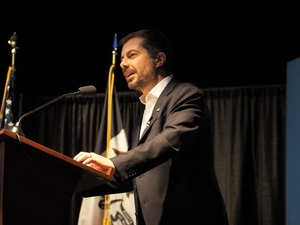
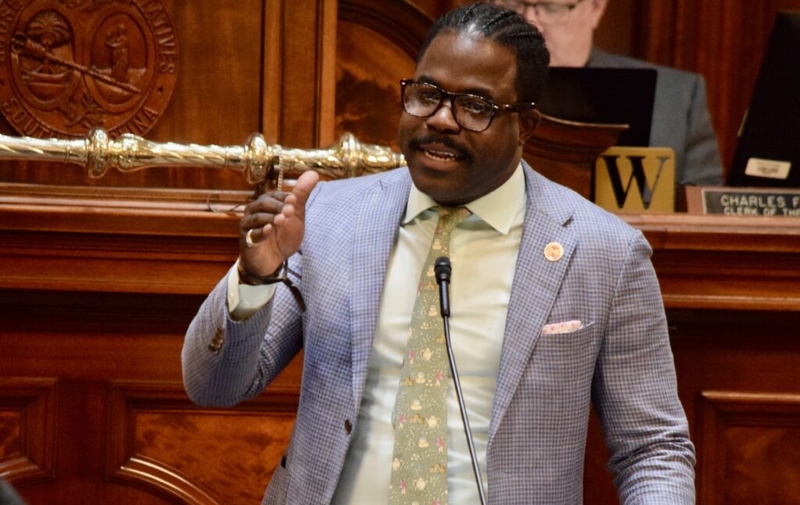
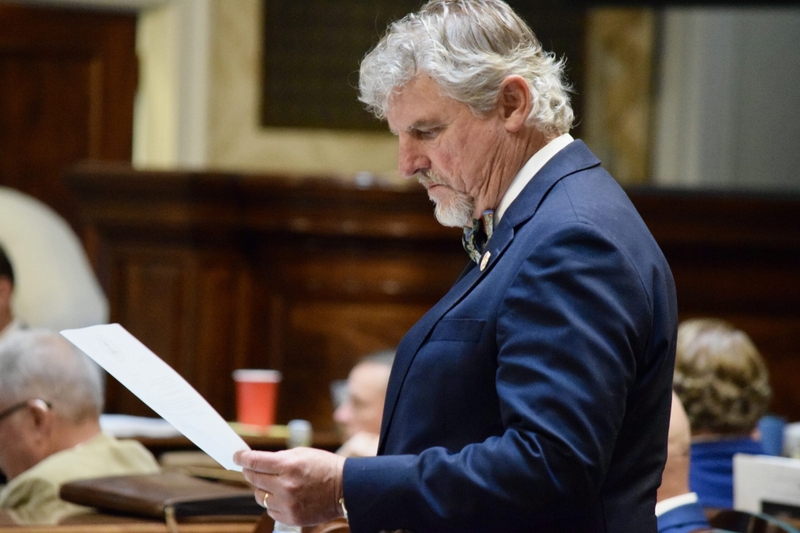
State Rep. JA Moore, D-North Charleston, scolded his GOP colleagues from the lectern in House chambers on Tuesday, May 19, 2026, for pushing through new congressional lines with voting in the June primaries already underway. (Photo by Jessica Holdman/SC Daily Gazette)
Editor’s note: This article was last updated following the House vote.
COLUMBIA — Republicans in the South Carolina House passed a new congressional map hours after voters’ rights groups sued the chamber’s GOP leaders Tuesday to stop the process.
The 74-36 vote at 12:21 a.m. Wednesday embraced a White House-backed plan aimed at securing a Republican clean sweep of South Carolina’s congressional delegation in November.
Four Republicans — Reps. Nathan Ballentine of Chapin, Tom Hartnett of Mount Pleasant, Dennis Moss of Gaffney, and Heath Sessions of Rock Hill — joined Democrats in opposing the quick overhaul just one week before the start of early voting and after the mailing of more than 11,000 absentee ballots. Twelve legislators had excused absences for not voting. One Republican in the chamber over two full days of debate didn’t vote on the bill itself.
The House then adjourned and, since it was after midnight, immediately reconvened as the next day to take the perfunctory vote needed to send the bill to the Senate. With that final vote at 12:39 a.m., representatives went home to await what senators do with the bill.
The full Senate Judiciary Committee has scheduled a public hearing for Wednesday afternoon.
But before that, a judge will hear initial arguments in a lawsuit that seeks to invalidate the House’s mid-debate change to the rules. The hearing at 9 a.m. Wednesday in Richland County Court could put the process on pause pending a ruling.
Democrats said they expect the lawsuit to be the first of many against efforts to redraw South Carolina’s congressional lines.
Opponents criticized Republicans for upending an election already underway to rush through a map made without any input from South Carolinians. That includes GOP leaders, who told their colleagues a day before circulating the White House-endorsed map that they hadn’t seen one yet.
House Minority Leader Todd Rutherford, D-Columbia, noted it’s based off 6-year-old census data in one of the nation’s fastest growing states.
“What you all are doing is wrong,” said Rep. JA Moore.
“You can justify it, rationalize it, but it’s wrong,” the North Charleston Democrat added.
The rules change
The state chapters of the League of Women Voters and American Civil Liberties Union sued Tuesday over the way GOP leaders dispensed with more than 500 of Democrats’ proposed changes.
To end the potential of debate dragging on indefinitely, the House Rules Committee adopted new rules Monday night limiting every legislator to one amendment and debate on each to three minutes. The full House then voted 73-33 on a resolution that put the changes in place for the duration of the debate.
A judge, however, could require all discarded amendments to be heard.
“The League wants to see public transparency in the process because it’s just so important,” league lobbyist Lynn Teague said of the lawsuit’s goal.
The lawsuit alleges the hastily called meeting violated the state Freedom of Information Act, which requires public notice of meetings at least 24 hours in advance.
Notice of the meeting was posted just eight minutes before the committee convened, and the meeting ended before reporters could make it to the room.
White House map of SC voting lines could help Democrats, GOP leader warns
House Speaker Murrell Smith told his colleagues the open meetings law doesn’t apply to the House Rules Committee.
“This is not a committee for the public,” the Sumter Republican said in overriding legislators’ complaints Monday night. “Internal workings of the House are not subject to FOIA.”
The lawsuit argues his ruling on the chamber floor, if left unchallenged, would set a bad precedent that allows “legislative committees to conduct consequential public business in secret.”
The groups also allege the meeting violated FOIA because the late notice lacked details. And, while meetings needed for “emergency or exigent circumstances” can avoid the 24-hour rule, no one pointed to that as a reason, and it wouldn’t apply anyway, according to the lawsuit.
“Any urgency was manufactured by Republicans in the House who became frustrated by members whose debate and proposed amendments slowed Republicans’ attempts to steamroll the passage of the bill,” the lawsuit reads.
On Monday, it took Republicans 10 hours to get through nine amendments. On Tuesday, following the rule change, they rejected dozens of amendments over several hours in an effort to adopt a map drafted by the National Republican Redistricting Trust.
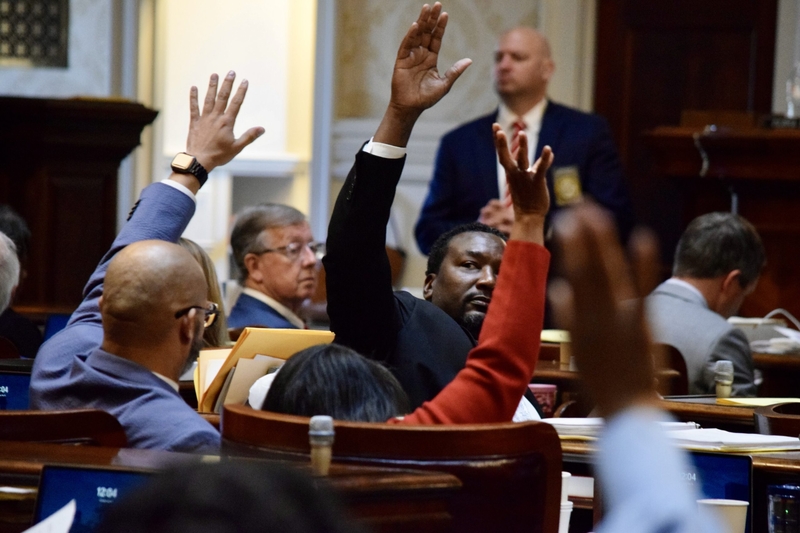
Debate on the bill itself then continued late into the night. The resolution allowed each representative to speak either for or against the bill for up to 10 minutes.
The 26 legislators who spoke in opposition included just one Republican.
The six Republicans who went to the lectern in support included Rules Committee Chairman Micah Caskey of West Columbia, who argued the resolution actually preserved debate.
“I understand the temptations of politics, but to those who are willing to be intellectually honest, you know that the suggestion that this resolution prevented debate is empty,” he said, while not addressing the lawsuit.
“No legislative body can operate that way,” he said about allowing indefinite debate as Democrats kept adding to the stack of amendments.
While the specially enacted rules limited members to one amendment, they had the option to redraft or introduce a new one that combined multiple proposals, he said.
“This was not a content restriction. It was merely a vehicle restriction,” said Caskey, the last legislator to speak on the bill.
“Amendments matter. Debate matters. The right of every member to be heard matters,” he added. “And the obligation of the House to eventually take a vote matters, too.”
Then at roughly 8:45 p.m., with a vote seemingly imminent, Rep. Rosalyn Henderson-Myers, D-Spartanburg, invoked a rule allowing any legislator to have an entire bill read aloud. Legislators had to sit in their seats as Reading Clerk Bubba Cromer read the 110-page bill of precinct names, block numbers, and their populations.
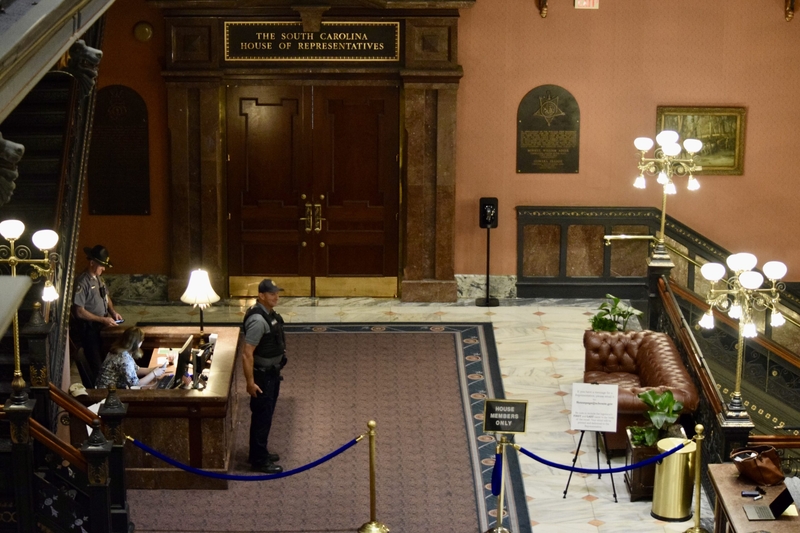
The reading lasted about 3 ½ hours, which included multiple interruptions from legislators tattle-telling on each other for not being in their assigned seat — ostensibly to pay attention to the succession of numbers.
Points of order included whether legislators were allowed to eat at their desk or go to the bathroom after the chamber’s doors to the lobby were shut to keep them inside.
The debate
Amendments that received “no” votes during the debate included proposals to automatically send out absentee ballots to voters who requested them for the first round, move the lines so that downtown Columbia and Clemson aren’t in the same district, and mail notices to all registered voters moved to a different congressional district because of the redraw.
Rep. Beth Bernstein asked lawmakers to approve voter education via text message alerts, direct mail, signage at polling places, a toll-free hotline for questions and social media outreach.
“When confusion becomes a barrier, a barrier becomes silence, and silence becomes a vote that was never cast,” the Columbia Democrat said.
Rep. Wendell Jones, D-Piedmont, urged his colleagues to think about what “should be done” for the long-term good rather than what’s possible for the midterms.
“This debate has been bigger than politics. It’s bigger than who wins the next election. This debate is about legitimacy,” he said. “And when people lose faith in the legitimacy of their institutions, the foundation of our democracy begins to crack.”
Hartnett, among the four Republicans who ultimately voted “no” opposed how the new map lumped together differing coastal economies. The overhaul would put much of Charleston County in the 7th District with Myrtle Beach. But the state’s port in Charleston Harbor shouldn’t be in the same district as the tourism-focused economy of the Grand Strand, he said.
“I was elected to defend the interests of my district, even if that means standing alone,” said Hartnett, the only Republican who used his 10 allowed minutes to oppose the bill. “I cannot support a map that weakens Charleston County voices, dilutes the Lowcountry’s influence, and places our region at a disadvantage when competing for federal resources.”
But Rep. Robby Robbins, R-Summerville, said the proposed map actually does a better job than the existing lines of keeping together rural communities, giving them a stronger voice politically, while splitting fewer counties statewide. Dorchester County, where he lives, would be part of the remade coastal 1st District that extends south to include all of Beaufort and Jasper counties.
Rep. Luke Rankin, the bill’s lead sponsor, called it “completely reasonable” to redraw the districts to flip the one seat safely drawn decades ago for a Democrat in a state dominated by Republicans.
“This debate is about far more than just South Carolina people,” said the Laurens County Republican. “The trajectory of our entire country is at stake. The balance of power in Congress is incredibly narrow and what we do today could ensure that Republicans keep a majority.”
Cost to taxpayers
The House measure would delay primaries until Aug. 18 for the state’s seven U.S. House seats. But as ballots have already been printed, the candidates’ names will still appear on June 9 ballots.
As of Tuesday, the state Election Commission had already mailed out 11,300 absentee ballots to voters, including military service members stationed overseas.
The state will spend an estimated $3.5 million to run a second set of primaries.
That estimate does not include costs incurred by county elections offices for expenses not covered by the state.
Rep. Roger Kirby, D-Lake City, said the state should help counties cover the bill, which elections officials expect will run counties hundreds of thousands of dollars.
Estimates provided to the state Election Commission by county offices include $526,000 in Charleston County, $124,000 in Greenville and $443,000 in Richland.
In Florence County, where Kirby lives, estimates came to about $202,000.
Meanwhile, the state spent at least $203,000 on pay for House members during the special session. The cost will increase with senators’ return to Columbia.
The effort to redraw South Carolina’s lines to create seven Republican seats followed a U.S. Supreme Court ruling that threw out Louisiana’s congressional map, striking down a majority-Black congressional district as an unconstitutional racial gerrymander.
Supporters say it’s necessary to “un-gerrymander” the state’s only district held by a Democrat, the 6th District. Longtime U.S. Rep. Jim Clyburn has held the seat since voters elected him in 1992.
Opponents pointed out that the U.S. Supreme Court has already ruled in 2024 that South Carolina’s map, redrawn after the 2020 census, was partisan, not racially, gerrymandered.
And some members of both parties have questioned the wisdom of targeting Clyburn, who has helped secure massive federal investments over his 34 years in office.
“The consequences do not end with politics,” Henderson-Myers said. “The consequences will affect real people across our state.”
Congressional representation can decide South Carolina’s share of federal dollars for rural health care, maternal health, education, roads and bridges and small businesses, the Spartanburg Democrat added.
“And more importantly, it will impact whether our constituents continue to believe that their voices matter in our democracy,” Henderson-Myers said.
Columbia