Most of us must show up to work. Why do Oklahoma lawmakers hold themselves to different standards?
May 11, 2026 | 6:30 am ET
Description
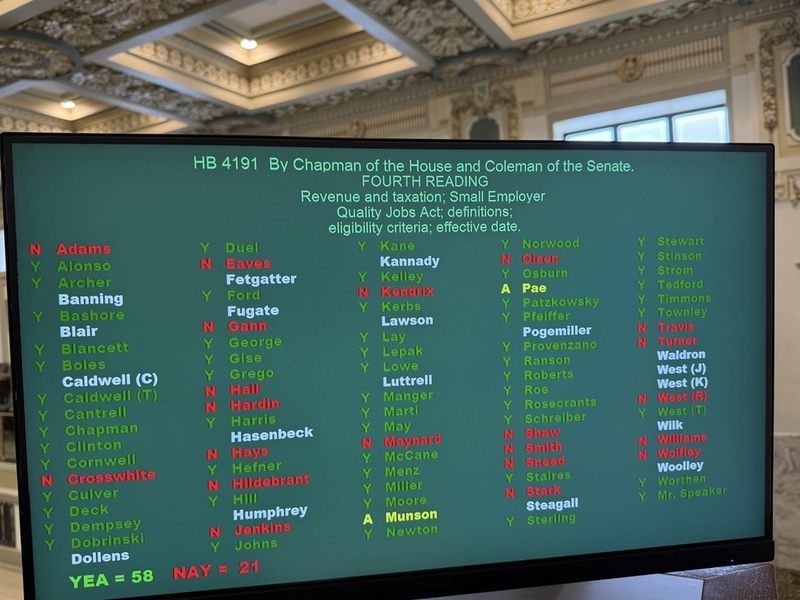
A screen in the House gallery shows which members of the chamber voted on a bill on May 6, 2026. (Photo by Emma Murphy/Oklahoma Voice)
If any Oklahoman decided to play hooky from work for three weeks, they’d be fired.
If we decided to ignore the state’s compulsory education laws and let our kids accumulate three weeks of unexcused absences, we’d wind up in truancy court, facing fines or even imprisonment.
So why, then, do House members think it’s acceptable to allow one of their own to miss over 300 votes and accumulate three weeks of unexcused absences?
And why, when legislators are so obsessed with regulating our actions and like to claim that they’re good stewards of our tax dollars, are they OK with allowing a colleague to bilk the good taxpayers of Oklahoma?
For the past three weeks they have been allowing Democratic state Rep. John Waldron to operate with impunity after he has apparently been AWOL from the Legislature and indicated to House Minority Leader Cyndi Munson that he doesn’t plan to return to the Capitol.
Rather than enforce a House rule that prohibits unexcused absences and expel him for this dereliction of duty, his colleagues on both sides of the aisle are enabling him to continue to collect on his $47,500 salary and benefits.
How is that fair?
Coincidentally (or not), Waldron’s sudden inability to make it to work coincided with his announcement that he plans to resign from office effective Oct. 1. Legislative records show Waldron submitted his resignation letter April 16, which is also the final day he voted for legislation on the House floor.
At the time of his resignation, Waldron faced accusations of sexually harassing a subordinate.
Nonprofit media outlet NonDoc reported that while serving as head of the state Democratic Party, Waldron used artificial intelligence to create a GIF of himself and a potential candidate for office kissing, and that he then sent the image to the woman.
Waldron swiftly resigned from his position as party chair, but rather than publicly demand that he resign from his House seat, legislators kept the purported harassment quiet for months, which emboldened Waldron to file for office again. Only after public outcry did Waldron resign from his legislative seat and suspend his reelection campaign.
But now as an apparent goodbye gift, lawmakers have given Waldron a golden parachute by inexplicably allowing him to make his resignation effective Oct. 1.
And then when he’s not shown up to finish the job he promised to do, they haven’t publicly done anything to hold him accountable.
Munson says there’s no mechanism to force a legislator to resign earlier than they want to.
But out of sight, out of mind. Right?
Wrong.
There’s a giant computerized vote board in the front of the House that tells clearly who is at work doing their job. In addition to changing color to show who is voting for and against measures, it also tells Oklahomans which legislators have an excused absence from work that day. Lawmakers that have obtained permission to be out have their name written in yellow on the House vote board and have a letter “A” by it.
Those who are absent without leave or miss votes remain white. Waldron’s name hasn’t changed color for weeks now.
Like the rest of us, lawmakers sometimes have valid reasons why they need to miss work.
For instance, one Republican state representative was diagnosed with cancer and needed live-saving surgery and treatment. But to his credit, he came back as soon as he was able to cast votes on behalf of his constituents. Another was excused for several days recently because he had a death in the family.
Serious illness and bereavement are legitimate reasons.
Hiding at home to escape embarrassing public scrutiny is not.
When Republican House Speaker Kyle Hilbert was asked about Waldron’s prolonged absence, he metaphorically shrugged.
“Ultimately, the reason I know that he’s not voting is because you guys (the media) keep talking about it,” Hilbert said. “I really don’t spend a lot of my days thinking about John Waldron, except every Thursday when we talk about it.”
Yeah. There’s a reason “you guys” are talking about it, and why he should be thinking a lot about John Waldron.
To spell it out clearly: It’s because it’s outrageous and unfair that legislators are holding one of their own to lower expectations than they’d expect of their own constituents.
I’d bet you a week’s pay that legislators would be unsympathetic if one of their constituents came to them angry that they were fired after they skipped work without permission for days on end to go golfing. Or if a constituent was referred to truancy court because it was too much work to get their kid to school.
Waldron did not respond to questions from an Oklahoma Voice reporter when his absences had reached two weeks.
Someone in House leadership should be keeping track of attendance, particularly since the lower chamber has an internal rule that prohibits members from being absent without leave.
When a reporter pointed out this rule mandating attendance, Hilbert bizarrely said it’s voters’ responsibility to enforce it and hold lawmakers like Waldron accountable.
Voters don’t create those rules. The chambers do. It’s not voters’ job to enforce those. It’s the job of those that create them, the legislators.
In the House, voters’ chance to hold legislators “accountable” at the ballot box comes once every two years. In the Senate, it’s once every four.
Constituents deserve to have someone actively representing them.
And if they don’t, then lawmakers need to be brave enough to police themselves and demand that their colleagues show up.
If legislators don’t know what’s an acceptable time to miss, maybe they need a set number of days they can be off, like the rest of us, barring, of course bereavement, or some massive issue that would be covered by the Family and Medical Leave Act.
If everyone refused to show up for days on end, we’d have a nonfunctional government or society.
And if someone suddenly refuses to come to work for no good reason, then perhaps you give them a warning.
If that doesn’t work, then expel them so voters can find someone who will.
Oklahoma City, OK