Ray Curtis wants to take voters, and politicians, back to school
May 08, 2026 | 2:15 pm ET
Description
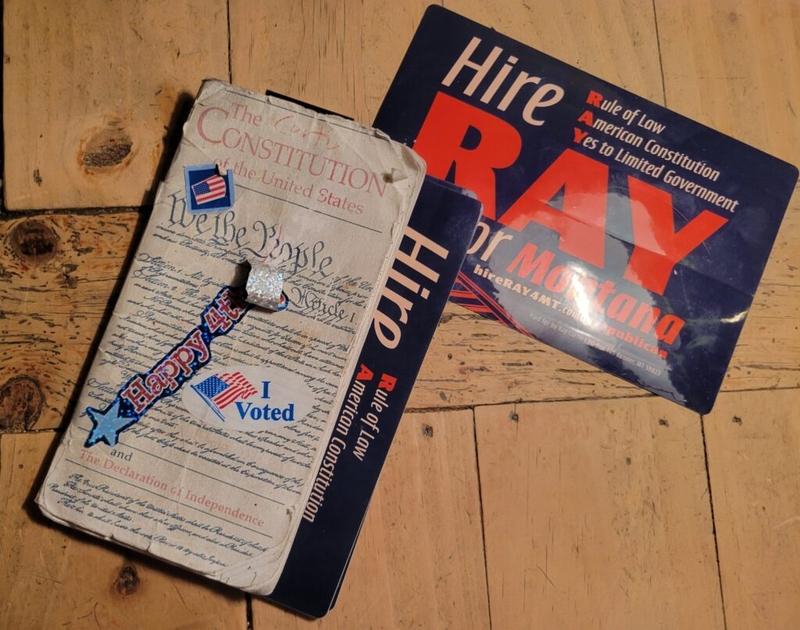
Ray Curtis, a candidate for U.S. House, always carries a pocket version of the U.S. Constitution with him, underlined, annotated and scribbled on for years. (Micah Drew/Daily Montanan)
Ray Curtis used to teach government classes at Flathead Valley Community College in Kalispell. The retired teacher, who now lives in Missoula, was back on campus this week just a few doors down from his old classroom.
“I felt like I was back to teaching again in that room,” Curtis told the Daily Montanan. “I was on that stage giving people information that they need.”
But it wasn’t college students that Curtis was instructing in the finer points of the Constitution of the way he understood government is meant to work — it was a room full of voters and two of the three candidates who, along with Curtis, are running for the Republican nomination for the Western U.S. House seat.
While talk radio host Aaron Flint and Flathead County Republican Central Committee Chairman Al Olszewski (Secretary of State Christi Jacobsen, also running in the primary, did not attend the event on Monday) have faced each other on the debate stage before and largely agree on positions, hewing closely to national party lines and avoiding criticizing the current administration.
But to their right on stage, Curtis offered critiques of major Republican talking points such as pushing back against the need to increase election security and unilaterally supporting the war in Iran, positioning himself as a moderate option in the race.
He’s banking on voters being willing to educate themselves about candidates and their policies.
Curtis will be the first to say he isn’t a politician, he’s a teacher who spent decades teaching government classes at the high school and college level trying to instill an understanding of the constitution in generations of Montanans.
Now he’s taking that same approach on the road in his long-shot run for Congress, to the point of assigning homework for his fellow candidates.
“I hope you get the impression that I’m running for something,” Curtis said in an interview. “I feel like the three candidates that put their name on the ballot aren’t much of a choice compared to somebody in the middle.”
The homework assignment Curtis has is for all Montana politicians – and citizens — to watch the final speech by former President Ronald Reagan. The remarks open with some sentiments about America’s willingness to accept immigrants and being a beacon of freedom and opportunity to the world as “one of the most important sources of America’s greatness.”
Reagan’s remarks then pivot to their main purpose — awarding the Medal of Freedom to former Montana Senator Mike Mansfield.
“A Republican giving this to a Democrat, we need more of that,” Curtis said.
Curtis believes a willingness to engage in bipartisanship discussions and call out wrongs within his own party, and his center-of-the-road ideology resonates with a swath of Montanans who feel alienated by the views further out on the left and right of the political spectrum.
Curtis taught at all three public high schools in Missoula, as well as stints at Flathead Valley Community College and Missoula College.
While teaching, he said he always tried to present himself as relatively apolitical to his students, focusing on the structure of government as written out in the U.S. Constitution and the guiding principles set out by founding members of the early nation.
“I always took great pride in the fact that students at the end of the semester would say they didn’t know what my bias was,” Curtis said. “We all have biases, but I’m not in love with political parties, kind of in the way Washington wasn’t either. We should be more American than anything else.”

But Curtis has always found himself to align closer to Republican principles — following the rule of the law, fiscal responsibility, and protecting individual liberties.
He doesn’t see those ideas reflected by the current Republican party compared to the one he used to teach about when covering politics in the classroom.
“I align with the Republicans in the past — Lincoln, Reagan — the dinners that Republicans have are named for them,” Curtis said. “Do we not believe what Lincoln believed? And Reagan had the last successful immigration policy. But I’m especially an Eisenhower Republican.”
Curtis invokes Eisenhower — or “Ike” — repeatedly when talking about successful Republican policies from the past, such as the former president’s warnings against the military-industrial complex and desires to cut the nation’s defense budget to focus on domestic programs, or the value of working with allies around the world.
“We’ve lost our closest allies in the world, they don’t trust us and it’s going to be hard to get it back,” Curtis said.
Curtis is willing to criticize Republicans where he sees fit.
He says that he is critical of Democrats for drastically increasing federal spending when in power, but then is disillusioned when a Republican Congress refuses to rein spending in, and instead adds to a deficit. He does not believe Trump nominated the best people for many cabinet-level positions and he does not believe election security is the major problem national Republicans say it is.
The SAVE America Act is a piece of legislation championed by Congressional Republicans and the Trump administration that would require proof of citizenship such as a passport or birth certificate in order to register to vote. But it “fixes nothing,” Curtis said, because elections are already safe — something he’s seen firsthand by volunteering as a poll worker.
Many of these statements draw disagreements from Curtis’ primary opponents, but he says politics shouldn’t be about falling in line or being considered the enemy.
Curtis is also critical of the war with Iran, which he said is a blatant example of the disintegration of separation of powers. He thinks the war wouldn’t have been necessary if Trump hadn’t pulled out of the Iran Deal in his first term, and said it would likely take years to broker a new comprehensive agreement.
“The people didn’t have a say in this war, it was a unilateral decision,” Curtis said. “Citizens every day are seeing when the dial on the gas pump spins around, that this has repercussions.”
Curtis said that during his tenure in the classroom, he felt he had done everything possible to demonstrate to his students how to engage in democracy, except putting his name on the ballot.
He said since he announced his campaign, he’s heard from numerous former students who have offered their support for what he’s doing.
Former colleagues have also expressed support for his run, including Sue Babcock, who taught AP History at Sentinel High School with Curtis.
“I would just think that knowledge of government and the constitution would be extremely important, if not, in my opinion, necessary, to be an effective member of the government,” Babcock said in an interview.
“I know Curtis looks to himself as an Eisenhower Republican and I think a lot of people are looking for a term like that to describe what they believe in,” Babcock said.
Jennifer Copley, a retired government and history teacher who was Curtis’ department chairwoman for a number of years, said when Curtis told her he was considering running for office she thought it was a great idea, and he would represent a Republican party that is “so much more than MAGA.”
“From the gut level, he understands Montanans,” Copley said. “He intends to walk the walk and speak those principles and values he believes are core to traditional Republican values.”
She said Curtis was always committed to teaching and informing people about how the government was intended to work, and she thinks he would continue that same work on behalf of Montanans.
“I think about what our Framers wrote about again and again, that in the end, character matters,” Copley added. “I think that’s a value Ray would bring. I think that can be more important than who has the loudest megaphone.”
When federal quarterly fundraising numbers were released in March, three Republican candidates had more than a quarter million dollars in cash on hand.
Curtis had none.
He’s running a campaign in an old-school way — going around and talking to people, not relying on TV ads, mailers or laminated yard signs.
“I don’ t like money in elections. I know what it’s used for and advertisements and brochures aren’t helpful to voters,” Curtis said. “What would I use money for? I’m just paying for gas money to get around.”
But Curtis is aware that he might come across as not being serious about his campaign due to his unwillingness to go head-to-head with well-financed candidates and play the political game the same way.
“There’s the word, ‘game,’ and the gamesmanship has to stop,” Curtis said. “We have to get to the point where we’re actually serious about policy, rather than playing games to get elected.”
Curtis cited a Princeton study that showed if you take a popular policy idea that has near-universal support — he says Daylight Savings Time could be a good example — it has around a 30% chance of passing; and if you take a terrible idea that the majority of people disagree with, it has about a 30% chance of passing.
“It depends on who’s paying,” Curtis said. “Funders are the ones getting their way. And I cannot – on principle – do that. I will owe donors nothing, and voters everything.”

Helena, MT