Legislators might try to redraw SC’s congressional lines. GOP senators caution that could backfire.
May 05, 2026 | 6:00 pm ET
Description
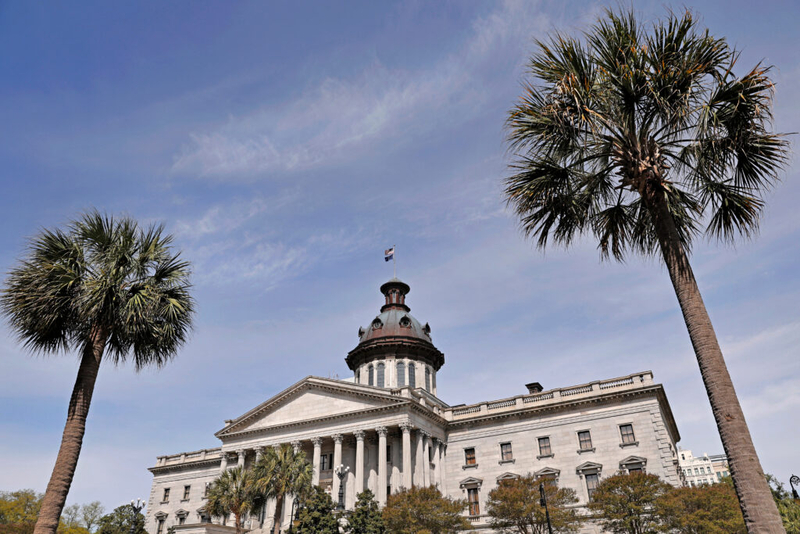
The South Carolina Statehouse is seen on Tuesday, March 24, 2026, in Columbia, South Carolina. (Photo by Travis Bell/STATEHOUSE CAROLINA/Special to the SC Daily Gazette)
COLUMBIA — Five weeks ahead of South Carolina’s primaries, House GOP leaders launched an attempt Tuesday to redraw the voting lines for Congress.
“We will start a process to give ourselves options,” House Speaker Murrell Smith told reporters.
That starts with votes Wednesday on whether to add redistricting to a resolution governing what the Legislature can do after the regular session ends May 14. Adding to the allowed to-do list requires a two-thirds vote in each chamber.
“There is absolutely no promise whatsoever” that the Legislature will ultimately redraw the map, said Smith, R-Sumter.
The decision follows the U.S. Supreme Court’s ruling last week that threw out Louisiana’s congressional map as unconstitutional gerrymandering based on race. The White House asked GOP leaders in both chambers to take a look at the ruling and South Carolina’s map.
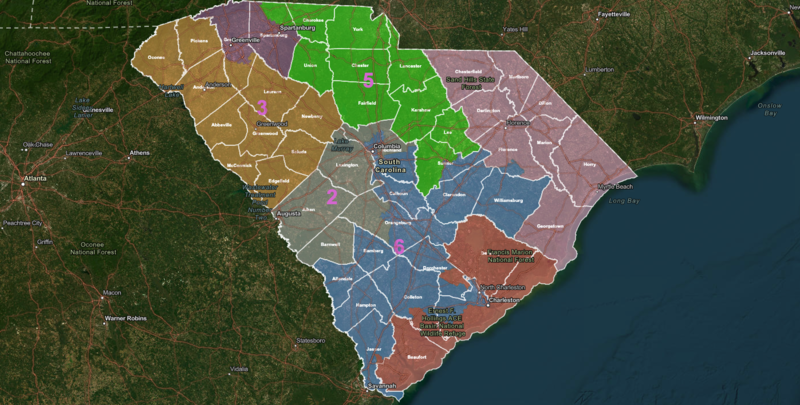
Republicans’ stated goal is to un-gerrymander the 6th District, the only one among South Carolina’s seven U.S. House seats represented by a Democrat. After the 1990 census, a lawsuit led to a federal court redrawing the state’s voting lines. The result was a majority-Black 6th District, which U.S. Rep. Jim Clyburn has held ever since.
Clyburn, who’s seeking an 18th term in November, called the U.S. Supreme Court ruling in Louisiana v. Callais “a giant step backward” and a dismantling of the 1965 Voting Rights Act.
“This decision threatens to send our country deeper into the thicket of never-ending redistricting fights, with repeated aggressive map redraws, protracted legal battles, and relentless partisan tugs-of-war, all of which are destined to result in more regressive Court decisions,” he said after last Wednesday’s decision.
Much remains unknown about how South Carolina’s attempt could affect voters.
“We can’t go to step two” without first determining whether the votes exist to proceed, Smith said.
One certainty, he said, is that the redistricting effort would affect congressional primaries only. Even if those contests are on pause, primaries for statewide and legislative races would proceed as scheduled June 9, he said.
If the House musters the necessary two-thirds vote to take up redistricting in a special session, the resolution’s chances in the Senate seem slim.
“That’s going to be a very tough vote in the Senate unless Democrats vote for it, and they might,” since a new map could improve their chances in November, said Senate Majority Leader Shane Massey.
The Edgefield Republican remains opposed to the idea despite getting two phone calls from President Donald Trump over the last two days.
“There was no pressure. He asked me to take a look at it. I’ve expressed my concerns,” he said, describing the calls as cordial conversations that lasted less than 10 minutes.
Those concerns include that the June 9 primary ballots have already been printed. Absentee ballots for military service members and other voters overseas were mailed more than a week ago. Early voting for the primaries begins May 26.
The state Election Commission is not aware of any similar situation of district lines changing so close to an election. A spokeswoman could not immediately answer questions about absentee voters and ballots sent.
U.S. Supreme Court throws out SC racial gerrymandering ruling
7-0 or 5-2?
Smith acknowledged that an attempt to pick up another Republican seat is driving the attempt.
But Massey worries that South Carolina could end up with two or even three Democrats in Congress, rather than seven Republicans.
“I think if you try to get 7-0, you’re more likely to get 5-2,” Massey said. “Trying to get cute with this is more likely to cause a problem than be beneficial.”
It’s also unnecessary, he added. The U.S. Supreme Court has already determined that South Carolina’s map is not racially gerrymandered.
That was the crux of legal challenges following the post-2020-census redrawing of lines. GOP leaders acknowledged precincts were moved between the 1st and 6th districts to make the coastal 1st District safer for Republicans again. A population boom in the Lowcountry had made it more purple.
Upholding the map on partisan grounds, the nation’s high court rejected a lower court’s reasoning that the lines were racially gerrymandered.
SC Supreme Court upholds voting map, throws out partisan gerrymandering claim
That’s why last week’s ruling doesn’t affect South Carolina’s map, Massey said.
But he’s concerned further tinkering of the lines might not survive the state Supreme Court.
After the federal challenge on race failed, opponents of the map sued in state court on the argument that partisan gerrymandering violated the state constitution. South Carolina justices unanimously disagreed last September, but Chief Justice John Kittredge warned the outcome could be different in a “future challenge.”
Sen. Greg Hembree, a former solicitor, also stressed the map has “passed constitutional muster” in state and federal courts.
“I think it’s an absolutely terrible idea,” the Little River Republican said of a redistricting attempt in the coming weeks. Noting Republicans hold six of seven House seats, he said, “that’s success. We should declare victory and move on.”
What might a new map look like?
The attempted redraw would put candidates in limbo. Beyond potentially extending their campaigns an unknown length of time, congressional candidates may ultimately be drawn out of the district they’re seeking. The most crowded contest by far this year is the coastal 1st District: 10 Republicans, seven Democrats and two minor-party candidates.
Unknowns at this point include whether parties will need to start over with candidate filing.
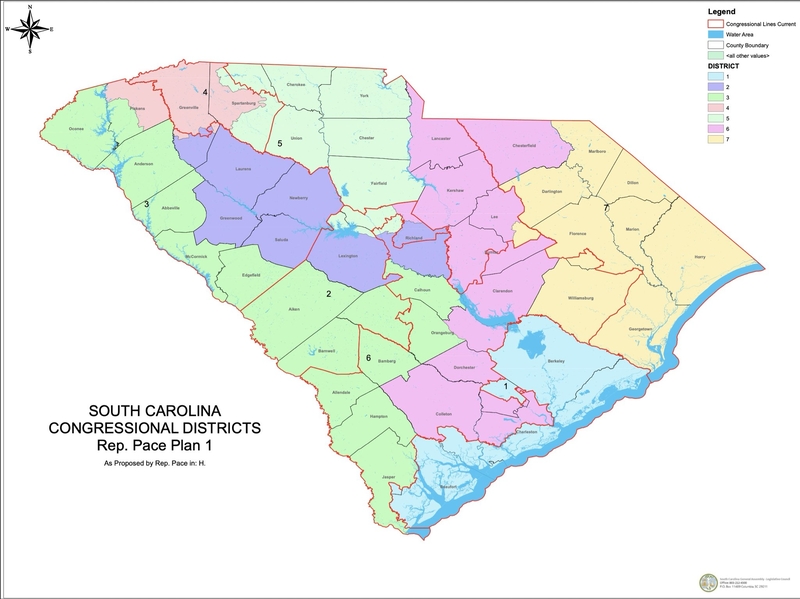
Also unknown is what a new map would look like. One proposed earlier this year by Rep. Jordan Pace, who leads the chamber’s ultra-conservative Freedom Caucus, would put large swaths of voters into congressional districts they’ve never been in.
His redistricting bill got a hearing in February but no vote and no second meeting.
On Tuesday, he said he’s happy the idea’s getting traction.
“I hesitate to use the word ‘vindicated,’ but I feel a little vindicated,” said the Goose Creek Republican.
He called the map he presented a starting point.
In his suggested overhaul, one district would lump together voters of the Upstate, Midlands and Lowcountry regions along the entire border with Georgia. The 6th District — the one ostensibly being un-gerrymandered — would stretch from the suburbs of Charlotte, North Carolina, to the Charleston peninsula.
“You’ve got people in Lancaster County in a district with people in Charleton,” Massey said. “It’s just weird.”
Pace pointed at the 6th District’s existing lines in response. It spans 14 counties, from Columbia to the Charleston peninsula, and from the state’s southern border with Georgia east to the Pee Dee. While no longer a majority-minority district, it remains reliably blue.
It “covers vastly different groups of folks, from accents to barbecue sauces,” he said. “By nature of just not having high population density in a lot of the state, you’re going to have large districts, no matter who the representative is.”
The exception, he said, is the 4th District. South Carolina’s most compact district is confined to Greenville and Spartanburg counties.
What does the governor say?
Gov. Henry McMaster would not say Tuesday whether he supports redistricting.
“This is up to the Legislature,” McMaster told reporters hours ahead of the House GOP Caucus meeting.
“That’s their job: to study, to analyze and make a decision whether it’s necessary,” he added. He encouraged them to “understand what the recent Supreme Court case said, understand what the one in 2024 said, consider the facts and make that decision.”
McMaster also would not say whether he supported delaying the primary elections until the maps could be redrawn.
Louisiana Gov. Jeff Landry signed an executive order delaying the May 16 congressional primaries in that state. More than 42,000 absentee ballots had already been cast, the Louisiana Illuminator reported Tuesday.
McMaster doesn’t have that power. And, as long as the Legislature passes a resolution setting the off-session rules, he also lacks the authority to call the Legislature back into session even if he wanted to do so.
Despite refusing to give an opinion on redistricting, the governor did remind legislators what should factor into their decisions.
“We’ve already started voting, particularly military people overseas,” he said, adding early voting is weeks away. “So, there will be ballots coming in anytime. There are some disruptions that go with changing the schedule.”
Editor’s note: The article has been corrected to reflect that a federal court drew the state’s 1992 voting map.
Columbia