Here’s what lawmakers passed in the first 24 hours of the ‘final day’ of 2026 session
May 03, 2026 | 8:22 am ET
Description
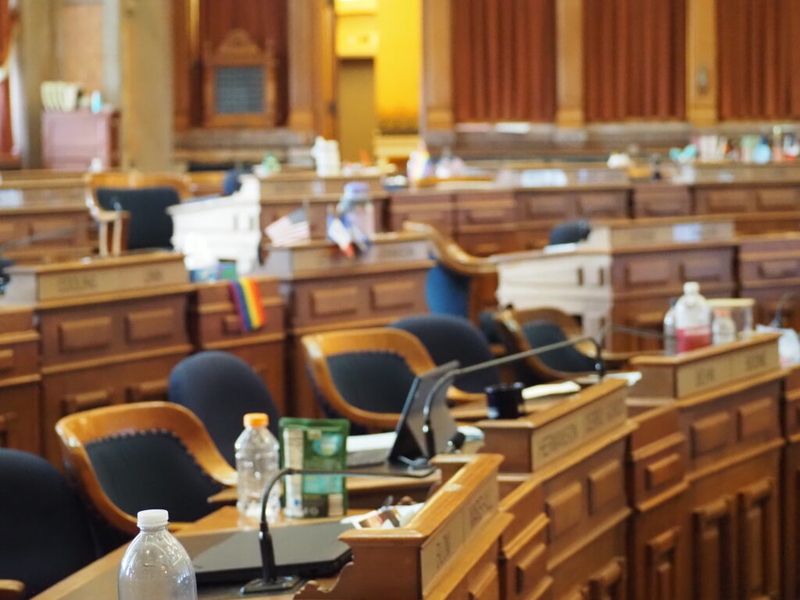
The House chamber in the Iowa State Capitol as seen May 3, 2026. (Photo by Robin Opsahl/Iowa Capital Dispatch)
Lawmakers sent bills on a nicotine and vape tax, hydrogen extraction and gubernatorial powers to Gov. Kim Reynolds on Saturday and early Sunday, but final agreements on several high-priority bills, including legislation on property taxes, have yet to come to the floor.
Iowa lawmakers began to convene and discuss the final bills of the 2026 legislative session at 8:30 a.m. Saturday. As of 7 a.m. Sunday, the Legislature was still in session as bills continued to be negotiated and finalized.
The Legislature’s end date goal was April 21, the day lawmakers stopped receiving per diem pay. But the session stretched 12 days past that date as House and Senate Republicans, alongside the governor, had not yet found agreement on a package aimed at lowering property taxes in the state. Both legislative leaders and Reynolds had named property tax relief as a top priority heading into the 2026 session, but the three parties had differing ideas on how to accomplish this goal.
There are also a handful of other bills on issues like abortion medication and warrant resolution clinics, as well as certain budget bills, that lawmakers are expected to discuss before adjourning for the year.
Here are some of the bills lawmakers passed in the 24 hours since getting to the Capitol Saturday morning:
Final policies
Nicotine tax: House lawmakers approved Senate File 2480, a measure setting a 5-cent tax on vapes and other nicotine products, like pouches, that will go to funding $3 million in pediatric cancer research at the University of Iowa Stead Family Children’s Hospital.
The funding would be routed through the state health care trust fund, a Medicaid funding stream. The first $3 million generated through this tax would go through the Board of Regents to be allocated to the UI Stead Family Children Hospital for pediatric cancer research, clinical therapy trials and provide physician-scientist leadership, while additional funding would be available for use for the state’s Medicaid program.
Rep. Austin Baeth, D-Des Moines, expressed his frustration with the bill, saying the measure was making funding for research to aid children with cancer contingent on people using addictive nicotine products. He expressed his support for the House proposal, House File 2310, to provide a standing appropriation of either $1 per Iowa resident or $3 million for pediatric cancer research at the UI.
Baeth also criticized the nicotine tax proposal as “being written by the big tobacco industry.” The bill would tax vapes at a rate of 5 cents per milliliter of nicotine or a nicotine analog in a solution, and a rate of 5 cents for each container of up to 20 nicotine pouches with a proportionate tax added for each unit above 20 in a container. Anti-tobacco and anti-cancer advocates have told lawmakers a higher tax needs to be implemented on these products to curb use.
“I think it is shameful that the big tobacco companies have used Iowa’s sick kids as political pawns, as political prisoners, to get their little vape tax inoculation across the line,” Baeth said. “It is shameful. And that’s why it is so hard to know what to do with this bill, because we have kids who are suffering from cancer in this state asking for help. Today, I’m going to be a yes on this bill. I’m going to help — along with many of you, I believe — try to help rescue these kids who have been taken as political prisoners. But then I say we go after those prisoner takers next year, and we do an actual tobacco tax, one that actually reduces the uptake of tobacco, one that actually saves Iowan lives.”
Rep. Brent Siegrist, R-Council Bluffs, who floor managed the bill, said he understood the frustration with the proposal, and that he was in supportive of a larger tax increase on nicotine products and tobacco.
However, he pushed back against the idea that more young people will pick up vapes or other nicotine products under the legislation.
“It may not deter a lot of them, but if you’re going to increase the price on the product, some people aren’t going to use it,” Siegrist said. “Now, it’s not like doing $1.50, I get that, but to suggest that this bill might actually have more kids vape, I don’t get it.”
While the Legislative Services Agency fiscal note on the proposal found it would take until 2031 for the tax to generate the $3 million in a year to go to pediatric cancer research, Sen. Kara Warme, R-Ames, said during floor debate on the bill industry officials have provided estimates that the tax will generate between $15 to $18 million in the first year of implementation. Baeth introduced an amendment to require $15 million generated from the tax to go toward pediatric cancer research.
Siegrist told Baeth, “I don’t disagree with what you’re saying,” but said the Senate would not accept the proposal, and it would lead to no funding going toward funding pediatric cancer research.
“I care about results,” Siegrist said. “Passing this bill, resisting this amendment, it’ll go downstairs to the governor, we will have started a small … effort to reduce the use of vaping and nicotine pouches, and will fund pediatric cancer research.”
He said he understood why there were opponents to the bill, but said he believed the measure was one of multiple steps the Legislature took in 2026 aimed at addressing Iowa’s high cancer rates.
“The fact of the matter is, this is a step forward,” Siegrist said. “This will help, it’ll help with cancer research, it;’ll help with some kids probably not buying because they can’t afford it. And I … respect everybody’s vote here, I truly do, and I have no concerns with that. But this should be a unanimous vote, because it’s a step forward.”
The bill passed 67-18, and heads to the governor for final approval.
Repeat offenders: Lawmakers reached an agreement on how to move forward with one of House Republicans’ major legislative goals of the 2026 session, the proposed “three strikes” bill.
House File 2542, as amended, would require that a person who has been convicted of their third felony offense would have a required seven-year mandatory prison sentence. It also would require the reporting of probation violations to the appropriate authorities.
Sen. Mike Bousselot, R-Ankeny, said the measure is intended to help make Iowa communities safer.
“As a colleague of mine said, one of, if not the paramount role for government in maintaining the social contract of our society is enforcing justice and keeping our communities safe,” Bousselot said. “This amendment, this bill as amended, is intended to accomplish just that.”
The amended bill is a much narrower proposal than the original version of the legislation passed by the House, that proposed creating a “three strikes” system for individuals who commit certain crimes. The bill proposed creating a system where one “point” would be given to a person convicted of felonies and aggravated misdemeanors including sexual abuse, domestic abuse assault, assault with intent to inflict a serious injury, the use or display of a deadly weapon or organized retail theft. A half-point would be given for other aggravated misdemeanors and serious misdemeanors such as assault and domestic abuse causing bodily injury or mental illness. Upon the accumulation of three “points” under the system, a person would face a minimum 20-year prison sentence.
Rep. Steven Holt, R-Denison, who led the bill in the House, said he believed the amended measure is a meaningful change, as the existing three-year habitual offender sentencing penalty is currently optional. The seven-year additional sentence on top of the base sentence for the crime committed would be non-negotiable, Holt said, and could not be reduced based on credit or other means.
He said the bill shuts the “revolving door” on repeat offenders repeatedly entering and exiting the criminal justice system.
“Career criminals should pack their bags and find another place to be criminals, because we are slamming the door,” Holt said. “And we will continue in future years to make improvements based on the problems we have uncovered in our review of the system.”
Rep. Ross Wilburn, D-Ames, said he wanted to acknowledge the amended bill is “less expansive” than the earlier version of the bill, but said he still had issues with the legislation.
“I wish that this may have been a potential starting point, as opposed to a bill that was so expansive,” Wilburn said.
Governor powers and shutdowns: House File 2694 made it to Reynolds’ desk as a bill limiting future governor’s abilities during public disaster emergencies like the COVID-19 pandemic. The measure restricts an Iowa governor from being able to order places of worship to close, or to mandate their locations or practices during public health crises and other disaster emergencies. It also prevents a governor from restricting private businesses’ operations during a public health disaster, and states a governor could not require vaccinations or regulate conduct within a private residence.
The legislation’s path to the current governor’s desk was not straightforward. The Senate had amended the bill to include language from another proposal, Senate File 2388, that would create a “continuing appropriations” measure to provide funding for the state government based on the previous year’s budget if the governor and Legislature do not reach an agreement before the beginning of the next fiscal year, July 1.
Senate Republicans said the legislation would prevent government shutdowns similar to those that have recently occurred in Washington D.C., but Democrats called the measure a “power grab” to allow a Republican-controlled Legislature to refuse to negotiate with a potential future Democratic governor.
Other advocates and lawmakers have also questioned if the proposal could also restrict the ability of lawmakers to force certain issues to a floor vote — refusing to vote in favor of budget bills was the method used by a group of Republican senators who forced a vote on legislation related to eminent domain use in carbon sequestration pipeline projects in 2025.
The proposal was amended by the Senate to state the “continuing appropriations” language would only take effect in cases where lawmakers pass and present a budget to the governor, but where the governor does not enact the budget by July 1.
House Republicans did not agree with their Senate colleagues on the proposal, with Rep. John Wills, R-Spirit Lake, telling House lawmakers, “I really don’t like that portion of the bill.” The House rejected the amendment and returned it to the Senate, where lawmakers receded on the amendment. The bill, without the language related to continued appropriations, went to the governor.
Hydrogen extraction: While some landowner rights activists said they were concerned about property rights being subverted in relation to potential geological hydrogen extraction in Iowa, House lawmakers said they believed Senate File 2490 would provide more protections for landowners than currently exist in Iowa law.
The measure would establish a 6% severance tax based on the “fair market value of the oil and gas extracted at a wellhead” in the state. The change comes as companies begin exploring the possibility of extracting geological hydrogen, which can be used as a fertilizer and fuel source, from rock formations in Iowa. Revenue from the tax would go to both the state and to Iowa counties.
The language that is more controversial among activists was the establishment of “pooling” standards. At least 25% of landowners on a site must agree to allow the company to drill for hydrogen in a location, and the creation of these standards would mean Iowans who do not enter agreements with drilling companies still receive compensation.
Some speakers opposed to the bill related the issue to the use of eminent domain, but lawmakers supporting the measure said this proposal does not involve eminent domain.
Rep. Derek Wulf, R-Hudson, said “for far too long, Iowa has lacked a clear, consistent framework for protecting landowners, and it leaves them vulnerable.” He said this proposal gives landowners “defined rights, defined options and defined protections.”
“Let’s be clear about one important point –this bill does not take away any landowner choice,” Wulf said. “In fact, it gives landowners more choices than they have today.”
The House did amend the bill to include language aimed at strengthening landowner protections, such as requiring an operator to receive permission from a surface owner before entering a site subject to a pooling order or within an exploratory spacing unit, and giving a surface owner the opportunity to decline further contact from a company outside of information required to be given to the landowner by law.
Rep. Elinor Levin, D-Iowa City, said she appreciated the changes made to the bill but said she could not support the measure moving forward because it does not contain adequate data reporting requirements and could endanger Iowa’s groundwater and aquifers.
“That being said, I think the hydrogen industry is an incredible prospect for Iowa,” Levin said. “I look forward to future opportunities to fine-tune this — I hope that that will be another open discussion as this one has been.”
The Senate accepted the House changes and sent the bill to the governor’s desk with a 35-11 vote.
Early Childhood Iowa: The House approved the compromise reached on Senate File 2488, the proposal making changes to the Early Childhood Iowa system, in an 83-2 vote Saturday.
The amendment agreed upon by both chambers would create an opt-in, voluntary system to allow the existing 34 Iowa ECI area boards to choose whether to move home visitation contracts – currently overseen by ECI through the “School Ready Fund” — to Department of Health and Human Services control. HHS officials said making this shift would allow the department to draw down additional federal matching funds through the Family First Act. It would also create an interim study committee to review the current ECI system and make recommendations ahead of the 2027 session.
This is a significantly pared-back proposal when compared to earliest versions of the bill, which proposed repealing the ECI system and moving its authority and funding to a newly established statewide Early Childhood and Family Services (ECFS) system, made up of seven regions. It also is a shift from another earlier version of the bill that proposed moving all home visitation contracts from ECI to HHS control while allowing the ECI boards to retain control over other funding — a move which is now voluntary under the bill sent to Reynolds.
The bill still does create the new ECFS structure, and moves to eliminate the existing Decategorization Projects, or Decat, boards which will have authorities transferred to the ECFS system, as well as giving HHS authority to contract for child abuse preventative services.
Rep. Rep. Michael Bergan, R-Dorchester, said the amendment reflects work that has been done by lawmakers, HHS, ECI stakeholders and local area directors to find an agreement on the best path forward for the legislation.
Bergan, who has been one of the major proponents of slowing down conversations on earlier versions of the bill presented to the Legislature, said he believed the bill as passed will help improve Iowa’s early childhood services.
He said the pandemic caused significant disruptions to how early childhood services were delivered, and that more connections were lost as the state went through agency restructuring efforts like the merging of the departments of public health and human services into HHS. But, he said, this bill is a step toward reestablishing those working relationships and trust.
“We lost some of the collaboration between our state departments, we lost some of the collaboration between the state and the local levels, and we suffer for it,” Bergan said. “And I’m hopeful that we’re able to reenergize some of that collaboration as we go to this next phase of change. Iowa does many things right that other states look to us as examples, whether it’s in childcare, whether it’s in our early childhood involvement, whether it’s our quality settings and our work in preschools. I’m committed to this.”
Budget bills
Agriculture/natural resources budget: The Senate gave broad bipartisan support Saturday to House File 2771, the $119.2 million budget for the departments of Agriculture and Natural Resources, on a 43-2 vote. The bill, which the House passed Friday, increases spending for the departments over the current fiscal year by a total of $900,000.
It includes most of the new water quality initiative introduced earlier Friday by the governor and Agriculture Secretary Mike Naig. In particular, this budget includes an increase of $300,000 for water quality monitoring through DNR and repurposing of $25 million to double the capacity of the Central Iowa Water Works’ nitrate removal capacity over the next three years.
The measure was amended in the Senate to shift all funding for water quality monitoring to the DNR. The previous version of the bill appropriated $300,000 from the Groundwater Protection Fund to go to the state’s Iowa Water Quality Information System administered through the Iowa Flood Center.
Rep. Norlin Mommsen, R-DeWitt, said the new language would have this funding go to the DNR to be dispersed through grants to other water monitoring organizations.
“This slight change in the bill does not deter from the significant water quality programs in this bill for Iowans,” Mommsen said.
Education appropriations: House File 2783 sets state appropriations to Iowa’s educational systems, totaling more than $1 billion and representing a 1% increase over last year’s budget. The Iowa Board of Regents and Iowa Tuition Grant program would see flat funding under the bill while community colleges receive a 1.4% increase, alongside a 2% increase to funding for the Iowa School for the Deaf and Educational Services for the Blind and Visually Impaired to match State Supplemental Aid increases.
The legislation also includes a $76,000 increase to school food service, a nearly $100,000 increase for the Teach Iowa Scholars program, a $5 million increase to the special education division of the Iowa Department of Education, $335,000 for teachers to use in training for teaching students with dyslexia and $500,000 for school district email security. Duplicative training is also removed from the bill.
The Iowa House and Senate both passed the legislation on April 30, with Democrats criticizing its areas of flat funding and saying it shows misplaced priorities in the Republican Party.
Health and Human Services budget: House File 2782, the budget providing more than $2.5 billion for the state’s Departments of Health and Human Services and Veterans Affairs, saw a net increase of $3.1 million compared to FY 2026.
The Senate approved the bill Saturday, after the House passed the measure Friday. Rep. Ann Meyer, R-Fort Dodge, said, “in total, with federal matching funds, this budget appropriates over $10.5 billion toward Medicaid, childcare, child welfare, public health, aging investment services in Iowa.”
The budget will “fully fund Medicaid,” Meyer said, and includes a 3% increase in funding, which she said will allow state lawmakers to “hopefully avoid a supplement next year, or at least reduce it.” The budget also includes rate adjustments for Medicaid providers, which Meyer said will amount to a total of $12 million in increased funding through federal matching dollars.
Meyer said the increase in premium taxes on Managed Care Organizations signed into law in April provided the money “allowed for the (Medicaid) provider investments in this budget and the 3% trend on the Medicaid estimate.”
She said also this budget also incorporates multiple “cost containment issues” put forward by the governor. Many of these reductions were accepted, she said, but lawmakers did not accept proposed funding reductions to the child vision screening program, Epilepsy Foundation, and mental health commitment transportation costs. Meyer also said she advocated for rate increases for speech and hearing services, but that House Republicans were unable to secure that increase.
When senators discussed the bill Saturday, Sen. Janet Petersen, D-Des Moines, criticized Republicans at the federal level for increasing health care costs through the expiration of ACA premium tax credits and Medicaid changes through the “Big, Beautiful Bill” Act, at the state level through the MCO tax.
“What the massive cuts to Medicaid are doing, it’s really job cuts for Iowans and health care cuts for all of us,” Petersen said. “Because when we don’t bring down federal dollars for our Medicaid program, that impacts everybody’s healthcare facilities. Friends, this bill is not a healthy budget for Iowans. We see the department continuing to push cost containments, which actually is code language for cuts to care, cuts to care for our kids.”
Judicial and Justice budgets: Both chambers moved through budgets appropriating funding for the state’s courts and law enforcement systems Saturday.
House File 2769 is functionally a status quo budget when compared to FY 2026, Rep. Brian Lohse, R-Bondurant, said, with a $500,000 increase for the creation of a specialty business court system as established by another bill sent to the governor Saturday. Lohse also noted during debate on the bill that another measure passed by lawmakers includes a provision allowing the judicial branch to have “autonomy in setting the judicial officer salaries.”
“They are a separate branch of government, though we control the purse strings, they need to be able to set their salaries for their entire branch as they see fit,” Lohse said.
The justice system appropriations bill, House File 2770, contains larger funding changes. It includes an increase of $759,000 to the Attorney General’s office, an increase of $375,000 to the victim assistance grant fund, and an overall increase of $775,000 for the Department of Corrections budget.
Additionally, it transfers $2.1 million from the Indigent Defense Fund to the state public defenders budget, which Lohse said will fund the hiring of 10 state public defenders, while providing a $4 increase for indigent defense rates across the board.
The measure was also amended to include the attorney loan repayment program, another program aimed at helping Iowa increase the number of attorneys available for indigent defense cases.
Lohse celebrated the provisions House lawmakers were able to add to the final agreed-upon budget, which he said will help solve the state’s pressing issues with indigent defense and legal deserts.
“Throughout this week, I … can’t get out of my head, the words of that great musical icon, Ice Cube: ‘Today was a good day,’” Lohse said.
Senate Democrats largely voted against the bill. Sen. Matt Blake, D-Urbandale, said the budget was not sufficient to cover all of the issues facing the justice system. He particularly cited the victims assistance grant, which he said had not kept pace with inflation and cannot cover the growing requests for service.
He added that while the indigent defense fund is growing, the approval of stiffer penalties for repeat offenders likely would create more demand for defense attorneys.
Rebuild Iowa Infrastructure Fund (RIIF) budget: Senate File 2484 allocates funding from the state’s Rebuild Iowa Infrastructure Fund, which contains the state’s gaming revenue. It funds several specific infrastructure projects, including $10 million for the rebuilding of the Iowa National Guard airport in Sioux City, $10 million for both Community Attraction and Tourism and Destination Iowa grants, and funding for maintenance of the State Capitol building and Terrace Hill.
The measure also allocates funding from RIIF toward some of the efforts to improve water quality laid out in the package introduced by Reynolds Friday. Rep. Jacob Bossman, R-Sioux City, said the RIIF budget includes a total $80 million in funding for water quality, including $18 million in new funding.
Rep. Jeff Cooling, D-Cedar Rapids, advocated for using RIIF funds to help maintain the USS Iowa battleship.
Bossman said, “We don’t always get everything that we want, but this bill, I think, is pretty close to the priorities passed in our bill.”
“We’ll come back next year and advocate for a lot of those things that weren’t included,” he said.
Transportation budget: Senate File 2478, passed by the House in a 85-1 vote, provides funding for the Iowa Department of Transportation. Bossman said this year’s budget, which draws funds from vehicle registration fees and the gas tax, was $18 million lower than the previous fiscal year, partly as roughly $18 million allocated last year to renovate a maintenance garage in Waterloo was completed.
In the current fiscal year, Bossman said, the DOT was funding $13 million in renovations for a maintenance garage in Alton, but said the cost of equipment for the DOT has reduced, with roughly $17 million in equipment purchases savings for the department.
Bossman praised the DOT for its work on the budget, saying the department “always does a great job of being a great steward of taxpayer dollars and being efficient with what they have — and I think that this is indicative of that by spending $18 million less than that last year to fund their operations.”
Administration and regulation budget: Lawmakers sent Reynolds the Administration and Regulation appropriations bill, House File 2768, earlier in the week. This budget included some decreases to funding for state entities when compared to the previous fiscal year, including a net decrease of $502,000 for the Iowa Department of Inspections, Appeals, and Licensing — much coming from the elimination of positions at the Food and Consumer Safety Bureau – $111,000 for the Iowa Department of Administrative Services and $29,000 decrease for the Iowa Department of Revenue.
It also included increases for the Iowa Racing and Gaming Commission of $428,000 in anticipation of the casino opening in Cedar Rapids, and $29,000 more to the Iowa Public Information Board to hire a staff member to conduct new mandatory training for public officials.
— Kathie Obradovich and Brooklyn Draisey contributed to this report.
Des Moines, IA