Yes, sales taxes in South Dakota can add up to 10%
Apr 28, 2026 | 10:00 am ET
Description
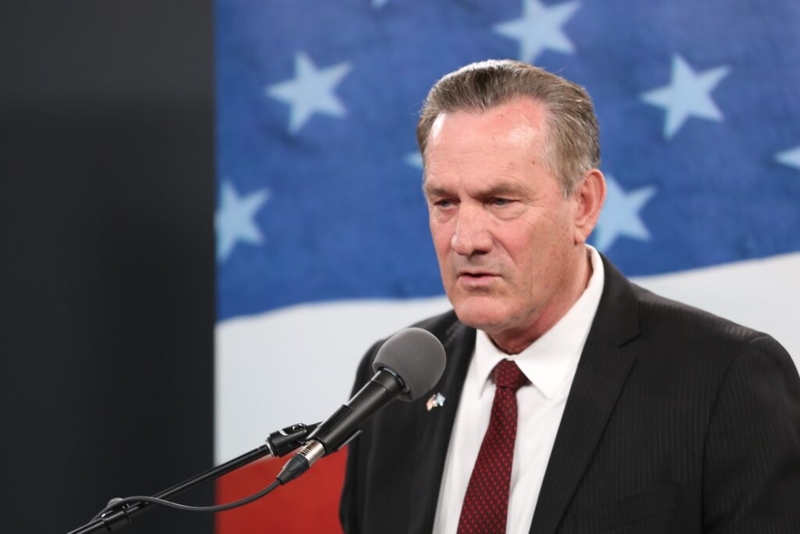
Gov. Larry Rhoden participates in a Republican gubernatorial primary debate on April 13, 2026, at the South Dakota Public Broadcasting studio in Sioux Falls. Rhoden has denied that total sales taxes in the state could rise to 10% as the result of recently approved legislation. (Photo by Joshua Haiar/South Dakota Searchlight)
When the governor challenged a gaggle of journalists recently, I felt obligated to respond.
The topic was taxation — specifically, criticism the governor is suffering for signing three bills into law that allow for new or higher sales taxes.
Two of the laws use revenue from a higher state sales tax rate and an optional county sales tax to reduce property taxes for homeowners. The third creates a sales tax that cities can use temporarily to pay for special projects such as building an arena.
One of Gov. Larry Rhoden’s three opponents for the Republican nomination for governor is U.S. Rep. Dusty Johnson, who has said the new laws will raise the maximum sales tax rate to 10%.
During a recent press conference, Rhoden said that figure is “fabricated.”
“Any one of you, you’re all bright people,” Rhoden said. “Tell me where he comes up with that number.”
I replied that adding up all the mandatory and optional sales taxes would, in fact, produce a sum of more than 10%.
The governor and I went back and forth a bit and discovered that I was including the tourism tax, and he wasn’t.
“That’s not a sales tax,” Rhoden said.
That’s technically true, because it’s a gross receipts tax. But it’s a distinction without a difference for consumers who end up paying extra at lodging establishments, campgrounds, spectator events and other tourism-related businesses.
“It’s just on a very few specific items,” Rhoden added.
Well, yeah. Like hotels. When I drove to Pierre in December for Rhoden’s budget address and paid for a room, the total tax rate of 8.7% consisted of:
- The 4.2% state sales tax.
- A 2% city sales tax.
- The 1.5% tourism tax.
- And a 1% city “bed, board and booze” tax.
The state rate was formerly 4.5%. Lawmakers reduced it three years ago, while scheduling a return to 4.5% in July 2027. Rhoden and lawmakers are letting that happen as planned, while inserting revenue from the increase into the education funding formula to reduce property taxes that homeowners pay to schools.
Rhoden and lawmakers also decided to let counties charge their first-ever sales tax, up to 0.5%, which can be approved by county commissioners or voters. The revenue will provide homeowners with credits against the county-imposed portion of their property taxes.
Finally, Rhoden and lawmakers authorized a new, optional sales tax up to 1% that cities can enact temporarily for special projects, in addition to other sales taxes cities can already charge. The new tax has to earn 60% support from a city’s voters.
Thus, when I go to Pierre in the future, the taxes on my hotel room could be 10.5%, consisting of:
- The 4.5% state sales tax.
- A 2% city sales tax.
- The 1.5% tourism tax.
- A 1% city bed, board and booze tax.
- A 1% city special projects tax.
- And a 0.5% county sales tax.
That’s not including the possibility of a business improvement district, which property owners can use to fund infrastructure and beautification projects.
When I stayed in Pierre in December, my hotel was in one of those districts, which charged a $2 occupancy tax in addition to the other taxes. My room rate was $72.80, and the total tax was $8.33, which means the effective tax rate was 11.44%.
As with any political debate, the truth is somewhere between the extremes. While it is possible to encounter taxes of more than 10% on purchases in South Dakota, it’s only on some transactions, and only in places where the city and county enact all of the optional taxes.
For homeowners, the higher state sales tax rate and optional county sales tax hold the promise of property tax savings. A recent attack ad against Rhoden from a political action committee omitted that information while dragging South Dakota Searchlight into the fray.
The ad quoted the first part of a sentence from a Searchlight news story: “Rhoden did sign three bills into law during the recently concluded legislative session that allow for new or higher sales taxes.” The ad did not include the rest of the sentence: “although two of them require the revenue to be used for property tax reduction while the other allows for temporary sales taxes with revenue going to specific city projects.”
All of which is to say that when you’re looking for truth in politics, ignore the rhetoric and check the receipts.

Pierre, SD