As Gov. Mills weighs data center ban, projects mixed on what the impact would be
Apr 22, 2026 | 4:11 am ET
Description
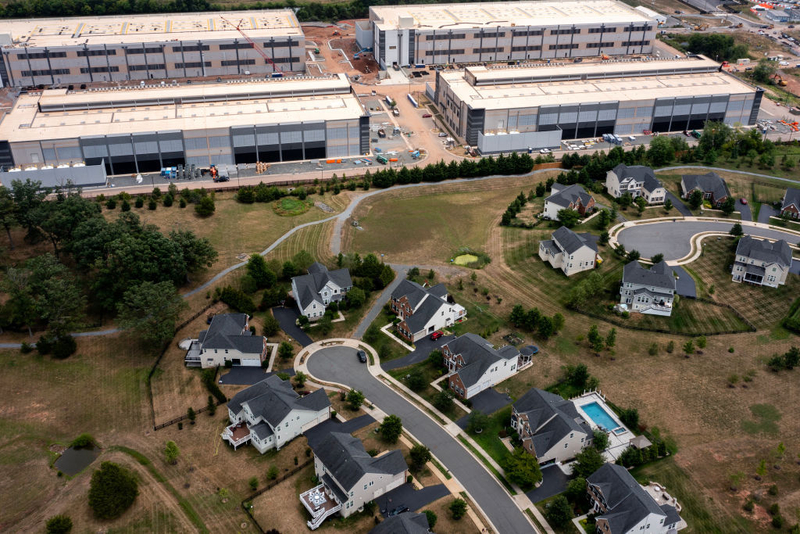
An Amazon Web Services data center is shown situated near single-family homes. (Photo by Nathan Howard/Getty Images)
Governor Janet Mills is considering whether to sign the first statewide data center moratorium in the country, weighing competing concerns about how it might impact the state’s economy and resources.
The bill, LD 307, prompted substantial debate in the Maine Legislature in the final weeks of the session, eventually passing through the Senate and House of Representatives on the final night of the session last Tuesday.
The bill bans data centers larger than 20 megawatts until November 2027, and creates a Maine Data Center Coordination Council to assess policy tools for regulating data centers.
Two experts who spoke to Maine Morning Star said it’s hard to predict if the moratorium would permanently stifle data center construction in Maine.
“If you’re a tech company who wants to build a data center in the state, and there’s a moratorium to 2027 and then uncertainty on what the policy will get after that, it’s going to make it hard to do the sort of gritty work required to get a project built in 2028 or 2029, so I think it sort of depends on how the moratorium plays out,” said Arjun Krishnaswami, senior advisor with the Federation of American Scientists.
It’s a national debate, and Maine is on the front edge, said Costa Samaras, professor of civil and environmental engineering and director of the Carnegie Mellon University Scott Institute for Energy Innovation.
“Maine is saying, before very large new power demand loads are approved, ‘What does it mean for rate payers, the grid, the environment and host communities?’” Samaras said. “And Maine is running an experiment and with this type of policy, both Maine and other states can see how data center development progresses or doesn’t progress.”
He added that as governments and industries look to meet future climate goals and move away from fossil fuels, there will be greater electricity demand, and data centers are a test case for how to approach that future.
“The decisions that states make in this sector are going to affect the way that we electrify other sectors,” Samaras said. “And we should be experimenting and revisiting and listening to communities and driving innovation and getting emissions zero.”
Now, all eyes are on Mills as she considers whether to sign the bill — without the exemption process she wanted — or veto it entirely.
And among those waiting to see Mills’ final decision are national groups, local officials and three data center projects in the works across Maine.
A 20-megawatt limit
Krishnaswami said nationally, most current data center proposals are much larger than 20 megawatts.
“What’s changing right now is that these companies, the tech companies, are trying to build and are actively building, these massive data centers that are needed to do both the training and actual computation associated with AI,” he said. “And when we talk about that AI data center growth, those data centers are way, way, way bigger than 20 megawatts.”
Samaras, who also served as a senior energy official in the Biden administration, said that type of capacity is considered an industrial-scale project.
“Normally, when I think about these types of scales, a major natural gas power plant might be a couple 100 megawatts. A nuclear power plant, a big one, would be 1,000 megawatts, and the Hoover Dam, when at full capacity, is 2,000 megawatts,” Samaras said.
When considering the energy use of data centers, the megawatt number is the maximum capacity the data center could be using at any given moment. And while other energy users, like residential homes, aren’t often operating at peak capacity, Krishnaswami said a data center would be operating at or near that capacity much more consistently.
And although 20 megawatts may be fairly small for data centers, it’s still a lot of energy for Maine.
Krishnaswami said he’d estimate that over a year, a 20 megawatt data center would use the same amount of energy as 20,000 Maine households.
According to the U.S. Energy Information Administration, Maine has a total power grid capacity of about 5,500 megawatts.
Debate on the bill frequently returned to the potential impact that sort of power usage would have on ratepayers.
Samaras outlined two primary ways this could occur: First, if the increased demand requires upgrades to grid infrastructure, that cost is usually spread across all ratepayers. The second is how rising demand could impact the cost of power.
“And so if the cost of buying the power starts to rise because there’s lots of new demand, eventually that starts to filter back to customers,” he said. “And that would happen over months or years, not immediately.”
Several proponents of the temporary moratorium said this session that they were concerned about the fast pace at which the industry is changing, and that even last year, they were told that Maine would not see data centers because of the high electricity costs.
But Samaras said the demand for data centers, especially with the artificial intelligence boom, has outweighed the costs in Maine. Higher prices in certain markets “are not an impediment” to construction, he said, “because these are investments that will last for decades and there’s a rush to get market share.”
The proposals: Jay
The most talked about project has been a proposal in Jay, at the site of the former paper mill. Lawmakers highlighted the project as a boon for the former mill town, and Mills said she wanted a way to exempt the project from the moratorium.
Tony McDonald, a longtime developer and owner of the site, said the project is being confused with other larger data centers from tech companies like Google and Amazon.
“So the backers of that bill are concerned, understandably, about AI and the impacts it’s having on the world,” he said. “I think they’re conflating AI with data centers, and they’re really two different things. Not all data centers are created equal.”
McDonald said the data center would inherit the paper mill’s existing agreement with Central Maine Power, which provides for 82 megawatts. McDonald said CMP estimates that the grid could provide up to 200 megawatts without needing any improvements and the agreement states that if the grid ever needed any upgrades, the data center would pay for that work.
McDonald said that the 20 megawatt cap in the moratorium doesn’t leave room for the project to be profitable.
“There’s a minimum threshold size that works for the company that wants to come in here,” he said. “There’s a certain amount of economies of scale that you need to do that, and it just doesn’t work at that level.”
He said the data center would use far less water than the paper mill, and developers plan to tear down the gas-fired power generation plant that’s on site, and build a solar field to help generate power.
“We’re using an existing facility,” McDonald said. “We’re plugging into an existing infrastructure for power and water. We have no wastewater discharge. We’re doing all the right things, but we are getting thrown into the same bucket as all these other big data centers just because we are a, quote, data center.”
He compared it to disliking all cars because of pollution.
“Okay, well, there’s a big difference between a Prius and a Humvee,” he said. “And you know, we’re the Prius.”
There's a big difference between a Prius and a Humvee. And you know, we're the Prius.
Not factoring in the moratorium, McDonald said the current plan is to begin work this summer to finish clearing out machinery from the mill. And the data center company — which McDonald declined to name — would begin work in January 2027, and look to be lit up by January 2028.
Even though that timeline puts off operations until after the moratorium ends, McDonald said the ban would be the end of the project.
“This is over a half a billion dollar investment and companies that finance things like that, they’re not real big on taking chances that things will all work out,” he said.
The proposals: Limestone
Further north, at the former Loring Air Force Base in Limestone, is another proposed data center, from Minnesota-based LiquidCool Solutions.
Herb Zien, vice chair of LiquidCool Solutions, said the project can operate at a smaller scale because of the low start-up costs at the location.
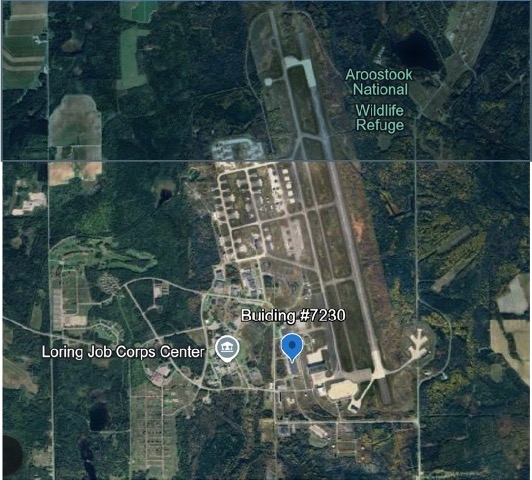
“In this case, the building exists, there’s already power in the building, and there’s good connectivity to both Boston and Halifax,” Zien said. “So it’s almost move in ready.”
He said the building already has two megawatts of power, and they have an agreement with Versant Power to supply up to 26 megawatts. But Zien said if the ban goes into effect, they would keep it to 20 megawatts.
“One of the great things about this project at the two megawatt level is that you can put your toe in the water without spending a lot of money,” Zien said. “Data centers are big bets, and if you can, for a few million dollars … get into the business to see how it works out, a lot of people would look at that as a good opportunity, because you can try it at relatively small risk.”
Zien said that LiquidCool has patented technology so they don’t require water to cool the servers in the data center, which reduces the power needs by about 40%.
“I think data centers today are being built incorrectly, because they’re being built for an obsolete technology, there’s a next generation technology — which LiquidCool Solutions has 72 patents around — which would eliminate a lot of the externalities that people are worried about.”
The proposals: Sanford
The final project up in the air is in Sanford.
Still in very early stages is a potential data center from the Texas-based multiFUELS, owned by longtime energy developer, Randall Gibbs.
Anthony Buxton, an attorney with Preti Flaherty, represents the company, which currently owns around 1,000 acres in Sanford. He said they are interested in building an integrated energy center that would include a data center.
He said the project would likely be in the 100-200 megawatt range, starting smaller and then growing. In the long-run, the project would be powered by hydrogen, but in the short-term would use on-site solar panels, and natural gas, Buxton said.
But he’s not sure exactly what the moratorium would mean for the project.
“Now they’re not ready to file applications, but a moratorium would be a pretty clear signal they weren’t welcome here,” Buxton said.
He said this project, and the one in Jay, tried to advocate for an exemption process that would have kept data centers heavily regulated.
“Data centers, properly sized and sited and thought through, present an opportunity to fill the holes left by globalization in the Maine economy,” he said.
But he feels now that Maine has gotten caught up in a national argument.
“It became pretty clear during these debates that the national opponents to data centers were looking for a small state to adopt a moratorium that they could tout nationally, and that prohibited any rational discussion about establishing a reasonable regulatory regime,” Buxton said.
Waiting on the governor
The Legislature finally enacted the ban on April 14, giving the governor ten days to decide whether to sign or veto it. And it’s still not clear what she will do. Mills told NBC News Friday that she hadn’t decided whether to sign the bill.
“It’s on my desk. I’m going to read it. Read it very carefully,” she said.
Mills said she wanted a “carveout” for the project in Jay, but it would be difficult to add an exemption now that the Legislature has adjourned and will only return for one final day of work at the end of the month.
“I’m also concerned about what data centers have done in other states — consumption of electricity and water usage, those kinds of things,” Mills said. “This one is right on the Androscoggin River, and that paper mill once used 40-something million gallons of water each day. So I’m looking at the comparison there, and whether or not it’s viable.”
It’s more than just local developers eyeing Mills’ next move. National groups have spoken out in support and opposition to the bill.
Americans for Prosperity, a libertarian conservative political advocacy group, are among the groups calling on Mills to veto the ban.
Ross Connolly, Northeast region director, said the ban would undermine Maine’s economic competitiveness and discourage job growth.
“Data centers represent a critical opportunity for Maine to revitalize underused industrial sites, create jobs, and establish a foothold in the rapidly growing AI economy,” Connolly said. “But rather than embracing that opportunity, policymakers are signaling uncertainty and hostility toward investment.”
On the other hand, Food and Water Watch, which has called for a nationwide data center moratorium, applauded the moratorium.
Mitch Jones, managing director of policy and litigation, called the bill smart and nation-leading, and said Mills should sign it immediately.
“Great credit to the people and state legislators of Maine for being at the forefront of a large and swelling national movement to put a halt to the reckless, unchecked explosive growth of hyperscale AI data centers,” Jones said. “These massive facilities suck up unimaginable amounts of water and electricity, and wreak havoc on the everyday Americans in nearby communities that are forced to foot the bills for this irresponsible, profit-hungry industry.”
If Mills does veto the moratorium, the Legislature will return for one day of work April 29, and could overturn the veto. It’s not clear if lawmakers would try again to amend the bill for an exemption, in the hopes of convincing the governor to sign.
It’s also not clear if a last-minute amendment would be persuasive enough for Mills, who two years ago refused to sign any bills passed after statutory adjournment.
Augusta, ME