Rent stabilization clash heats up after Smiley follows through with the veto he warned would come
Apr 20, 2026 | 5:28 pm ET
Description
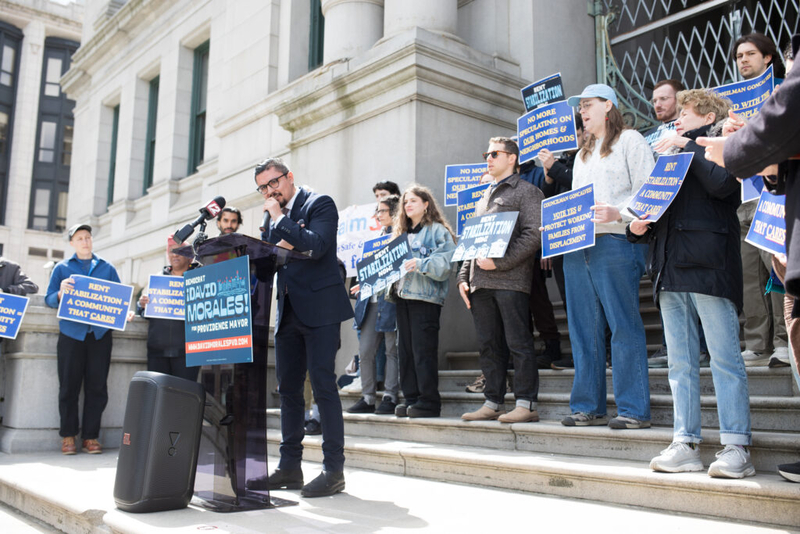
Providence mayoral candidate and Democratic state Rep. David Morales speaks outside City Hall on Monday, April 20, 2026, calling on the City Council to override Mayor Brett Smiley’s veto of the rent stabilization ordinance passed last week. (Photo by Alexander Castro/Rhode Island Current)
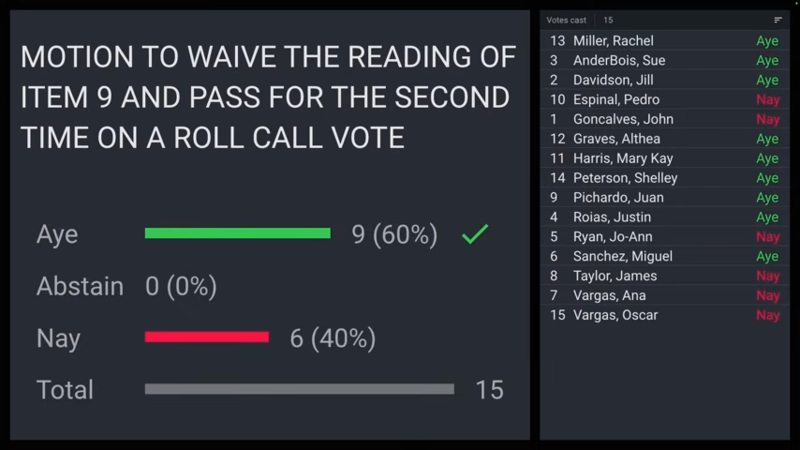
No one was surprised after the Providence City Council voted 9-6 last Thursday night to pass a rent stabilization ordinance, sending the measure to the mayor’s desk.
On Friday morning, Mayor Brett Smiley vetoed it. Then came his Democratic rival’s rebuke.
“I recognize that rent stabilization is a policy that resonates with many neighbors who are facing real and immediate housing pressures,” Smiley wrote in his veto letter to the council. “It is our responsibility to pursue approaches that address the root causes of our housing challenges instead of policies that risk worsening them.”
Smiley’s swift block of the proposed ordinance — which would cap annual rent increases at 4% for select apartments in the capital city — had already been promised by the Democratic mayor months ago.
The council voted on the second passage of the rent-regulating tactic a day after Smiley released his budget for the upcoming fiscal year, one replete with an assortment of housing initiatives that modeled alternatives to the City Council’s proposal.
“Even if you think rent control is a good idea, this is a bad version of a bad policy,” Smiley told reporters last Wednesday after his budget address.
Smiley reprised his earlier melody in a brief 11 a.m. press scrum at his City Hall office Friday. He said had just vetoed the ordinance “a couple minutes ago” in opening remarks to reporters, and he continued to argue his case that the council rushed through the measure despite the potential negative consequences of its impact.
“I hope that now we can turn the page and focus on the many, many things that we agree on,” the mayor said. “This council and I do, in fact, share the same objective, which is to make Providence more affordable, particularly as it pertains to housing costs.”
The City Council has 30 days from the veto to move to override the mayor’s rebuke. As of Monday, that gives councilors 27 days, until May 17, to initiate the vote. To overpower the mayor’s decision, the council will need a supermajority of 10 votes — one more than councilors who support the measure were able to secure at Thursday night’s vote.
The six councilors who voted against the ordinance Thursday — Pedro Espinal, John Goncalves, Jo-Ann Ryan, James Taylor, Ana Vargas and Oscar Vargas — sent a letter to the mayor’s office that same day requesting a “third-party, independent study,” Smiley said Friday.
No such vote has been scheduled yet, Providence City Council Chief of Staff June Rose said via email Monday afternoon.
But Rose added, “Council President [Rachel Miller] fully intends to pursue that path — both as a moral responsibility to address the housing crisis and in response to the clear mandate from the 74% of Providence residents who support rent stabilization,” referencing a recent poll first reported in the Boston Globe poll which noted strong support for the measure among likely Democratic voters.
Last Wednesday, Smiley had said of the ordinance, “The administrative questions are numerous, the fiscal impact is huge, the burden that it’s going to shift onto other residential taxpayers is real.”
By Friday morning, however, having freshly axed the ordinance, Smiley maintained that the council would be responsible for keeping the budget intact if it were to call an override vote.
“The council, I think, has a choice to make whether they’re even going to call the vote,” Smiley said. “And the very serious questions that remain open-ended about how to actually implement and how to pay for this only need to be addressed if they do that.”
“I’m just not focused on that at the moment,” Smiley reiterated Friday about the council’s hypothetical rent proposal and its possible impact on municipal costs.
The proposed ordinance would create a regulatory board and enforcement structure with a handful of staff that, per the fiscal note produced for the City Council, would have an additional ballpark cost of about $576,000 in annual salary and benefits.
Like countless municipalities, Providence’s budget is constrained by an ever-widening array of fixed costs, leaving scant room for, as the mayor’s team phrased it last week, “hypothetical” expenditures. Smiley said he was more “focused on all of the other housing programs we have right now, all of the ways in which, frankly, that we agree.”
Smiley’s fiscal year 2027 budget includes a bundle of $2.04 million for housing and related initiatives, including $1 million for a new rent relief fund, $500,000 for eviction defense, and $500,000 for a revolving fund meant to help cover code repairs, plus smaller sums for landlord and tenant education as well as acute emergency needs. While city officials stressed the lack of funding for hypothetical ventures, these supports would also need to be subsidized by the sale of several defunct city properties, they added.
The budget was initially tabled by the City Council last week. It typically goes to the council’s finance committee, which is chaired by Councilor Jo-Ann Ryan, a Smiley ally and one of the six councilors who voted against rent stabilization.
Council President Miller said in a statement Friday, “A majority of the Committee on Finance shared that they had reached an impasse with the current chair. Additional members of the council shared that they did not have confidence that their voices would be heard in the upcoming process.”
At a special meeting Monday night, the Council is expected to formalize the creation of a new body, the Special Committee on Ways and Means, which will be charged with taking up the mayor’s proposed budget.

Keys in the door vs. boxes on the curb?
Smiley told reporters Friday of the veto, “This was not a political decision for me. This was a principled policy choice for me.”
His challenger in September’s Democratic primary has a different take. Democratic state Rep. David Morales, who is running against Smiley for the capital city’s mayorship, quickly criticized the veto in a press release Friday. On Monday, Morales took to the steps outside City Hall — just beneath Smiley’s second-floor office — with a band of housing advocates as well as City Councilor Justin Roias, who voted in favor of the ordinance last week.
Rather than a simple matter of policy, Roias characterized the veto as something more akin to class war in a statement issued Friday.
“Some people profit from a housing crisis; most people suffer from it,” Roias wrote. “That’s the difference between Mayor Smiley and the rest of us.”
Outside City Hall Monday, Roias impugned Smiley’s slowness to act, as well as the mayor’s rent relief fund as a kind of sublimated relief for what the city’s residents really need.
“Friends, this is not hypothetical,” Roias said. “This is keys in the door, or the other option, which is boxes on the curb.”
Morales supports the ordinance and his progressive brand of politics more closely aligns with the City Council. In his turn at the podium, he accused Smiley of siding with “corporate landlords” and “big real estate” over working renters. He named each of the six City Councilors who voted no last week and urged them to reconsider if and when an opportunity to override emerges.
Morales also shot down what he saw as an inaccurate narrative from the mayor’s office about the rent proposal’s fiscal aspects.
“I’ve been disappointed to see the lack of collaboration that’s come from the mayor’s office when engaging with council leadership to actually determine the financial figures, because the financial figures provided by the Chief Financial Officer ranged by a significant amount when citing what the actual financial impact would be on the city,” he said.
Asked after the press event whether he felt better going into September’s primary after the veto, Morales relayed a bit of biography. The housing crisis, he said, is one of the very reasons he chose to run for mayor.
I hope that now we can turn the page and focus on the many, many things that we agree on. This council and I do, in fact, share the same objective, which is to make Providence more affordable, particularly as it pertains to housing costs.
“I grew up to a single immigrant mom, and we couch surfed a lot, and what I hear today as a state representative are constant phone calls from working families that are struggling to be able to find a place to live,” Morales said. “And so I start thinking back to the way I grew up and the fact that these are struggles that no one should have to be experiencing on a daily basis.”
After releasing his budget last week, Smiley told reporters it takes an experienced team to wield an almost $640 million budget largely devoted to fixed spending.
But Morales did not see evidence of that expertise in the administration’s actions. Under Smiley’s tenure, Morales said, taxes have risen, schools have been underfunded, and basic services — from snow removal to street sweeping and pothole repair — have been delivered unevenly.
“I’m going to prioritize department appointments not based on political pressure or political needs, but more so based on actual expertise and experience,” Morales said. “We’re going to prioritize that I actually listen to our neighbors making the proper budget allocations, but then thereafter being able to communicate the progress that we’re making.”
Is his support for rent stabilization evidence of Morales’ listening to the city?
“Absolutely,” Morales said. “The issue of rent stabilization has demonstrated that our current mayor would much rather prioritize the interests of corporate real estate agents and lobbyists as opposed to the actual needs of working people in our city who are struggling.”

Providence, RI