Independent Bill Hill runs “race against time” in bid to knock off GOP U.S. Rep. Begich
Oct 31, 2026 | 3:08 pm ET
Description
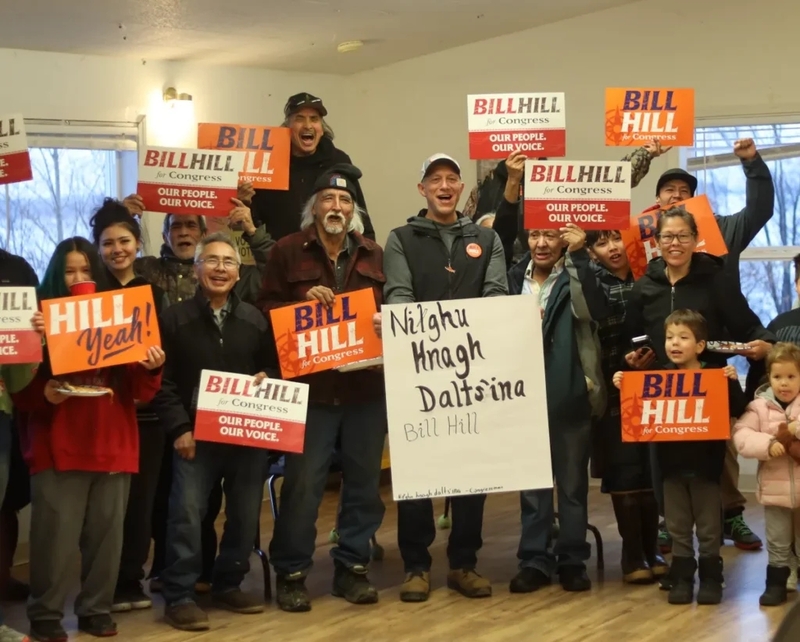
Independent Bill Hill poses with Nondalton residents Monday. He won 86% of votes cast in the village in the primary — but he has to build a much larger coalition to win the U.S. House seat he's seeking. (Nathaniel Herz/Anchorage Press)
For a minute Monday, in the small Bristol Bay village of Iliamna, it looked like U.S. House candidate Bill Hill might not get out of the local graveyard.
Hill, the independent running for Alaska’s sole House seat, had stopped to pay respects to a relative who’d recently been buried. Afterward, he jumped in the car, with his younger brother Karl at the wheel — and the rig promptly got stuck in deep sand.
Bill didn’t have time to spare: He’s on an ambitious schedule for the homestretch of his campaign, stumping from Fairbanks to Sitka as he tries to close a suddenly shrinking gap between himself and incumbent Republican U.S. Rep. Nick Begich III. After his Iliamna visit, he was set to fly to three other villages before sundown.
“Momentum,” Bill said calmly as Karl spun the wheels. “Gotta get the momentum up first.”
The car rocked back and forth before it finally got purchase. I couldn’t detect any tension between the two brothers, and when I mentioned, once we were rolling, that the vehicular detour felt like a test of their fraternal relationship, Karl cracked a joke: He wasn’t listening to his brother anyway.
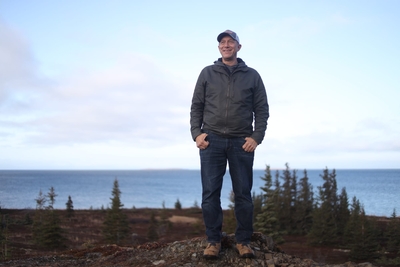
Bill Hill’s poise and his tight family ties are both themes of his effort to knock off Begich, who’s finishing up his first term. Hill’s case on the campaign trail: Begich has prized partisan politics and wealthy allies over loyalty to Alaska constituents and he’s supported decisions by President Donald Trump that have hurt his home state, spiking the prices Alaskans pay for essentials like food, gas and health care.
The campaign started as a long shot, seeking to introduce an unfamiliar face to a statewide audience in a year when airwaves are jammed with ads for Alaska’s U.S. Senate candidates.
But the race has now tightened to what could be nearly a dead heat: Two polls released in October show Begich leading by no more than two percentage points.
Hill is not a polished politician; his vibe onstage gives more “your friend’s dad” than it does electrifying speaker. He’s faced fierce attacks over actions that predate his recent entry into politics, like a misdemeanor conviction for commercial salmon fishing outside legal boundaries — an infraction many fishermen describe as the cost of doing business.
Opponents also say he leans farther left than he lets on, pointing to old campaign donations to Bernie Sanders and Alexandria Ocasio-Cortez.
But what Hill lacks in conventional political experience, his supporters say, he makes up for in Alaska bona fides: He comes from an Indigenous familywith deep roots and a long history of leadership in the Bristol Bay region, and claims an understanding of the state’s rural communities that can come only with decades spent living there.
Hill’s campaign allowed me to join him on part of his final stretch — specifically, a multi-village tour through Bristol Bay, including stops at the site of his Dena’ina grandmother’s old cabin and his childhood home in the village of Kokhanok.
At every turn, supporters showed up to give Hill a hug, share news about friends and relatives, and joke about the attack ads that, as one person quipped in a text message to the candidate, make Hill out to be a drinker of “unicorn blood.”
“Fuel, groceries, electricity, airfare, it’s getting really tough,” said Jessie Wilson, a cousin of Hill’s who attended a small campaign event Monday in Iliamna. Hill “lives in it,” she added. “He gets it. He’s in the thick of it just like we are.”
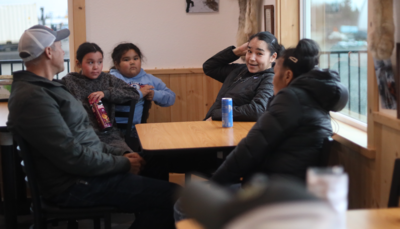
The question for Hill is not whether he has support in rural villages like Iliamna and neighboring Newhalen, where he claimed 65% of the primary vote in a single combined precinct. It’s whether his message will resonate enough in Alaska’s more urban areas to propel a first-time candidate for public office into U.S. Congress.
Hill thinks it will, telling me that “the issues that are important to rural Alaska translate directly to the rest of Alaska.” He’s pledging to work to contain gas prices and health care costs, to limit the influence of money in politics and to close tax loopholes for the wealthy.
“A lot of the work that Begich has done, through the support of the party line and what the administration wants, I don’t think reflects what Alaskans need,” Hill said.
Begich’s campaign declined my request to spend time with the candidate in the lead-up to Election Day.
But it did send a lengthy statement highlighting Begich’s legislative accomplishments, which spokesman Paul Smith described as “significant action on Alaska Native land rights, tribal health care and Alaska Native veterans.”

Those include sponsoring bills signed into law that extend Vietnam War veterans’ opportunities to claim Native allotments and transfer federal land to a Native corporation and Native health care provider — as well as efforts to boost oil and gas lease sales and Arctic security, Smith said.
“His commitment extends well beyond Washington: He has traveled to communities throughout Alaska, from Bethel and Aniak and Chuathbaluk to Nome, Kotzebue, Anaktuvuk Pass, and Southeast Alaska, listening to the challenges facing families and local leaders,” Smith added. “Every day he serves in Congress, he is making the case for Alaska, period. His priority is Alaska, and his focus remains on delivering opportunities and results for the people he represents.”
Hill’s story, or at least one strand of it, starts in a shallow, grassy pit that once housed a cabin near the shore of Lake Clark — a bright blue expanse tucked into the mountains some 165 miles southwest of Anchorage, at the eastern reaches of the Bristol Bay watershed.
Hill’s paternal grandmother, Katie Trefon, was born there in 1919.
She lived a life that straddled the Indigenous Dena’ina subsistence traditions of trapping and fishing, and the Western commercial salmon harvesting economy that sprang up in Bristol Bay with the arrival of thousands of European immigrant fishermen in the late 19th and early 20th centuries.
Her first husband was Bill Hill’s grandfather Billy Hill, who came from Finland and worked as a boat builder, prospector, mechanic and winter caretaker at a fish cannery, according to a National Park Service history.
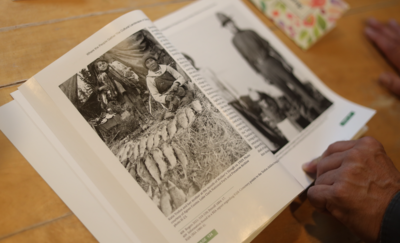
Billy died suddenly in the 1940s, and Katie remarried. She raised 13 children in total, including Bill’s father.
“She was just the stalwart rock of the family,” Bill said Monday, midway through a walking tour in Port Alsworth that took him past the site of the cabin and a small burial ground. “Tough lady, but a very loving lady.”
Hill now has siblings, cousins and other relatives scattered across the region, where the Hill family members are “some of the best and brightest that Bristol Bay produced,” said John Branson, a longtime historian with the national park that encompasses Lake Clark.
Hill’s uncle Frank was one of Alaska’s first Native school superintendents. Bill’s parents were both schoolteachers and raised Hill and his siblings in the village of Kokhanok, on the south shore of the massive Lake Iliamna, just south of Lake Clark.
The kids — Hill has five siblings — grew up in what he describes as the “idealized version” of rural Alaska, chopping wood, hauling water, caring for and running the family’s several dozen sled dogs.
The Hills later moved to the Bristol Bay hub town of Naknek so that the kids could attend high school. In Kokhanok, Bill, the oldest, had just one classmate; in Naknek he had 12.
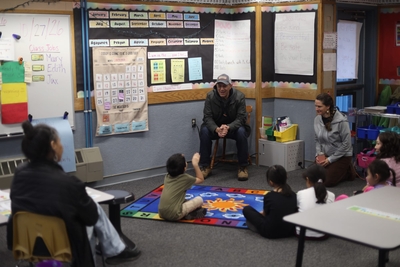
Hill went to college for a teaching degree, then did construction and joined a trade union before getting a graduate degree and working as a teacher, principal and, ultimately, superintendent of the Naknek-based Bristol Bay Borough School District.
His service there has become a subject of attacks in recent weeks, with Begich’s campaign knocking declines in test scores that came during Hill’s tenure; Hill’s campaign says the data was cherry picked from a period when there was a statewide decline in scores tied to a change in testing methods.
Hill married and had four kids; he now has seven grandchildren. He retired from his superintendent job in 2023 and now draws a pension of some $80,000 a year, according to his financial disclosure.
Hill’s perfect retirement, he said, “would be just spending the rest of my life in Bush Alaska, not having a lot on my plate and enjoying grandchildren all over the place.”
“But we all know that sometimes those things can slip away,” he said. “They need to be preserved for the future.”
Frustrated by what he describes as “billionaires taking over our government,” Hill started having conversations with contacts he made at Alaska’s Capitol during his education career, when he’d travel to Juneau on advocacy trips. His first thought, he said, was to run for the Alaska House, but the idea of holding statewide office and “changing things at a national level” ultimately appealed more.
Hill wouldn’t identify any of the people who pushed him to run for Congress. But his conversations led him to Ship Creek Group — the Anchorage political consulting firm that’s worked with Democratic U.S. Senate candidate Mary Peltola, Democratic gubernatorial candidate Jonathan Kreiss-Tomkins and Republican-turned-independent former Alaska Gov. Bill Walker.
Ship Creek Group’s consultants, who now help lead Hill’s campaign, describe Hill’s biography and personality as some of the biggest selling points in their decision to work with him. And they say their polling shows that the candidate’s backstory connects with voters.
“We need to back the kinds of people who aren’t most naturally equipped to run, but who will bring a perspective and a level of decency that doesn’t exist in D.C.,” John-Henry Heckendorn, one of the group’s owners, wrote in a personal fundraising email to family and friends.
That email was sent five weeks from Election Day. At that point, Heckendorn wrote, the campaign was “no longer in a race against Nick Begich.”
“We are in a race against time,” he said. “If Alaskans learn who Bill is and what he stands for, he will win.”
Hill and his allies have also targeted Begich’s multi-million-dollar net worth, much of which is invested in software and technology companies. And the messaging seems to be working: On Tuesday, a closely watched political newsletter, Sabato’s Crystal Ball, shifted the Begich-Hill race from “likely Republican” to “leans Republican.”
What does Hill actually stand for?
He opposes Trump’s tariffs, the elimination of renewable energy tax credits, and the Citizens United decision that allows unlimited corporate spending in elections.
He supports expanded Medicaid coverage, abortion rights and gun rights, and natural resource extraction — except the big Pebble mine project in the Bristol Bay region, which has long been opposed by many residents and commercial fishermen for the risks it poses to the watershed’s huge salmon runs.
He’s refused to say whether he’d caucus with Democrats or Republicans if elected — though he has said he wouldn’t join a caucus headed by the current U.S. House speaker, Republican Mike Johnson.
Conservative groups have attacked him for his donations to Sanders and Ocasio-Cortez, saying they show Hill is a closet Democrat. In an interview this week, Hill said those contributions reflect “somebody that’s pissed off that billionaires are taking over our country.”
“I’ve also voted for Don Young, and (Ted) Stevens,” he added, referencing the two late, long-serving Alaska Republican politicians. “Just because you may see one segment of my politics in fundraising, it doesn’t reflect the entirety of me.”
Hill’s core message of affordability lands most urgently in rural Alaska, where gas prices in many communities now exceed $10 a gallon — driven in part by the U.S. war in Iran.
But Hill and his consultants say that practical centrist positions can appeal to a broader coalition that other politicians like Peltola, Lisa Murkowski and Walker have ridden to victory in Alaska — which more often elects Republicans, even though nearly 65% of registered voters are independents.
That coalition combines Democrats with pro-development labor unions, moderate Republicans in coastal fishing communities, rural Alaska Native voters and swing voters in urban precincts.
On Tuesday, in Bristol Bay, I asked Hill why he was taking precious time in the closing stages of the campaign to visit communities with so few voters.
He acknowledged that the numbers favor him spending time in urban areas, but quickly pivoted to how more than 200 Alaska communities can only be reached by plane.
“They deserve to be represented. They deserve to have people in Washington, D.C., who understand what their lives are like — understand the power that belonging to a remote community brings and the value it brings to your life,” he said. “They should not be overlooked.”
Hill’s campaign says he’s traveled more than 25,000 miles across the state since launching his bid for House this year in his effort to build a winning majority.
But doing so is a tall order for a candidate who’s never run for elected office beyond the board of his local Native village corporation — especially without the benefit of party affiliation, according to Margaret Stock, an attorney who ran for U.S. Senate as an independent in 2016.
“A lot of people only vote based on the party label,” Stock said. “I would call people and ask for money and they would say, ‘You’re not a Democrat, I’m not giving you money.’ ‘You’re not a Republican, I’m not giving you money.’”
She added: “It’s a lot easier if you have the party infrastructure behind you.”
One key support to Hill’s campaign is a super PAC called Wheel Dog PAC, which has spent millions of dollars on his behalf.
Wheel Dog has collected six-figure contributions from groups aligned with progressive causes, including $400,000 from Sixteen Thirty Fund — an organization that Politico describes as “the left’s dark money behemoth.”
That same fund is linked to multiple other groups that have donated six-figure sums to Wheel Dog, including Contours Inc. and Government that Works PAC.
On his last-minute swing through Bristol Bay region, Hill leaned on family infrastructure, with two of his brothers, Rob and Karl, flying him in their own Bush planes.
Monday morning began in Naknek, with the three brothers, plus Rob’s wife and daughter and a pair of campaign aides, cramming into a Cessna 182 and a Piper Cherokee 180 — nearly every square inch filled with campaign signs, snacks and boxes of pizza.
They flew first to New Stuyahok, a Yup’ik village 50 miles north of Naknek on the Nushagak River, then loaded up again for the 80-mile flight to Iliamna. I met them there midday, having flown in directly from Anchorage.

I chatted with residents at one of the village’s stores as Hill and his crew arrived. Tref Andrew, a commercial fisherman who showed up in a baseball cap that said WTF — Where’s The Fish — told me how fuel prices were so high this summer that, after setting his net, he would take the unusual step of turning off his engine while waiting for salmon to swim into it.
“How we’re going to survive here as a rural community, given the increase in the cost of living — it wasn’t too bad when I was growing up here as a child. One season of commercial fishing, you could buy everything,” Andrew said.
Today, Andrew added, he can spend $20,000 on maintenance, storage and insurance before his boat even goes into the water for the summer.
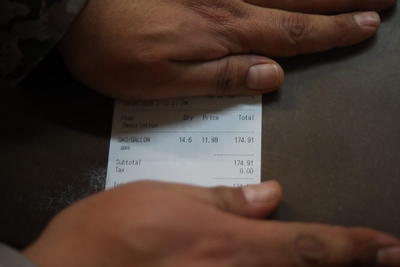
At our next stop, another store in Iliamna, the themes were similar. One shopper left with a small bag of groceries — four tomatoes, a head of iceberg lettuce, sour cream, taco seasoning and cheese — that cost $60. Another bought a $175 tank of gas at $11.98 a gallon — “like a stab in the back, every time you fill up” — while the store’s operators complained of steep prices for electricity.
Karl’s plane carried Bill onward to Port Alsworth, then to the 130-person village of Nondalton, where one Elder met him with a handwritten guide to local Dena’ina clan names.
Something like one-fourth of the village population turned out to eat the campaign’s reheated pizza and to listen to a short stump speech from Hill after a Lord’s Prayer and an introduction, in the Dena’ina language, from his sister-in-law.

More chit-chatting came afterward, but daylight was dwindling; Hill and his campaign and brothers had to fly back across Lake Iliamna to Kokhanok for the night. We all clambered into a pickup truck to head back to the airport, with several of us sitting in the bed.
The next morning in Kokhanok, Rob flipped dozens of sourdough pancakes, served with sides of fried Spam and moose sausage, for residents at the old school, where the family had lived behind a partition when they first arrived in the village.
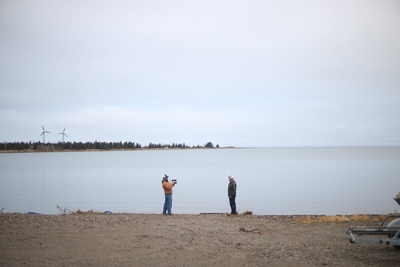
Afterward, an aide, Wil Garcia, pulled Hill outside to the shore of the lake, where he taped some video. Then Hill drove to the new school, stopped by a couple of classrooms and ate a community lunch of locally harvested caribou ribs.
One last coffee at Rob’s house, and a walk along the water, before it was time to go: The plane was heading back to the road system, and to Hill’s last week on the trail.
Juneau