Louisiana sues federal officials for denying proof-of-citizenship change to voter form
Apr 16, 2026 | 4:00 am ET
Description
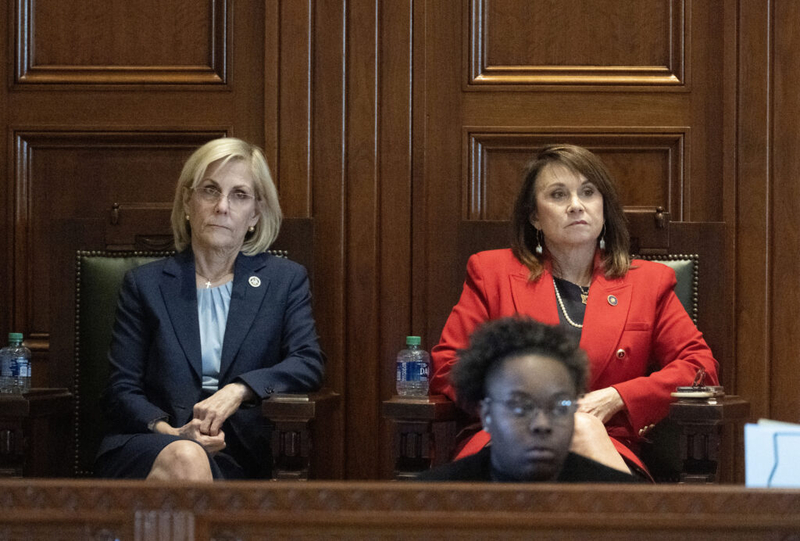
Louisiana Secretary of State Nancy Landry, left, sits with Louisiana Attorney General Liz Murrill as Gov. Jeff Landry speaks on opening day of a legislative special session focusing on crime, Monday, February 19, 2024, at the State Capitol in Baton Rouge. (Hillary Schienuk/ The Advocate, Pool)
Louisiana officials believe federal election commissioners are unconstitutionally blocking the state’s addition of a proof-of-citizenship requirement on a federal voter registration form.
Attorney General Liz Murrill filed a lawsuit Tuesday against the U.S. Election Assistance Commission and Brianna Schletz, its executive director, in Louisiana’s Western District federal court in Monroe.
The case, Louisiana v. EAC, stems from a law the state legislature approved in 2024 that requires applicants to include proof of their U.S. citizenship on their voter registration application.
The National Mail Voter Registration Form, one of several ways for registering to vote, asks for a person to provide their name, address, date of birth and a government ID or driver license number. Under federal law, each state has its own instructions for what kinds of identification are acceptable.
Citing the 2024 state law, Louisiana Secretary of State Nancy Landry submitted a request to the Election Assistance Commission in January 2025 to modify the state-specific instructions for government IDs numbers on the voter registration form. She asked that the form require the submission of student exchange visa number, alien registration number, naturalization certificate or other immigration identifier when applicable.
The attorney general’s office said in a news release Wednesday the state wants to collect the information “so election officials can verify that only United States citizens are registering to vote in our elections.”
The commission deadlocked over Louisiana’s modification request, resulting in its rejection. Murrill wants that decision tossed aside and is asking the federal court to declare the National Voter Registration Act “unconstitutional as applied by the EAC or as applied to the State of Louisiana.”
“The Election Assistance Commission should not be getting in the way of the State’s sovereign right to protect the integrity of its elections,” Murrill said.
The commission, created under the Help America Vote Act of 2002, consists of four members, no more than two of whom can belong to the same political party. The president nominates commissioners based on recommendations from majority and minority leaders in Congress. Its current membership includes two picks from President Barack Obama in 2015 and two from President Donald Trump in 2019. Members may serve two consecutive terms and past that deadline until a successor is chosen.
Thomas Hicks, an Obama appointee, and Benjamin Hovland, a Trump pick, disapproved Louisiana’s request.
In their denial letter, the commissioners wrote that the state’s reasoning for the proof-of-citizenship requirement could cause equal protection issues by requiring naturalized citizens to disclose more information and go through more hurdles to register than American-born citizens.
They argued that creating additional requirements on a federal voter registration form is an authority that rests with Congress, not the commission. The National Voter Registration Act, which Congress enacted in 1993, determined the information people must put on the federal voter registration form, according to the letter.
The commissioners further argued that Louisiana provided no evidence of why such additional information is necessary.
In her request, Landry said her office discovered roughly 400 potential non-citizens were registered to vote in Louisiana, but she failed to say how many of them, if any, used the federal mail-in form to register. The commissioners noted Landry’s office didn’t respond when asked for that data.
Baton Rouge, LA