Seeking $150M more, Commerce shifts blame to SC agency not included in Scout negotiations
Apr 06, 2026 | 9:15 am ET
Description
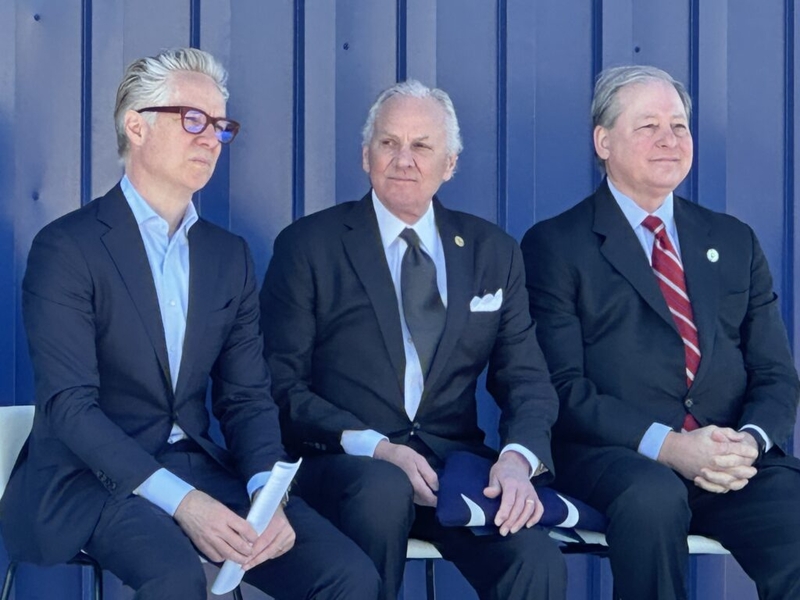
Left to right, Scout Motors CEO Scott Keogh, South Carolina Gov. Henry McMaster and state Commerce Secretary Lightsey participate in the groundbreaking ceremony for Scout's $2 billion electric vehicle assembly plant Thursday, Feb. 15, 2024, in Blythewood. The state's economic development chief now says comments by the state’s Department of Natural Resources caused most of the massive cost overruns the state now faces on the site. (Jessica Holdman/SC Daily Gazette)
COLUMBIA — South Carolina’s economic development chief blames the state’s Department of Natural Resources for massive cost overruns on the site of the Scout Motors electric vehicle assembly plant.
“We ended up in a situation that they took a position that we did not expect them to take, and that resulted in substantial cost,” Commerce Secretary Harry Lightsey recently told Senate budget writers, who are putting their budget proposal together this week.
The state Department of Commerce has racked up more than $150 million in overages as it works to fulfill pledges it made to lure the Volkswagen subsidiary to the state. Now the agency is asking taxpayers to make up the difference.
Roughly $100 million of the unexpected costs is due to the natural resources agency, Lightsey told senators. But it was never consulted during the deal-making process.
Ahead of deciding whether to fund Commerce’s request, senators wanted to know what sent the project over budget, who bore responsibility and how to stop it happening again.
SC is $150M over budget on promises it made to bring Scout Motors to the state
An environmental agreement
In its 2023 agreement with Scout, the state Department of Commerce and Richland County agreed to contract and pay for all mass grading of the 1,600-acre site about 12 miles north of downtown Columbia at no cost to the company.
At the heart of the issue were tight deadlines for getting this work done so Scout could begin assembling vehicles in 2027, as well as an environmental package meant to offset the wetlands lost when the company started to build, Lightsey has said.
Commerce needed a waiver from the U.S. Army Corps of Engineers to avoid a more lengthy, two-year environmental permitting study that Lightsey has said would have killed the deal with Scout.
The costs of all associated environmental requirements were to be borne solely by the state and county, the 192-page contract reads.
So Commerce and the county, on Scout’s behalf, first offered to protect 4,902 acres of wetlands near Congaree National Park and another 155 acres on the Broad River, known as Shelton Island, thinking it would be enough to win approval.
The Department of Natural Resources disagreed.
In a letter to the Corps during the federally required comment period, the agency suggested adding improvements to streams in the Sumter National Forest. It also raised concerns that construction had already begun on the site, making it difficult to fully evaluate environmental impacts.
Commerce did not consult the natural resources agency before submitting its proposal, Lightsey said in response to a question from Sen. Tom Davis, R-Beaufort.
Ultimately, the Corps required work stop on the site until the wetlands permit was approved, delaying construction for about five months as equipment costs continued to pile up.
In a breakdown of the $150 million that Lightsey gave legislators, additional environmental work and keeping equipment on site for those extra months cost more than $70 million, while speeding up construction after the delay to make up for lost time cost roughly $20 million. He attributed $17 million as the cost of building dams to stop runoff, which was required by a different state agency: the Department of Environmental Services.
Lesson learned
After working with the Department of Natural Resources, under its former director, Commerce and Richland County added 18 miles of stream restoration in Sumter National Forest to its environmental proposal, along with more improvements to land along the Congaree River, and the Corps signed off.
Former Director Robert Boyles, who retired last year, declined to comment to the SC Daily Gazette on Lightsey’s explanation.
“Maybe this is one of the lessons learned from this, but to the extent that there is going to be the required approval of state agencies … it might be a good idea on the front end to get their comments and have their involvement so that whatever problems there might be are fleshed out in advance,” Davis said.
Lightsey said he won’t let such a cost overrun happen again.
Commerce is making internal changes to ensure other state agencies are brought into the fold on future projects, Lightsey said. Under his leadership, Commerce also won’t enter into agreements requiring it to fully complete construction projects. Instead, it will only agree to a set amount of spending, he said.
Sen. Stephen Goldfinch told the SC Daily Gazette he appreciates Lightsey’s efforts, but the Murrells Inlet Republican worries capping spending might not actually fix the problem. Future heads of Commerce might opt to “pad the budget up front to make it look like they’re saving money on the back end.”
“It’s such an open-ended thing,” he said.
‘Anger and frustration’
The request to fund the overruns is a sore spot for South Carolina lawmakers.
In his own budget proposal, Gov. Henry McMaster recommended giving Commerce only a third of the money it’s requesting. House budget writers declined to include any money for the project in the spending plan it approved last month. And in last week’s GOP gubernatorial debate, Republican U.S. Rep. Ralph Norman called the project a “boondoggle.”
“There’s a lot of anger and frustration and distrust,” Goldfinch said.
After all, lawmakers, in March 2023, already agreed to spend $1.3 billion to bring Scout to the Palmetto State. That package included $70 million to cover cost overruns, which Commerce has burned through as well.
If the General Assembly does not agree to pony up the additional cash, Lightsey said Commerce would have to tell contractors working on the site that it doesn’t have the money to pay them.
Scout Motors is not weighing in.
In a prior statement, the company said it “appreciates the State of South Carolina’s continued commitment to completing the earthwork and site preparation” but it did not approach Commerce or the governor about making the budget ask.
A call for investigation
Commerce could pull from other parts of its budget to help cover the overruns. But that could take many years. The budget package legislators passed last year provided Commerce $71 million total in state taxes. That included $21 million for what’s called the “closing fund” — money Commerce uses to seal economic development deals.
Funneling all of that to the Scout project means Commerce won’t be able to recruit other companies to the state, Lightsey said.
“The question then becomes: What goes unpaid? What are the priorities?” Goldfinch said. “Commerce might have to make that call with their own money. Maybe economic development projects don’t get funded at the same level for the next two or three years.”
Beyond the Department of Natural Resources, Lightsey invoked Richland County and outside contractors as sharing in the blame, raising more questions and prompting Sen. Tom Corbin to ask whether anyone within Commerce had been held accountable for the “debacle.”
“I think all of our agency feels accountable for this. We take it very seriously,” Lightsey responded. “I think we did the best job we could given the circumstances that were given to us by factors beyond our control.”
Goldfinch said, if the Senate agrees to pay, he plans to add a rule to the budget calling for a state investigation into whether any outside contractors bear financial responsibility and could be sued to recoup the money. He says the attorney general should be in charge of the investigation.
“We all want to honor our obligations because it’s the right thing to do and because we don’t want to endanger future economic development deals, but we have to make sure that we are getting what we bargain for,” said Goldfinch, who is running for attorney general. “But we have to make sure that we’re getting a good deal, and we can’t just write blank checks.”
Columbia