April starts with record low snowpack in Northern Nevada, water managers prepare
Apr 06, 2026 | 8:00 am ET
Description
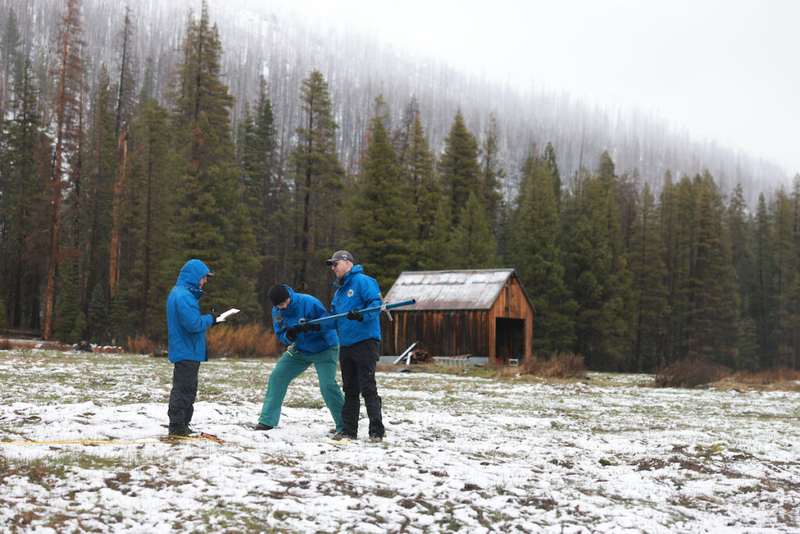
The California Department of Water Resources found no measurable snow at the Phillips Station in the Sierra Nevada east of Lake Tahoe on April 1, 2026. (California Department of Water Resources photo)
March heat has left critical snowpack at record-low levels across Northern Nevada, leaving water managers the difficult task of managing a fraction of the water provided in previous years.
Snowpack in Nevada and parts of the Eastern Sierra mountains is currently less than a quarter of what’s typically seen for this time of year, breaking new record lows in several basins.
In Nevada, the last three months have been the warmest on record, according to the National Oceanic and Atmospheric Administration.
Rapid snow melt followed a record breaking March ‘heat dome’ that caused temperatures to rise up to about 25 degrees F above normal across Reno, Elko, and Las Vegas, according to the National Weather Service. That heat decimated Nevada’s remaining snowpack, leaving only two snow measuring stations outside the Sierra with any snow to measure by early April.
Mountain snowpack in the Humboldt basin, a major source of water for agriculture in Nevada’s rural northeastern, has completely melted six weeks earlier than the previous record, according to the National Weather Service (NWS) Reno office.
Historically, April 1 is considered to be near the peak of the snow accumulation season, but poor snowfall and rapid melting means snowpack in Nevada reached its peak back in February this year, and has only shrunk ever since.
“This year, we’ve been way ahead of schedule. This year peaked around February 20 for most basins,” said Tim Bardsley, the senior service hydrologist at the NWS Reno office.
Water managers and climate experts had been hopeful for a March miracle – a strong cold storm that could set the region back on track – but a blistering heatwave dashed any chance of hitting average snowpack.
Though there’s still potential for more snow in the forecast, experts said it won’t be enough to cover deficits.
“You may add a little bit of snow in the mountains this week, but it’s definitely not enough to make a big difference in our water supply and snowfall condition,” Bardsley said.
It’s not just the amount of snow left on mountaintops that’s concerning water managers, but the amount of moisture still frozen within them. In Nevada the “snow water equivalent,” a measurement of water held in the snowpack, is exceptionally low.
Across Northern Nevada snow monitoring stations recorded the least snow water on record for March, based on snow pillow data back to 1981.
Scientists at the Central Sierra Snow Lab, on Donner Summit, measured “extremely low” snow density in parts of the Sierra Nevada, at times equaling 23 inches of snow per 1 inch of snow water or 4.3% density.
Water managers at the Truckee Meadow Water Authority, which serves Washoe County, said the snow water equivalent in the Truckee River basin is at its second lowest level dating back to 1986. As of early April, snow water in the basin is less than a quarter of what’s typically seen for the time of year.
“It is a very low snowpack year for this time of year, and that is due to the low snowfall and warm conditions throughout the winter, including the past several weeks, where we experienced record breaking heat,” said Kara Steeland, the senior hydrologist and watershed coordinator for Truckee Meadows Water Authority, during a press call.
Extreme variability is not unusual for Nevada, which has given water managers in the state the tools to navigate this year’s record breaking snow drought, said Steeland.
Despite unusual conditions this winter, Truckee Meadow Water Authority officials said they expect normal operations through the 2026 water year and do not expect to dip into water from their drought storage reserves this year. That’s largely thanks to previous wet years that have allowed reservoirs along the Truckee River to reach 85% of their full capacity.
“We’re extremely fortunate in this watershed to have that reservoir system. It allows us to deal with the variability we see in snowpack,” Steelend said. “Thanks to our upstream reservoirs, we are actually in good shape from a water supply perspective.
Bardsley, the senior service hydrologist at the NWS Reno office, said the early snowmelt across the West is more likely to impact agriculture and areas with limited reservoir infrastructure, like the Humboldt River basin.
“The early melt means a large gap between elevated streamflows and water demand. That’s especially critical for systems with limited groundwater or reservoir access,” Bardsley said.
The Rye Patch Reservoir, which primarily supplies irrigation water for agricultural land in the lower Humboldt River’s Lovelock Valley, is at about 10% capacity compared to 60% last year. Rapid snowmelt and low storage levels in the Humbolt River basin reservoirs will likely make drier summer months more difficult to navigate.
“The snowpack in our area is our biggest natural reservoir, and this year we’ve already seen most of that water be released well in advance of the summer demands,” he continued.
The prolonged snow free season could also lead to a more severe fire season and impact recreation and ecosystems, said Bardsley.
One of the few bright spots for the state is robust rainfall that has increased soil moisture, which will help more snowmelt reach streams and reservoirs. Warmer winter temperatures prevented snowpack from forming, not the lack of rainfall.
In the Tahoe, Truckee, Carson and Walker basins rainfall reached above median percentages, which helped soil moisture hit at or above record high level for this time of year. The Northern Great Basin, Lower Humboldt and Eastern Nevada also experienced near or above normal precipitation.
As of early April, only Elko County experienced extreme drought conditions, which were limited to the Nevada-Idaho border. About three-fourths of the state was experiencing abnormally dry or moderate drought conditions, according to the U.S. Drought Monitor.
Las Vegas, NV