Wind, dry conditions drive growth of Qury Fire near Custer
Mar 13, 2026 | 5:40 pm ET
Description
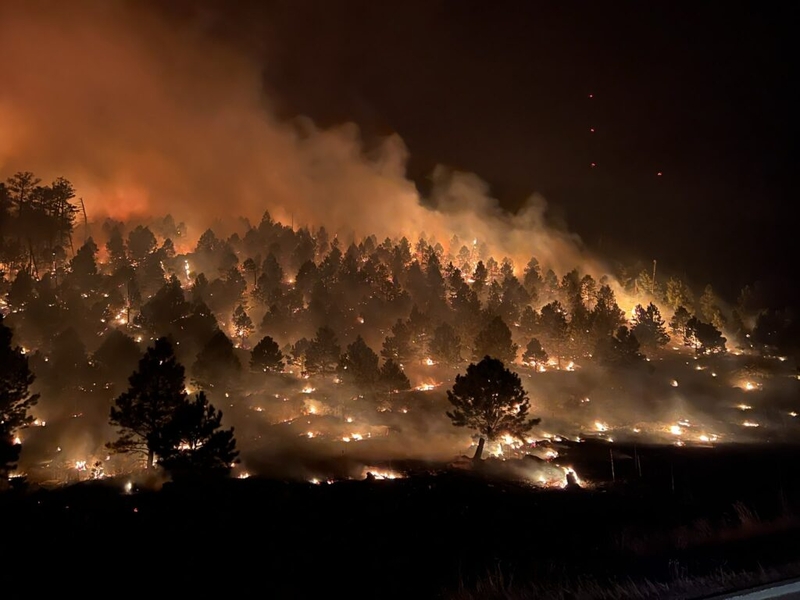
The Qury Fire near Custer, South Dakota, pictured on March 12, 2026. (Courtesy of Qury Fire information page)
A wildfire a few miles southeast of Custer in South Dakota’s Black Hills grew to nearly 8 square miles in size between its ignition on Thursday and Friday morning, officials said early Friday afternoon.
The Qury Fire spread east, away from the city, and “made a significant run of a few miles” on Thursday due to strong winds, said Todd Hoover of the U.S. Forest Service, the fire’s incident commander.
Federal, state and local officials are all part of the response team for the fire, Hoover said, which ignited just after 1 p.m. Thursday.
As of Friday afternoon, there were 20-25 fire engines, two crews of firefighters and four bulldozers working to manage the blaze with support from National Guard air operations. The fire was not contained, Hoover said, but the strong winds that drove its rapid spread had died down.
New law limiting utilities’ liability approved as wildfires break out in Black Hills
The crews have been focused on “trying to save buildings” thus far, he said. Work to preserve homes is ongoing, but “we’re starting to actively move into trying to get some sort of containment at this time.”
“It is a large fire,” he said. “It is going to take some time.”
Custer County Emergency Management Director Steve Esser urged residents to heed road closures, including on Highway 87 through Custer State Park.
“These are hard closures,” Esser said. “They’re not to be traveled upon by the public.”
The Custer County Commission was set to enact a countywide burn ban at a special meeting Friday afternoon.
The latest information on road closures and area evacuations is available through the Custer County Emergency Operations Center at (605) 673-8155.
Updates are also being posted to a Facebook page created for the fire, and the federal InciWeb fire incident map now has a page for Qury Fire information.
The cause of the Qury Fire is under investigation.
The fire ignited on the same day Republican Gov. Larry Rhoden signed a bill into law that will limit wildfire liability for utilities. The law removes “strict liability,” meaning liability for damages regardless of a utility’s actions surrounding a fire, as an option for plaintiffs who wish to sue over wildfire-related damages.
Once the law takes effect July 1, people who sue will only be able to recover damages from utilities that either fail to file fire mitigation plans with state or local authorities and follow them, or act with criminal intent or exhibit “willful and wanton” misconduct. No claims will be valid four years after a fire, and plaintiffs will be limited in the types of damages they can recover. Utilities would need to identify higher-risk areas, establish inspection and operating standards, implement vegetation management strategies, and coordinate with the appropriate wildfire agencies as part of their mitigation plans.
Black Hills Energy, which services the area around the Qury Fire, initiated a Public Safety Power Shutoff for about 560 customers in eastern Hot Springs and other areas of the southern Black Hills on Thursday afternoon to prevent any new fires sparking from downed power lines. By shortly after 7 p.m. Thursday those customers had power again, according to the utility’s website.
The utility “will continue to monitor conditions to help keep our customers and communities safe,” its website said on Friday afternoon.
Fire danger is higher than usual. On March 4, KOTA-TV reported that Rapid City experienced its warmest winter on record since the 1800s, at an average daily temperature of 37.4 degrees, 2 degrees warmer than the previous record in 1930. The city also got around half the average amount of winter precipitation.

Pierre, SD