Abortion-rights group agrees to stop ads at South Dakota gas stations and settle litigation
Mar 09, 2026 | 4:10 pm ET
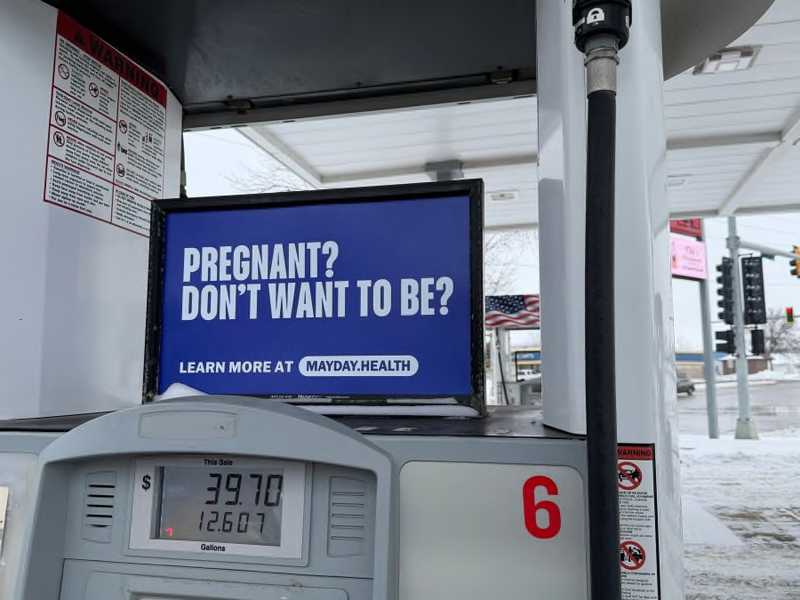
Description
Mayday Health posted signs like this one at gas stations around South Dakota in December 2025 as part of a campaign to spread awareness about the availability of abortion pills. (Courtesy of Mayday Health)
A monthslong dispute over abortion-rights advertising is settled, after a New York nonprofit agreed to remove its ads and end its campaign at gas stations in South Dakota.
The group, Mayday Health, began placing signage above gas station pumps across the state in December with links to information about abortion and birth control options, with the tagline “Pregnant? Don’t want to be?”
The nonprofit educates people about the safety and effectiveness of abortion pills. After it began its ad campaign in early December, Republican South Dakota Attorney General Marty Jackley sent the group a cease-and-desist letter and asked a state judge to stop the campaign.
Listen to an audio version of this story by reporter Meghan O’Brien. For broadcasters: See below for a downloadable version.
South Dakota lawmakers adopted an abortion trigger ban in 2005 that took effect in 2022, after the U.S. Supreme Court overturned Roe v. Wade. Abortions are prohibited in the state, unless the mother’s life is threatened by a pregnancy.
Abortion pills are not legal in South Dakota, said Jackley, who accused Mayday Health of spreading the opposite message. He announced a settlement Monday ending litigation between the state and nonprofit.
“Mayday Health targeted women and young girls encouraging them to take abortion pills while misleading them about the physical risks,” Jackley said in a press release. “My position has been clear and unwavering, South Dakota law governs, and the misleading advertisements must be, and are, stopped.”
The federal Food and Drug Administration has approved the drug mifepristone to terminate pregnancy, when used with misoprostol, finding the pills to be safe and up to 99% effective. In 2023, the FDA allowed mifepristone prescriptions without an in-person doctor visit. The state of Louisiana is challenging that policy in court.
Mayday Health initially refused to comply with Jackley’s cease-and-desist letter, citing First Amendment free speech protections. The group filed a federal lawsuit in January, also on the grounds of free speech, to prevent Jackley from taking legal action against the campaign.
A federal judge declined to intervene and said she could not interfere with the concurrent action at the state level in South Dakota, where Jackley filed a lawsuit seeking to stop Mayday’s ads. A state judge had set a court date for July.
Federal judge declines to intervene in South Dakota attorney general’s fight against abortion ads
Jackley and Mayday agreed both cases are now resolved, following Monday’s settlement announcement.
Mayday Health sent a statement to South Dakota Searchlight: “This is why you fight. South Dakota tried to intimidate Mayday. We sued the Attorney General. A federal judge agreed our speech is constitutionally protected. And now the AG is dropping all charges. We’ll continue exercising our First Amendment right, telling Americans in all 50 states that they can still access abortion pills. That includes South Dakota.”
The federal judge said during a hearing on the federal litigation that she believes “the proper way to view Mayday’s website and the materials on it” is as “noncommercial speech subject to protection under the First Amendment.” She ultimately did not issue the court order Mayday sought to prevent Jackley’s action against the group, citing lack of jurisdiction.
The reference in Mayday’s statement to “charges” was apparently a reference to Jackley’s lawsuit in state court. He did not file criminal charges. Although Mayday said it plans to continue its messaging in all 50 states, its settlement with South Dakota says Mayday will remove its gas station placards and terminate its campaign to place additional placards in South Dakota.
Legislation against medication abortions
While the state has been in court against Mayday, South Dakota’s Republican-dominated Legislature has been debating legislation that would make it a felony crime to dispense, distribute, sell or advertise abortion pills and any other “article or thing” intended for producing an abortion, or that leads another person to use or apply it for producing an abortion. The bill would also alter language in the state’s existing abortion ban, changing language criminalizing the administering, prescribing or procuring of an abortion for any “pregnant female” to any “person.”
The bill would additionally empower the state’s attorney general to impose civil penalties of up to $10,000 for each violation, and to seek preventative court orders if the attorney general “has reason to believe that a person is engaging in, has engaged in, or is about to engage in a violation.”
The bill passed the state House of Representatives last month, and the state Senate approved it 31-2 on Monday. The bill will now go back to the House for consideration of an amendment made in a Senate committee.
In 2023, medication abortions accounted for 63% of clinician-provided abortions in states without total abortion bans, according to the Guttmacher Institute. Mifepristone and misoprostol are also listed on the World Health Organizations’ list of essential medicines. In 2024, the U.S. Supreme Court rejected an attempt by anti-abortion medical organizations to overturn the Food and Drug Administration’s prescribing guidelines for mifepristone.
For broadcasters
The settlement agreement in litigation between the state of South Dakota and Mayday Health.
- 5:32 pmThis story has been updated with the result of state Senate action on abortion legislation.

Pierre, SD