SC advocates call for more money and legislation to help survivors of abuse
Mar 06, 2026 | 9:00 am ET
Description
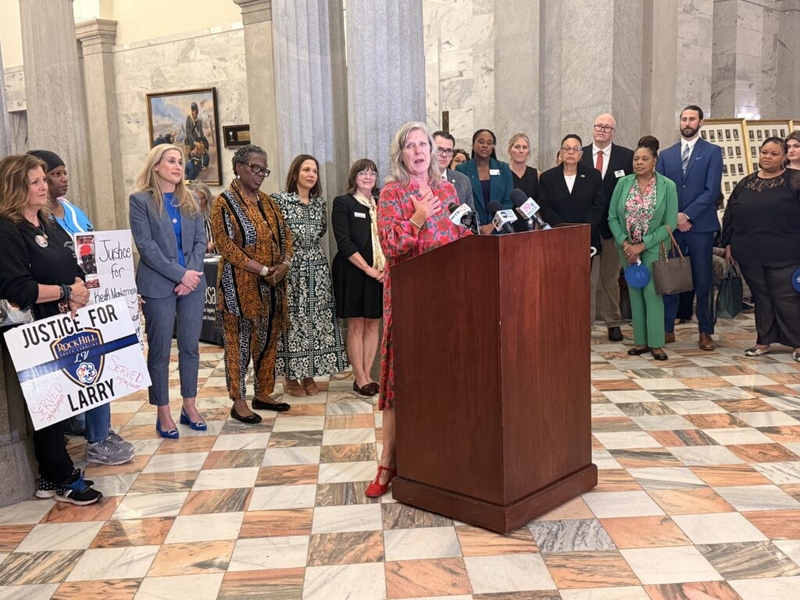
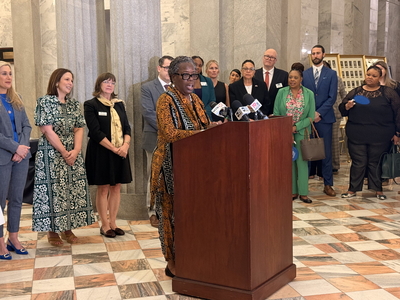
Survivor Evelyn Mitchell of Greenville talks at a news conference in the Statehouse in Columbia, South Carolina on Thursday, March 5, 2026, about how her ordeal led to a 2020 state law. (Photo by Adrian Ashford/SC Daily Gazette)
COLUMBIA — Advocates for survivors of sexual violence called on legislators Thursday to double annual funding for rape crisis centers and pass legislation to better protect victims.
“Victim organizations are already stretched to capacity and beyond,” said Sarah Ford, program director for the South Carolina Victim Assistance Network. “We cannot say that we value victims and then underfund the very services that keep them safe.”
Advocates are seeking $3 million for those centers in the 2026-2027 state budget. That’s double what’s been provided through the Department of Public Health for the last several years.
Rape crisis centers provide survivors support including counseling, emergency hotlines, transportation to a hospital or shelter, and legal advice.
In 2024, more than 3,500 new survivors of sexual assault sought help from one of those centers in the state. Only 12% of them said they’d reported the incident to law enforcement, according to the latest report from the South Carolina Coalition Against Domestic Violence and Sexual Assault.
Only one in three victims nationwide report their sexual assault to law enforcement, according to the Rape, Abuse & Incest National Network.
Domestic violence victims in SC can wait weeks for legal protections
Legislation
The coalition also advocated Thursday for two bills that would expand how the state defines domestic violence and abuse.
One of them, sponsored by Sen. Tameika Isaac Devine, D-Columbia, would update who qualifies for court protection orders. Existing law defines “household member” as a spouse, former spouse, people who have a child together, or heterosexual couples who are or were living together.
Devine’s bill would expand the definition to include people who are or were dating. It would also delete the reference to “male and female” to include people of any gender living together.
The coalition’s report showed that violence happens more often in dating relationships than marriages.
According to the coalition’s report, 59 people were killed by their partner in 2024: 45% involved boyfriend-girlfriend relationships and 34% of the victims were killed by a spouse.
“The dynamics of intimate partner violence remain the same in a dating relationship,” Sara Barber, the coalition’s director, said after the news conference.
Most states already include dating relationships in their domestic violence laws. Legislation to add that in South Carolina has repeatedly failed since at least 2019, when it was part of recommendations from a task force formed by then-Gov. Nikki Haley to address the state’s status as one of the nation’s worst in domestic violence. The senator formerly leading the effort was Republican Katrina Shealy of Lexington, before she lost her bid for re-election in 2024.
Senators advanced Devine’s bill to the floor a year ago, and a Republican and three other Democrats signed on as co-sponsors last May. But it’s yet to get a floor vote. And a bipartisan companion bill in the House has gone nowhere.
The legal definition matters because it allows victims to seek a court order of protection, Barber explained.
By law, the alleged abuser is banned from communicating with the protected person in any way, to include attempting to enter the home, workplace, school, or any other location specified in the order. The order can also award temporary custody of children and pets, require financial support, and block the sale of property. Violators can be sent to jail.
And if a judge believes someone seeking the court’s protection is in fear of “imminent peril,” the order can bar the alleged abuser from having a gun or ammunition. The ban applies for the duration of the order, which can last six months to a year.
The gun piece is what’s held up the bill, Barber said.
Gun rights enthusiasts contend allegations that might be part of a messy break-up shouldn’t strip someone of their Second Amendment rights.
Advocates are working on an amendment to remove the possibility of court-ordered protection taking away someone’s guns in dating situations.
The other bill they’re backing, sponsored by Sen. Stephen Goldfinch, would go further.
In addition to adding dating relationships to the definition of “household member,” his bill would expand what’s domestic abuse to include “coercive control.” The proposal would make it illegal to emotionally and mentally abuse a partner and strip the victim of free will. A pattern of abuse could include isolating the victim from friends and family, constant degrading, monitoring a partner’s every activity and depriving the person of basic needs.
Goldfinch, R-Murrells Inlet, pre-filed the bill in December. It’s yet to get a hearing.
Her ordeal helped change SC law. Now she wants to ensure rape kits are used to convict.
Tracking rape kits
Evelyn Mitchell of Greenville shared Thursday how her horrific experience eventually led to a 2020 state law on rape kits.
In 1980, she and a friend were abducted in Louisville, Kentucky, and brutally raped and beaten. After the police found them, they took sexual assault exams.
“I vividly remember the extensive, cold, and scary exam they performed to take evidence from my body,” said Mitchell, now 66. “But I endured it, because I thought it would be the key to catching my attackers one day.”
But in 2018, an officer called her to inform her the evidence had been destroyed decades earlier, only two years after her attack.
She helped push for a bill by Rep. Gilda Cobb-Hunter, D-Orangeburg, and signed into law in 2020 that mandated the creation of a statewide tracking system for rape kits.
The law directed the State Law Enforcement Division to create and operate that tracking system. It was supposed to be operational by June 2022. But the system didn’t go live in all regions of the state until February 2024, according to a 2024 Legislative Audit Council review.
According to the audit, it took about a year and a half, on average, for a rape kit to be picked up from a medical facility, transported to a lab to be tested, and analyzed.
The system is meant to allow victims, law enforcement, and prosecutors to track the evidence, Mitchell said.
“Accountability is so important to survivors,” she said. “The system isn’t perfect, but thankfully, there is now an oversight process in place.”

Columbia