Even if they could get it passed, Democrats might not get what they want from redistricting
Feb 20, 2026 | 6:31 pm ET
Description
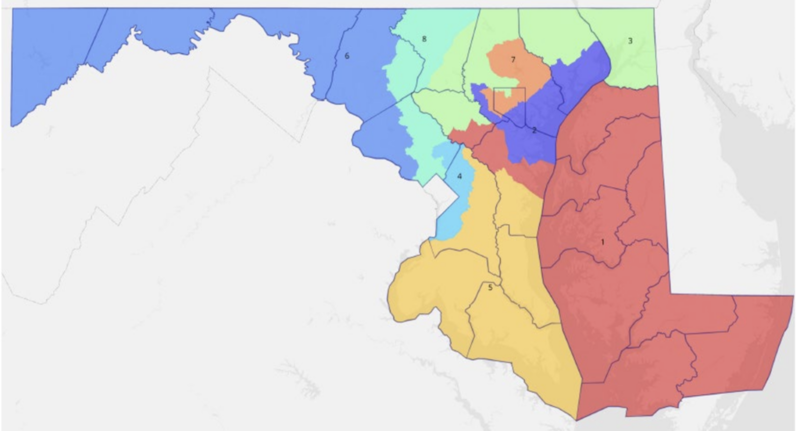
The concept map forwarded by the Governor's Redistricting Advisory Commission, that would move more Democrats into the Eastern Shore's 1st District, currently the only one in Maryland held by a Republican. But that could make other Democratic districts susceptible to GOP win, particularly the 3rd District. (screen shot)
U.S. House Minority Leader Hakeem Jeffries (D-N.Y.) visited Annapolis on Wednesday and personally urged Maryland Senate President Bill Ferguson (D-Baltimore City) to allow the Senate Rules Committee to consider House Bill 488, the emergency bill that redraws the state’s eight congressional districts for the 2026 elections.
Jeffries aims to eliminate Maryland’s only Republican-held district, currently represented by Rep. Andy Harris, who has held the 1st District seat in Congress since 2011.
However, Jeffries and his office staff might be unaware of the analysis by one witness who shared his findings with the Maryland House Rules and Executive Nominations Committee on Jan. 27.
“I understand the national implications as well. If we move forward with a new map, it should be a decisive 8-0. The map in HB 488 is not,” Steve Shapiro testified. “Dave’s Redistricting App shows that District 3 would lean Republican by 1.47%, based on voting history. There’s no point in enacting a new map now that would create a Republican or toss-up district.”
After watching the hearing on YouTube, I assessed whether the newly drawn 3rd District might favor Republicans. Shapiro is right!
“Map maker” David Kunes, a native of Montgomery County, might not realize that his new 3rd District could be the most solid Republican district, even surpassing the traditional Republican strongholds, the 1st and 6th.
Your opinion matters
Maryland Matters welcomes guest commentary submissions at [email protected].
We suggest a 750-word limit and reserve the right to edit or reject submissions. We do not accept columns that are endorsements of candidates, and no longer accept submissions from public officials or political candidates.
Opinion pieces must be signed by at least one individual using their real name. We do not accept columns signed by an organization. Commentary writers must include a short bio and a photo for their bylines.
Views of writers are their own.
Based on his data, the new 3rd District would be 49.02% Republican, 47.55% Democratic, and 3.43% other. Compared to the current 3rd District, the new 1st District will have 45.69% Republican, 51.28% Democratic, and 3.03% other, while the new 6th District will have 45.33% Republican, 51.66% Democratic, and 3.01% other. Additionally, the new 3rd District will have the largest share of white residents at 69.66%.
We don’t understand why Kunes assigned the number “3” to the northeastern corner of Maryland, which now includes the 1st and 2nd Districts.
If HB 488 should somehow land on Gov. Wes Moore’s desk and he signs it into law, the new 3rd District will have 13 Republican delegates and 12 Democratic delegates in the Maryland House, along with six Republican senators and five Democratic senators.
According to the U.S. Department of Agriculture’s 2022 ranking of congressional districts by farms, Maryland’s 1st District ranked 139th out of 435 districts in the U.S., with 4,621 farms. It was followed by the 6th District (ranked 166th) with 3,525 farms; the 5th District (ranked 224th) with 1,994 farms; the 2nd District (238th) with 1,553 farms; the 3rd District (289th) with 528 farms; the 8th District (326th) with 224 farms; the 4th District (365th) with 78 farms; and the 7th District (398th) with 27 farms.
Since the new 3rd District includes parts of the current 1st and 2nd districts, it could replace the current 5th District as the third-largest agricultural district.
Currently, Maryland has 54 Future Farmers of America (FFA) chapters. (FFA is an intracurricular student organization for students interested in agriculture.)
Under the proposed map, the district with the most FFA chapters would be the new 6th District, which would contain 19 chapters, down from 32 in the 2002 map. The second would be the new 1st District with 10 chapters, unchanged since 2002.
Surprisingly, the new 3rd District would tie with the new 8th District for the third-largest number. Both would have eight chapters each, a rise of seven chapters from one on the 2002 map.
The new 2nd District could be the biggest loser, with no chapters under the proposed map and seven losses since 2002. (The current 2nd District includes Carroll County and the northern part of Harford County.)
The new 4th District will add a chapter, bringing its total to three. Both the new 5th District and the new 7th District would lose one chapter from the 2002 map, so the 5th will have five chapters while the 7th will have one.
This shift could stop the Democratic Party from winning all eight of Maryland’s congressional districts in the next election. That result depends on the regular farming voters living in the new 3rd District.
Alternatively, if the national Democratic Party’s platforms become less popular later this year, Maryland voters might elect three Republican candidates in the 1st, 3rd, and 6th Districts, resulting in a five Democrats-three Republicans split, rather than eight Democrats and zero Republicans.
Annapolis, MD