An attorney disbarred for seeking nude pics from a client proves State Bar corruption: GOP senators
Jan 15, 2026 | 3:23 pm ET
Description
Photo via Getty Images
Republican state lawmakers are again going after the State Bar of Arizona, even though they seem to have a fundamental misunderstanding of how the organization works.
Their prime examples for why the State Bar should be stripped of its role in policing attorneys were a California man who was disbarred in the Grand Canyon State for soliciting nude photos from a potential client and an attorney whose law license was suspended for making unfounded claims about superior court judges.
The State Bar of Arizona, which is responsible for licensing attorneys in the state and is overseen by the Arizona Supreme Court, has for decades been a target for Republican legislators. In recent years, GOP criticism of the organization has centered on discipline doled out to lawyers who defended election-challenge lawsuits in 2020 and 2022 that the courts found to be frivolous and brought in bad faith.
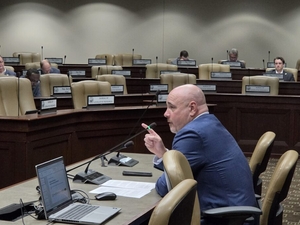
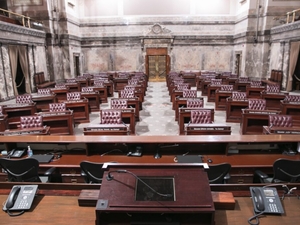
Republican Sens. Wendy Rogers and Mark Finchem invited the lawyers with grievances against the State Bar to testify in front of the Arizona Senate Judiciary and Elections Committee during a hearing on Wednesday. Finchem has a particular grudge against the State Bar after the attorney who represented him when he challenged his loss in the 2022 race for secretary of state was sanctioned and forced to retire for a year for bringing a case with “no legal merit.”
During the committee hearing, Rogers, a Republican from Flagstaff who chairs the committee, read portions of an affidavit submitted by Jeffrey Moffatt, who was disbarred by the Arizona Supreme Court in 2016 after he repeatedly asked a potential client for nude photos in exchange for legal services. Moffatt claimed he was denied due process in the proceedings.
Rogers and Finchem, who hails from Prescott, traveled to California in October to attempt to testify on Moffatt’s behalf in a federal criminal case stemming from his disbarment. Moffatt was indicted by a California grand jury in 2021 for failing to disclose to the Social Security Administration or his clients that he had been disbarred in Arizona while he continued to represent elderly and disabled clients in Social Security benefits cases in California and other states.
Finchem claimed that Moffatt was found guilty of only one of five counts against him for “checking a box” on a Social Security Administration code of conduct form, but by checking that box Moffatt falsely claimed that he had not been disbarred.
When Sen. Analise Ortiz, a Phoenix Democrat, asked Rogers if Moffatt was the same man who was disbarred for soliciting the nude photo, Rogers said she didn’t know. She then accused Ortiz of sullying Moffatt’s character.
“This is about not whatever that is, it’s not germane. What’s germane is why he was disbarred,” Rogers said.
The initial complaint against Moffatt that resulted in his disbarment was filed by the woman from whom he solicited the nude photo, and he was disbarred for that, as well as his efforts to delay the disciplinary case against him.
A disciplinary panel found that Moffatt missed hearings that he had requested and was required to attend and “filed numerous motions that contained nonsensical or unsupported allegations, including one motion in which he alleged that an attorney not involved in the discipline proceedings actually represented the State Bar in the discipline proceedings.”
Another attorney who aired his grievances during the hearing, Vladimir Gagic, of Phoenix, claimed that he was in the process of being disbarred for inflammatory comments he made on the social media site X. On his profile on that site, Gagic equates Republican Maricopa County Attorney Rachel Mitchell with the antichrist.
“The Bar will subvert the truth just for cronyism,” he said during the hearing.
Gagic went on to accuse a judge of holding a grudge against him because Gagic allegedly found out the judge spent time during his workday at a strip club.
According to the State Bar of Arizona, Gagic was not disbarred, but his law license was suspended for a year and he has not taken the necessary action to reinstate it.
Gagic also claimed that he had texted with the late former Arizona Attorney General Mark Brnovich about his own negative experiences with the State Bar and read some of the messages out loud. Brnovich entered into a diversion agreement with the State Bar in 2022 to resolve two ethics complaints against him, one regarding alleged mishandling of 2020 election fraud cases.
Gagic said he agreed with a speculation posted to social media by right-wing blogger Rachel Alexander that stress from Brnovich’s experiences with the State Bar likely contributed to his death earlier this week at age 59.
Finchem railed against the State Bar of Arizona, calling it a “quasi authoritative group” and claimed that the organization applied discipline to lawyers arbitrarily.
He speculated that the organization could have a “100% conviction rate” for complaints against attorneys and claimed that there is no screening process for weeding out frivolous complaints, resulting in every complaint submitted immediately launching an investigation.
Representatives from the State Bar of Arizona told the Arizona Mirror on Wednesday evening that none of Finchem’s allegations are true.
The State Bar employs five lawyers who are tasked with evaluating complaints against attorneys, and 78% of those are closed without an investigation, according to an annual report from the Attorney Regulation Advisory Committee. In 2024, the organization received nearly 3,000 complaints, and only around 500 — pertaining to about 300 attorneys — proceeded to an investigation.
Most of those were dismissed or ended with diversion agreements requiring attorneys to take classes about educating them about issues surrounding the complaint.
Of those roughly 500 complaints that were investigated in 2024, the Arizona Supreme Court issued 29 reprimands, and 28 law license suspensions. Only nine lawyers were disbarred that year, out of 26,000 licensed in Arizona.
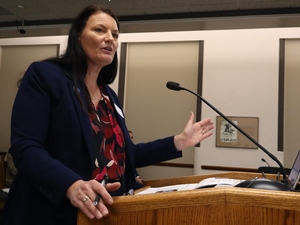
Maret Vessella, chief counsel for the State Bar of Arizona told the Mirror that there is a lot of misinformation about the attorney discipline process.
“We don’t have authority to discipline lawyers,” she said.
The State Bar receives the complaints, screens and investigates them, and then sends recommendations for diversion or discipline to the Arizona Supreme Court’s Attorney Discipline Probable Cause Committee, which operates independently from the bar.
Decisions on attorney suspension or disbarment — and review of diversion agreements — are made by a panel that consists of a Presiding Disciplinary Judge, a volunteer attorney and a volunteer non-attorney member of the public. All decisions made by that panel are directly appealable to the Arizona Supreme Court, which is required to take those appeals.
“There are so many checkpoints in the process,” Amy Rehm, deputy chief Bar counsel, told the Mirror. “Almost nothing the State Bar does on its own without oversight. Virtually everything we do is reviewed by someone else.”
Vessella said she was uncertain whether the senators truly lack understanding of how the discipline process works or if their statements serve some other purpose.
All of the organization’s processes and rules are laid out on its website and its staff are happy to educate anyone about how it works, she said.
“There is no rampant corruption or cronyism or bias or anything like that. We call cases like we see them,” Rehm said.
So far this year, Finchem has introduced two bills pertaining to the State Bar. Senate Bill 1148 would remove responsibility for licensing and investigating attorney complaints from the organization and return that duty directly to the state’s high court and his Senate Bill 1039 would require the State Bar to reimburse attorneys who prevail in disciplinary hearings for loss of income during the investigation.
Finchem claimed during the Judiciary Committee hearing that attorneys are barred from practicing law while they’re being investigated, but that’s true only in rare cases.
Committee members voted 4-2 along party lines to approve SB1039 to be considered by the full Arizona Senate.
“The Bar exists not to punish attorneys but to protect the public,” Ortiz said before voting against the bill.
***CORRECTION: A comment originally attributed to Amy Rehm was actually said by Maret Vessella.
Phoenix, AZ