US Education secretary promotes returning school autonomy to states
Jan 12, 2026 | 6:20 pm ET
Description
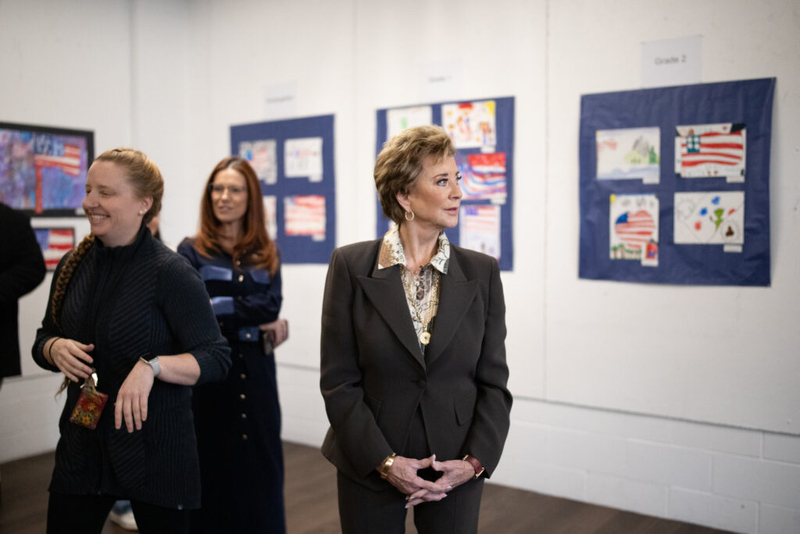
U.S. Education Secretary Linda McMahon takes in a selection of grade school students' patriotic artworks and high schoolers' recent output in a special installation set up at Exeter-West Greenwich Regional Junior High and High School on Monday, Jan. 12, 2026. (Photo by Alexander Castro/Rhode Island Current)
In a Monday morning high school art class in West Greenwich, a security detail stood next to a table adorned with rows of metallic-tubed paints in varying states of fullness, and kept close watch over U.S. Secretary of Education Linda McMahon as she maneuvered from student to student and asked what they were working on.
“So you’re the only guy around here?” McMahon asked senior Jacob Tefft, the only male student in the six-student class, when she arrived at his seat.
McMahon’s Monday morning appearance at Exeter-West Greenwich Regional Junior High and High School comprised the Rhode Island leg of her Returning Education to the States Tour, which began in August 2025 and, with the conclusion of Monday’s tour, has so far come to 26 states.
The tour, according to the U.S. Department of Education’s boilerplate copy, comprises a mission assigned to McMahon by President Donald Trump to “lead on one of his most momentous promises to families — returning education to the states and equipping all parents to choose an excellent education for their children.”
It is also meant to emphasize what public education funding and regulation might look like once transformed by President Donald Trump’s administration. The Education Department has framed the tour as an attempt to gather best practices from schools nationwide as it attempts to redefine what public education could look like with a shrunken, or at least changed, federal role.
While Trump has previously and loudly proclaimed his intent to cast the Education Department into oblivion, McMahon told reporters during a scrum at the end of roughly two-and-a-half-hour visit that the availability of federal funding, not the name of its source, is educators’ core concern.
“What they want reassurance of is that there is going to continue to be oversight, there’s going to be accountability,” McMahon said. The end of her department, she argued, would not dispel longstanding federal obligations to schools.
“Before there was a Department of Education, this funding — the Title I funding — still came through,” McMahon said. “IDEA funding still came through. The laws have not changed and the accountabilities have not changed for these laws, regardless of who is having the oversight and looking at this.”
McMahon’s visit to West Greenwich was the first tour stop since her Jan. 7 trek to Iowa, where the U.S. Department of Education approved what it described as the first “Returning Education to the States” waiver — a move federal and Iowan officials suggest can be a model for how states can have more flexibility and control over federal education dollars.
The waiver allows Iowa’s education agency to consolidate four federal funding sources into a single, state-level pot and, in the Education Department’s estimate, could lead to “nearly $8 million to be redirected from bureaucratic red tape to the classroom over four years.”
The grant approved by the Education Department is more selective than Iowa’s original proposal, which wanted to consolidate 10 programs.
“The goal…with returning education to the states,” McMahon said Monday, “is more autonomy at the state level.”
How would these block grants help further the Trump administration’ s goal of autonomy?
McMahon told reporters that the grants, by allowing for less stringent regulations over where grant monies go, give states “more flexibility in the spending.” Her department first invited education departments nationwide to submit waivers in July 2025.
The waivers are meant to, in the department’s words, relieve state education agencies of “burdensome statutory and regulatory provisions by using the authority outlined in the Elementary and Secondary Education Act.”
Critics of the Trump administration’s block grant plan argue the intended flexibility could still lead to money being pooled toward some purposes over others, leaving some programs like multilingual education or after-school programs underfunded. Congressional Democrats have urged McMahon to reject block grant requests, saying such a funding plan would fail “the very students these provisions aim to support.”
Since Iowa’s successful waiver, however, more governors are expressing interest, McMahon claimed. “They’re lining up relatively quickly now,” she said.
Rhode Island Education Commissioner Angélica Infante-Green, who attended Monday’s classroom tour and the subsequent roundtable discussion with the secretary, does not consider Rhode Island among the states queuing up.
“I think that we are looking at what is best for Rhode Island,” Infante-Green told reporters, saying of the waivers, “And right now, that doesn’t seem to be the best way to go.”
But, the commissioner added, “We will work with whoever we need to work with and to ensure that our state has what it needs and that our students get everything that they’re entitled to.”
Friendly territory
McMahon’s Rhode Island appearance was less shrouded in obscurity than the August 2025 visit of fellow cabinet member and U.S. Secretary of Labor Lori Chavez DeRemer to a Cranston fire station. Chavez DeRemer’s visit played out in an almost clandestine fashion, with the labor secretary never meeting reporters’ gazes except through the darkened glass of a garage door window.
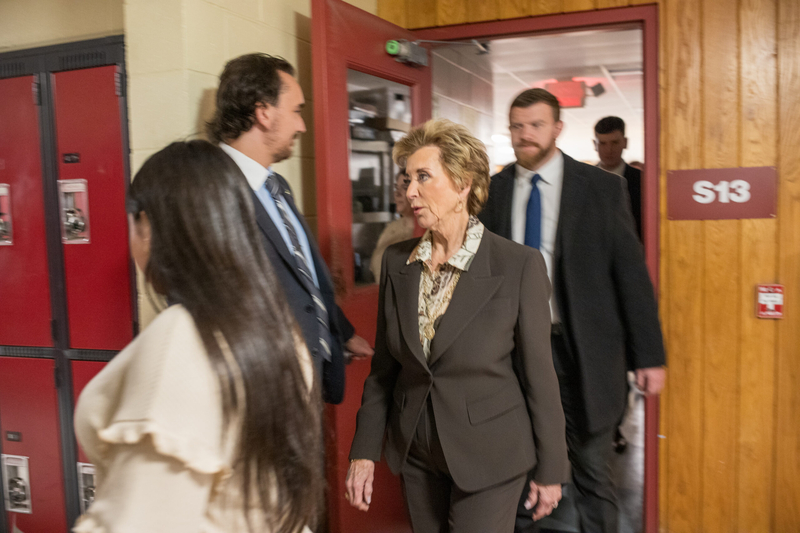
McMahon’s team, meanwhile, let a small band of reporters tag along with the secretary and her posse of security, staff and government photographers as she toured four classrooms and spoke with students and teachers.
Reporters were also permitted to sit in during the opening remarks of McMahon’s roundtable discussion — which included local leaders, school administrators and educators, a few students, and Infante-Green. Then the press was ushered out and brought back to the holding space in the school’s auditorium, where McMahon appeared about 45 minutes later to field questions. One reporter asked if West Greenwich was chosen because of the town’s conservative voting record, arguing that many of McMahon’s pit stops have been in conservative areas.
“I don’t think that it was because it’s particularly conservative,” she replied. “There’s a lot of CTE [career and technical education] concentration, and we are talking a great deal in this administration about workforce development and how much we need it.”
“We have really a deficit in our workforce, and we just have to rethink education, as to how we want to do it,” McMahon continued.
West Greenwich is, in fact, a town where nearly 64% of West Greenwich voters opted for Trump in the 2024 election. Residents mostly elected Republicans to represent them in the Rhode Island General Assembly that same year and the five-seat Town Council is all Republican. (One seat on the Council is currently vacant due to former occupant Chas Calenda taking a job as the state’s interim U.S. Attorney in December.)
McMahon’s office confirmed in a separate email that Sue Cienki, a former East Greenwich School Committee and Town Councilor, suggested the school as McMahon’s tour stop.
Cienki said in a Monday night email that she “suggested a few different schools for Secretary McMahon to visit” after the secretary’s office had office reached out.
Asked about whether Iowa’s waiver is a route Rhode Island should emulate, Cienki said,“ I would have to look into the specifics of Iowa’s request before I could comment on whether RI should ask for a similar waiver.”
Make like a banana and split
McMahon praised career and technical education in her roundtable opening remarks, but she also saw a less technical and more expressive take on Exeter and West Greenwich’s curriculum in visits to two art classes, a science class, and a gallery of student artworks.
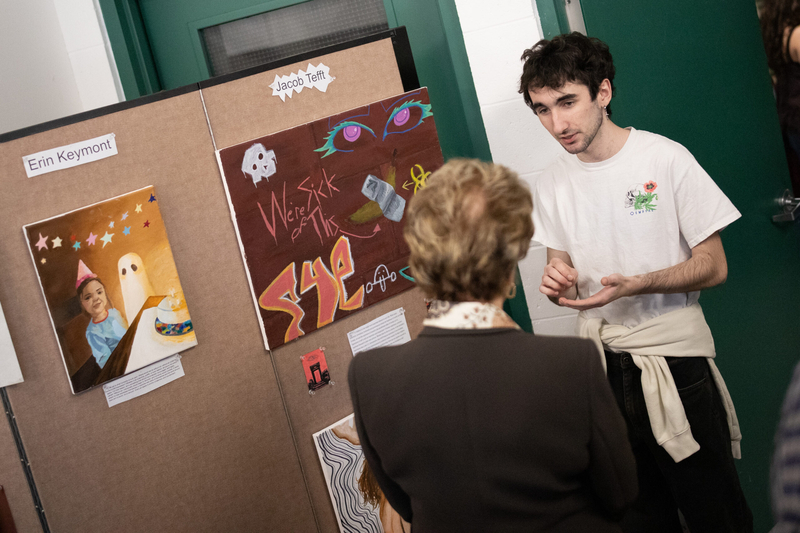
The gallery in a separate room on the school’s first floor is where McMahon received a brief lesson in contemporary art from senior student Tefft.
One of Tefft’s canvases parodied Maurizio Cattelan’s “Comedian,” a 2019 conceptual gag of sorts that, in consisting of nothing more than a banana duct-taped to a wall, became the target of ire for the same art world pretension it sought to mock.
“I was going to ask why there was a banana,” McMahon said.
Some of that banana’s iconoclasm, or at least refusal, might also be glimpsed in the underlying purposes of McMahon’s tour, which criticizes the very department she leads and aims to disband. Speaking to reporters, she cited a moment during her confirmation hearing.
“I said, ‘We spent all this money. We put all these programs in place. We’ve got all of this happening,’” McMahon recounted. “We’ve continued to fail our students.”
Infante-Green separately told reporters she still thinks the U.S. Department of Education is “necessary, and I will stand by that,” she said.
“But I also think that my job is to work with everyone that’s going to bring resources into our state and make sure that our kids and our state shines and continues to shine,” the commissioner added.
- January 13, 20261:28 pmUpdated to include a comment from Sue Cienki.
Providence, RI