Gov. Tim Walz’s Minnesota in 8 charts
Jan 07, 2026 | 7:00 am ET
Description
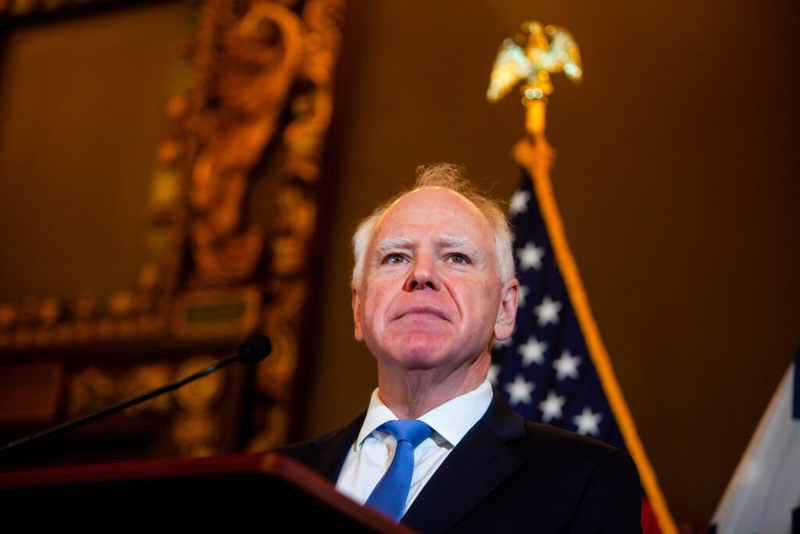
Gov. Tim Walz announces he will step down from the 2026 gubernatorial election Monday, Jan. 5, 2026 at the Minnesota State Capitol. (Photo by Nicole Neri/Minnesota Reformer)
Minnesota trailed the nation in economic growth during Gov. Tim Walz’s tenure, but Minnesotans continued to enjoy higher wages than most states, lower unemployment and a decrease in crime.
Walz announced the end of his campaign for a third term on Monday in the face of increasing pressure from his own party and attacks from Republicans over widespread fraud in state-run social services programs.
He said he takes accountability for the fraud that happened on his watch as well as the successes of his administration through the remarkable lows and highs of his tenure: the COVID-19 pandemic, the murder of George Floyd, Democrats winning control of state government and passing a sweeping progressive agenda, and the assassination of his friend and colleague Melissa Hortman.
“If the buck stops with me on when there’s problems, the buck stops with me on successes,” Walz said at a Tuesday news conference celebrating the rollout of the state’s paid family leave program.
Here are eight charts exploring how the state has been doing over the course of Walz’s tenure since 2019.
Minnesota’s economy grew slower than the nation’s, as measured by gross domestic product — the state’s output of goods and services. The U.S. economy grew around 16% since 2019, while Minnesota’s grew 10% in the same time frame.
The Minnesota Chamber of Commerce, which represents companies in Minnesota, published a report in November finding that job growth and income growth in the state is also not keeping pace with the nation’s.
Unemployment is creeping back up after a low in 2022 according to the September data from the Federal Reserve Bank of Minneapolis. Unemployment in Minnesota remains lower compared to the U.S. as a whole, but higher than some other states in the region.
In an August release, Minnesota Department of Employment and Economic Development Commissioner Matt Varilek said that employment trends might be the result of federal layoffs, funding freezes and tariff policies under the Trump administration, along with shrinking immigration.
Minnesotans still earn the highest average hourly wages in the Midwest. The average Minnesota worker earned $37.58 per hour in 2024, compared to $32.66 nationally, according to the Bureau of Labor Statistics.
Wages have generally matched or outpaced inflation over the past several decades. Although high inflation coming out of the pandemic eroded many workers’ buying power, wage growth has since caught up. Low-wage workers — particularly those in nursing homes and food service — benefited the most from a tight labor market, which has pushed wages up much more quickly than inflation in recent years.
Index crimes — a group of eight serious crimes that law enforcement agencies use to track crime over time — were lower in 2024 than at the start of Walz’s term in 2019, according to the most recent data from the Bureau of Criminal Apprehension.
The total crime rate in 2024 was at a multi-decade low, driven by a drop in property crimes. Meanwhile, homicide rates dropped from a COVID-era spike but still remained high.
Minnesota students’ performance on state-wide standardized tests have stagnated since the start of the COVID-19 pandemic closed schools in 2020. Proficiency rates in reading and math in 2025 were 10 percentage points lower than they were in 2019. In 2025, fewer than half of Minnesota students met grade-level expectations for reading and math.
More Minnesota families are getting their kids out of routine vaccinations, reflecting growing vaccine skepticism across the nation bolstered by President Donald Trump’s appointment of vaccine skeptic Robert F. Kennedy Jr. to lead the Department of Health and Human Services.
Nearly 6% of Minnesota kindergartners received non-medical vaccine exemptions in 2024, compared to 3.4% in 2019.
Even so, Minnesotans can expect to live longer than people in other states in the Midwest, according to the National Center for Health Statistics’ life expectancy estimates for a person born in 2022.
State Fair attendance — an important metric of Minnesotans’ pride in their Minnesotan-ness — was a record high in 2019. The pandemic put a damper on sales of pronto pups and other sticked foods, with the 2020 state fair cancelled and the 2021 state fair only hosting 1.3 million people, compared to 2.1 million in 2019.
Attendance has been rising since then, though, with numbers back up to 1.9 million in the past two years.

Saint Paul, MN