Nebraska Supreme Court considers state bargaining, remote work dispute
Dec 02, 2025 | 5:32 pm ET
Description
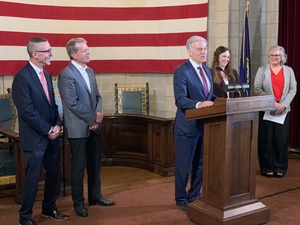
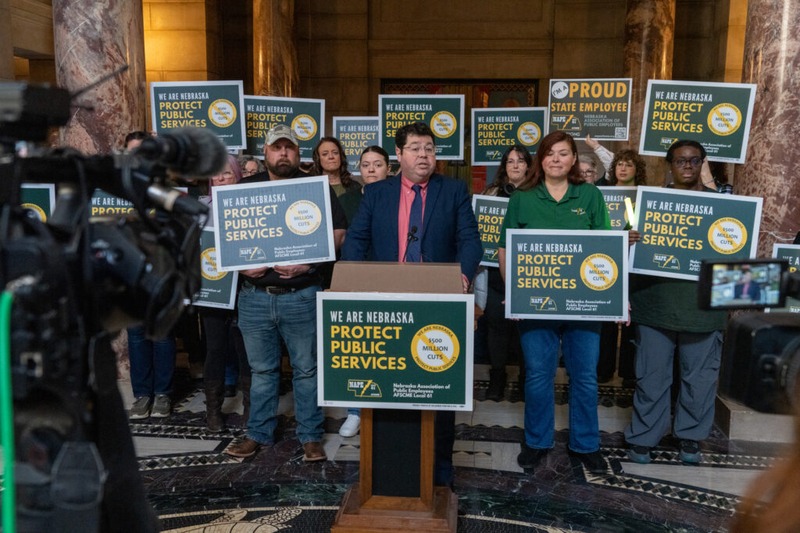
Justin Hubly, executive director of the Nebraska Association of Public Employees, leads a rally in the Nebraska State Capitol against state spending cuts to state workers and in response to the union's Nebraska Supreme Court appeal over its labor contract. Dec. 2, 2025. (Zach Wendling/Nebraska Examiner)
LINCOLN — The Nebraska Supreme Court considered arguments Tuesday in a multi-year fight over whether state officials needed to bargain with a state employees union over an executive order seeking to limit remote work.
Multiple justices questioned what constituted “bargaining” in relation to the November 2023 executive order from Gov. Jim Pillen, which ordered most state employees to return to work in person, beginning Jan. 2, 2024.
A three-member panel of the Nebraska Commission of Industrial Relations, a state labor court, unanimously upheld the order in July 2024. The commission decided state officials didn’t violate the rights of the Nebraska Association of Public Employees when it refused to negotiate.

The court said the labor contract already “covered” remote work and that the union’s lawsuit was “frivolous” and done in “bad faith.” As a punishment, the commission ordered the union to pay $42,234.63 for state attorneys’ fees.
The union appealed, arguing it was the union’s duty to defend members’ rights. The union also said that while it tried to negotiate limited work standards before a two-year contract took effect July 1, 2023, the state flatly rejected the attempt.
State employees received “historic” pay increases under that contract, which state officials said was a concession, but a union leader and the union’s attorney said pay raises were separate and not a “quid pro quo” agreement.
What is ‘bargaining’?
Justices Jonathan Papik and John Freudenberg asked whether the union abandoning remote work standards and not pushing the state further was still “bargaining.”
Attorney Richard Griffin, for the union, said it was not and that the union had not “clearly” or “unmistakably” waived its right to bargain.
“Bargaining involves give and take,” said Griffin. “Bargaining involves counter proposals. Even hard bargaining involves some response, and then the parties look to other provisions of the contract where they can reach compromise. This was not bargained over.”
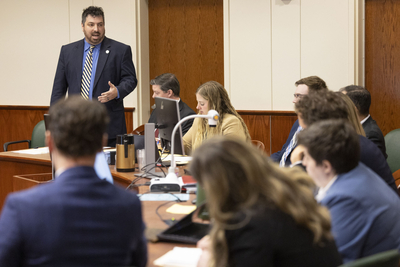
The union represents more than 8,000 state employees, or about 45% of state workers. Since the union challenged the order, the commission paused the remote work order for union-covered positions. The current two-year contract, mid-2025 to mid-2027, included no further clarifications on remote work.
Zach Viglianco, the state’s principal deputy solicitor general, said the state’s refusal to consider limited remote work standards was a “bargaining strategy.” He said state officials chose to “surrender” on other matters but “jealously guarded” broad authority over remote work.
Viglianco echoed the commission that the labor contract gave state employers “the right to increase, reduce, change, modify and alter the composition and site of the work force.” Viglianco said that clearly means “where” work occurs, in addition to other broad language for various aspects of work at any time, including shifts, working hours and duties or responsibilities.
“There is no other way to read that unambiguous language,” Viglianco said. “The fact that a party can present an alternative interpretation of language does not render it ambiguous.”
‘Site of the workforce’
Justice Jason Bergevin honed in on that part of the contract and asked why “site of the workforce” didn’t mean remote work. Griffin said it might but doesn’t explain implementation.
Griffin and Justin Hubly, the union’s executive director, said state law still requires negotiations over specifics of and full rights to members for implementation, such as defining “remote work” and “remote location.”
“Why wouldn’t it fully define the party’s rights to say the state can determine the site of work, and that’s the definition — the state has complete discretion?” Papik asked.
Griffin responded that it still doesn’t answer what happens when a worksite is unavailable because of no or little office space. Some exceptions were considered in Pillen’s executive order in such cases, leaving broad authority to state agency heads to implement the order.
The Nebraska Department of Administrative Services did not respond to a Tuesday request from the Nebraska Examiner on the latest status of remote or hybrid work for state employees.
Hubly said only one in six of union members ever worked remotely during the pandemic, and many had returned to work in person. He estimated that about 1,000 state workers were still remote, some of whom had always been in remote or hybrid positions.
“The idea that nobody is working remotely is just not true, but it is significantly reduced from where it was,” Hubly said.
Pillen’s order also asked for “mechanisms” to measure and confirm productivity for public servants still allowed to work in remote or hybrid settings, which the union sought to clarify.
Order relates to COVID-19 pandemic
Freudenberg asked Viglianco whether Pillen’s order stemmed from the COVID-19 pandemic. Pillen himself said in the executive order that Nebraskans expect that people are most productive in person and that “the COVID-19 pandemic is over.”
“The people of Nebraska expect their elected leaders to restore Nebraska’s public servant workforce to the posture it was in prior to the pandemic,” Pillen wrote in his order.
NE labor court sides with Gov. Pillen’s order calling state employees back to the office
Viglianco said the pandemic had some influence, such as on the number of workers working from home. However, he said remote work has existed since at least the 1980s.
A state brief to the Supreme Court argued the union hadn’t complained before regarding remote work, including a May 2021 executive order from then-Gov. Pete Ricketts.
Attorneys’ fees
A separate question before the Supreme Court is whether to uphold the assessment of attorneys’ fees against the union. It was one of the first cases where the party suing in front of the labor court had been awarded attorneys’ fees. The union worried it could “chill” further labor disputes.
The state estimated its attorneys’ fees at $113,296.63 but found the commission’s lower award “reasonable.” State attorneys and the commission alleged the union purposefully tried to delay the case while increasing its fee-paying membership.
“[Deterring] future frivolity is an important role played by awards of attorney fees,” the state wrote in a brief to the Supreme Court justices. “Affirming the award entered here will reinforce the notion that abuse of legal process, like crime, does not pay.”
Griffin told the justices that hundreds of employees had contacted the union and that it was within the union’s free speech rights to seek to increase membership or ask for donations. The union also argued the commission could not assess fees against those filing labor disputes, describing the action as “punitive,” “unprecedented” and beyond the commission’s authority.
Hubly said the union would begin the next round of bargaining in September and that remote work could still make sense for some needed positions, such as human resources, accounting and information technology. However, he said it’s not for all positions, like snowplow drivers.
“We’re really happy that we decided to take this appeal all the way to the Supreme Court,” Hubly said at a noon-hour rally. “Regardless of what happens there today, we’re going to get clarity from the highest court, and that will guide our path at the bargaining table in the future.”
The Supreme Court will issue an opinion on the case soon. Sarpy County District Judge Stefanie Martinez rounds out the current six-member court.
Nebraska Association of Public Employees v. State of Nebraska timeline
Beginning September 2022 —A union representing state employees and state officials begin negotiations for the next bargaining agreement to cover July 1, 2023, through June 30, 2025.
July 1, 2023 — Labor contract takes effect, including the largest salary increases for all union members in the then-35-year history of the State Employees Collective Bargaining Act.
Nov. 9, 2023 — Gov. Jim Pillen signs an executive order directing most state employees to return to work in person beginning
Jan. 2, 2024, with some exceptions. The state employees’ union requests to negotiate in late November on remote work.
Dec. 8, 2023 — State officials indicate to the state union it didn’t intend to negotiate the matter.
Dec. 13, 2023 — The state employees’ union files suit against the executive order in the Nebraska Commission of Industrial Relations.
Dec. 29, 2023 — A three-member panel of the Nebraska Commission of Industrial Relations agrees to temporarily halt the Pillen executive order specifically for positions and members covered by the state employees union.
Jan. 2, 2024 — The Pillen executive order takes effect for most state employees.
Jan. 4, 2024 — The Nebraska Association of Public Employees files a contempt motion against the state in response to the implementation of the executive order, particularly the Nebraska Department of Health and Human Services and Nebraska Department of Revenue. State attorneys seek clarification from the Commission of Industrial Relations on the order, which clarifies that current work-from-home assignments couldn’t be altered during the lawsuit.
Feb. 26-27, 2024 — The Commission of Industrial Relations hosts a two-day trial into the labor dispute.
July 11, 2024 — The commission rules in favor of the State of Nebraska and orders attorneys’ fees to be paid to the state from the union.
Jan. 8, 2025 — The attorneys’ fee fine is set at $42,234.63. It is lower than estimates from the state that totaled $113,296.63.
Jan. 9, 2025 — The state employees union appeals the commission decision to the Nebraska Supreme Court.
Dec. 2, 2025 — The Nebraska Supreme Court considers oral arguments in the labor dispute appeal.
— Zach Wendling
Lincoln, NE