Proposed student housing fee in Providence draws heavy opposition at committee hearing
Nov 14, 2025 | 5:00 pm ET
Description
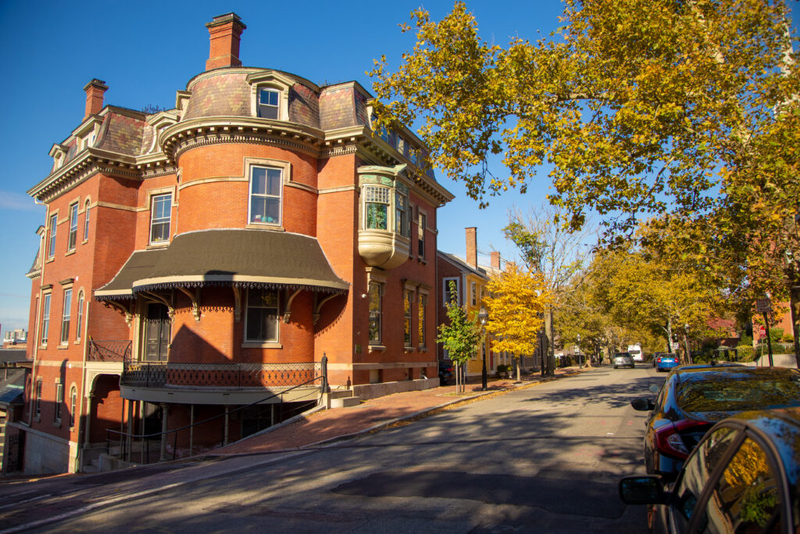
A street in Providence's College Hill. (Photo via Providence Warwick CVB)
A proposed $300-per-tenant annual fee for landlords who provide student-only housing drew strong reactions during a public hearing before a Providence City Council committee Thursday night, mostly from opponents.
In June 2025, Councilors Shelley Peterson and John Goncalves introduced the proposal to amend the city’s housing laws and allow for the fee for owners of off-campus buildings rented solely to college students. Noncompliant landlords could face fines of up to $500 a day. The ordinance would require the city’s colleges and universities to supply lists of students living off campus.
There was no vote at Thursday’s meeting of the Committee on Ordinances, which was held expressly for committee members to hear residents’ thoughts on the proposed “student impact fee.” In her opening remarks, Peterson acknowledged her proposal was controversial, adding that disagreement is an ingredient in the democratic process.
“What we’re discussing tonight isn’t about politics or personalities,” Peterson said. “It’s about whether we believe that everyone who benefits from our city should also share in the responsibility of taking care of it.”
Peterson — who presides over Ward 14, home to Providence College (PC) and dense with off-campus housing — then went on to “dispel a very immediate rumor” that the fee is “about punishing students.”
“It’s about holding accountable the landlords and developers who profit most from student housing while contributing the least to the neighborhoods that they reshape,” Peterson said, and cited the example of Ward 14, where the city has had to install more than 200 new parking signs, clear drains, and “respond to more police and sanitation calls [near student housing] than any other part of the ward.”
The council’s ordinances committee first took up the issue at its July 17 meeting, and planned for a future public hearing. Before Thursday’s meeting, Goncalves removed himself as a sponsor. Goncalves did not immediately respond to a request for comment Friday.
Peterson told the students who turned out to testify in opposition that they’re being misled by landlords. A handout at the meeting also sought to counter the claims made by landlords about the ordinance.
“Contrary to everything that they’ve told you, the city does value you,” Peterson said. “You are part of the fabric of Providence. You do support our businesses. You do volunteer your time, and you do bring life to our streets.”
“You’re not the problem,” Peterson continued. “The problem is an unchecked housing system that treats you as a product and your neighborhood as a profit margin.”
There’s much profit to be made off students living off Providence’s many campuses, which include Brown University, Providence College, Rhode Island College, Rhode Island School of Design and Johnson & Wales University.
But most of the 150 pages of written testimony the council received leaned heavily against the measure, with 135 pages of opposition to 15 pages of support. A good chunk of the opposition letters were names from a petition.
Providence Mayor Brett Smiley submitted a letter in opposition to the ordinance as drafted, citing “serious operational and enforcement concerns.” Forcing colleges to share information on students’ addresses might conflict with federal privacy laws, Smiley suggested, and matching anonymized student data to specific properties could prove tricky and time-consuming.

Broke college students
The proposal is another chapter in what’s been a woeful year for the finances of Rhode Island’s capital city. A November 2024 settlement with the state education department forced city officials to come up with $11 million, leading the city to ask for the General Assembly’s permission to increase its overall tax levy. The successful maneuver nevertheless offered a rare moment at the State House where landlords and tenants decried the effect the legislation would have on property taxes, which had skyrocketed in the latest cycle of property reevaluations.
The levy increased 5.85% for fiscal year 2026 only, but the increases fell upon homeowners in unequal ways. Non-owner occupied, multifamily homes with two to five units — the kinds of housing inhabited by college students — were subject to an average 13% increase in property taxes for fiscal year 2026.
That trickles down, argued Kevin Keaveney, a Providence College senior studying finance and business management. He told the committee Thursday that students “are genuinely worried about the financial strain this proposed plan would place on them.”
“The stereotype that college students are broke exists for a reason,” Keaveney said.
Peterson actually voted against final passage of the fiscal year 2026 budget in July, one of only two councilors to do so. The additional student fee money would not go into general revenue or municipal services, however. Instead, Peterson said the fees would be directed to the city’s new home repair program, which she said “helps our low-income homeowners fix code violations by making repairs and staying in their homes in a city where the median household income is $66,000.”
“The money collected here won’t go to the general fund,” Peterson said. “It’s not going to get lost in red tape.”
Peterson said the ordinance targets landlords, not students, and she cited the largest off-campus landlord in Ward 14’s Elmhurst neighborhood who provides housing for roughly 1,200 students, pulling in an estimated $7 million a year in rent. Add in fees — “There’s added fees for pretty much everything that you guys have, right?” Peterson said — and the landlord could rake in $660,000 monthly in fees alone, in the councilor’s estimate.
That business model incensed Peterson and Councilor Justin Roias, a co-sponsor who strongly defended the ordinance. Toward the end of the meeting, Roias observed Keaveney said his rent was $1,290 a month in an eight-person house. Roias did some rough math and argued that a triple decker could pull in hundreds of thousands of dollars a year in rent income.
“I would argue that the student housing developers in Ward 14 specifically have had a monopolizing effect on the neighborhood,” Roias said. “They’ve actually set the market…I look at this ordinance as one of very few tools that we even have as a city to discourage student developers from continuing this business model.”
The ordinance, Roias said, is not against “mixed” housing, with “a student on the first floor and a family on the second floor,” he said. “This is exclusively student housing that this ordinance targets.”
‘It’s economics 101’
Perhaps most targeted by councilors’ ire were companies like the 02908 Club, a student rental business near Providence College in Ward 14. The Club had recently sent out multiple emails regarding the hearing and public comment period to students. While Peterson did not name the company in her opening remarks, her handout did, and she called the email blasts “a waste of time.”
Shannon Russell, who sent those emails as part of her job as operations manager for the 02908 Club, disagreed.
“It’s my company that’s being attacked and lied about here tonight, just to put that out there,” Russell said in her turn at the podium.
I would argue that the student housing developers in Ward 14 specifically have had a monopolizing effect on the neighborhood.
She said the fees could absolutely be passed onto students. Distributors’ costs are passed onto sellers who pass those increased costs onto customers, she said.
“It’s economics 101,” Russell said. “It’s simple. It’s basic.”
But ordinance supporter Joanne Rich argued the $300 fee was modest compared to the rents being charged.
Rich said the situation near Providence College — such as a highly publicized incident on Halloween night, which Russell and the college claimed did not involve PC students— was evidence that Ward 14 “has already been converted to an unruly, unmonitored extension of the PC campus.”
Rich then apologized for being “a little snarky” but pressed ahead anyway. She said that if landlords pass along the fees, “I would suggest that the students impacted spend $8 less a week on alcohol, which might go a little way toward lessening the nuisance towards their neighbors as well.”
A date for a committee vote has not been set as of Friday.
“Having the public hearing was really the only planned next step,” City Council Chief of Staff June Rose said in an email Friday. “The sponsor will now consider the feedback from the community, decide on any amendments, and then she would request from the chair that it be scheduled for a vote.”

Providence, RI