More money, more problems: RI leaders aren’t celebrating a $109M boost to revenue forecast
Nov 11, 2026 | 3:52 pm ET
Description
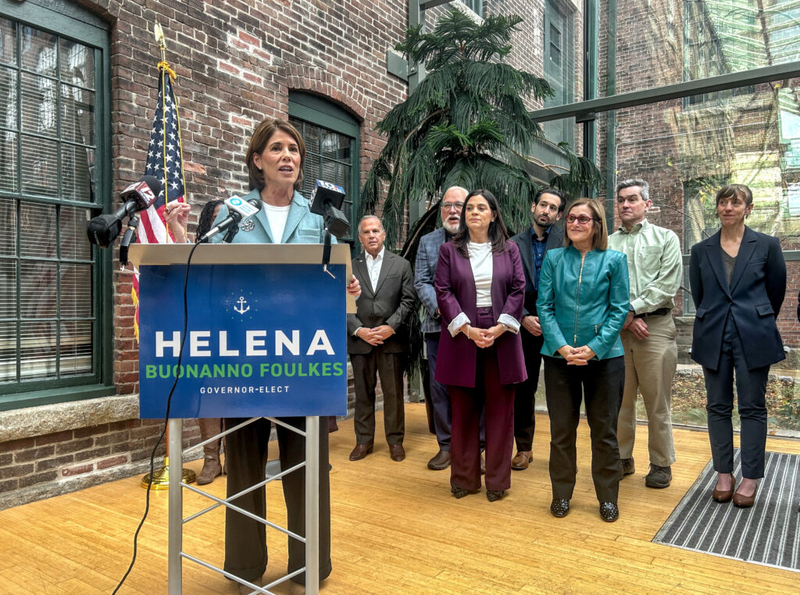
Gov.-elect Helena Buonanno Foulkes said at a press conference on Tuesday, Nov. 10, 2026 that the upcoming fiscal 2028 budget process will be challenging, despite higher-than-expected revenue. (Photo by Nancy Lavin/Rhode Island Current)
Gov.-elect Helena Buonanno Foulkes will have an extra $109 million to work with when putting together her first tax and spending proposal for the upcoming fiscal 2028 budget.
The nine-digit boost to the income side of the state ledger came at the conclusion of the biannual Revenue and Caseload Estimating Conference on Tuesday. State budget analysts now expect $108.7 million more in general revenue to flow through state coffers in the current fiscal year that ends June 30, compared with the spring estimates lawmakers used to finalize the fiscal 2027 budget.
The updated projections will shape Foulkes’ inaugural budget proposal, which will be unveiled sometime in January, setting off the six-month review and editing process by the Rhode Island General Assembly.
Despite the rosier-than-expected financial picture, Foulkes, a Democrat, remained cautious about the state’s long-term financial picture.
“We need to think about more than just one year,” she said at a press conference Tuesday. “One of the challenges will be to be really disciplined about this.”
The revenue estimates adopted Tuesday don’t account for the expense side of the balance sheet. In June of this year, at the time the fiscal 2027 budget was adopted, the House fiscal office projected a $240 million deficit in fiscal 2028, swelling to $540 million by fiscal 2031.
Federal funding cuts under H.R. 1, including massive overhauls of the Supplemental Nutrition Assistance Program and Medicaid, the latter of which accounts for one-third of the state’s $15 billion budget.
Rhode Island legislative leaders, all of whom are Democrats, pointed to federal policy changes under the Trump administration and a Republican-controlled Congress as an ongoing challenge despite an increase in projected revenue.
“While revenue projections are higher than initially forecast, we must remain mindful that many Rhode Islanders continue to struggle with rising costs and economic uncertainty,” Senate President Valarie Lawson said in a statement Tuesday. “As the state budget is developed and considered, we must also account for the significant fiscal challenges posed by changes in federal policy and their potential impact on our state. Our approach must be measured and responsible, balancing this positive revenue news with the needs of Rhode Islanders and the long-term financial health of our state.”
House Speaker Christopher Blazejewski echoed this concern, referring to “punishing” federal policy choices and “ongoing harm and uncertainty” from the federal government in a separate statement Tuesday.
In contrast, outgoing Gov. Dan McKee, also a Democrat, took an optimistic tone, touting the stronger fiscal outlook from the revenue estimates as evidence of his administration’s fiscal responsibility.
“We are leaving Rhode Island in a better fiscal position than we found it, and I’m proud of the stronger foundation we’ve built for our state’s future,” McKee said in a statement.
McKee, who lost his reelection bid to Foulkes in the September primary, also said the upward revenue revisions “set the stage” for holding the line on taxes, while providing enough extra money to continue phasing out the state tax on Social Security income and increasing reimbursement rates for primary care providers.
Foulkes said Tuesday it was too early to say how she would spend the extra revenue, but reiterated her campaign priority to increase housing development. During the campaign, Foulkes pledged to build 20,000 homes over the next eight years using the state millionaire’s tax. The surtax on income over $1 million begins in January, with the expected $22 million boost to fiscal 2027 revenue already spent through the state’s general fund.
The state’s 7% sales tax was the largest driver of the revenue boost, now $61 million higher than previous estimates. Business taxes also rose by $49 million, while personal income taxes fell $25 million, reflecting lower-than-expected revenue from income withholdings.
Lottery revenue is now expected to be $300,000 less, too, with losses in income from iGaming and video lottery terminals partially offset by boosts to sports betting and table games at casinos in Lincoln and Tiverton.
State budget analysts will meet again in May to revise financial projections based on updated revenue reports.

Providence, RI