Private Islamic schools under fire from Florida Cabinet received millions in taxpayer dollars
Oct 28, 2025 | 1:07 pm ET
Description
An empty class at Coral Glades High School, Tamarac, Florida. (Photo by Dan Forer/GettyImages)
Two private Islamic schools derided by Florida’s Cabinet for accepting school scholarships have received millions in taxpayer dollars through the state’s school voucher system.
Hifz Academy and Bayaan Academy in Tampa have together brought in more than $18 million in scholarship funds during the past decade, according to data provided to the Phoenix by the non-profit that administers most of the state’s scholarships, Step Up for Students.
Both schools on Monday came under heavy fire from members of the Florida Cabinet for accepting school vouchers while allegedly promoting Sharia law.
Of note, “Sharia” appears nowhere on either of the schools’ websites.
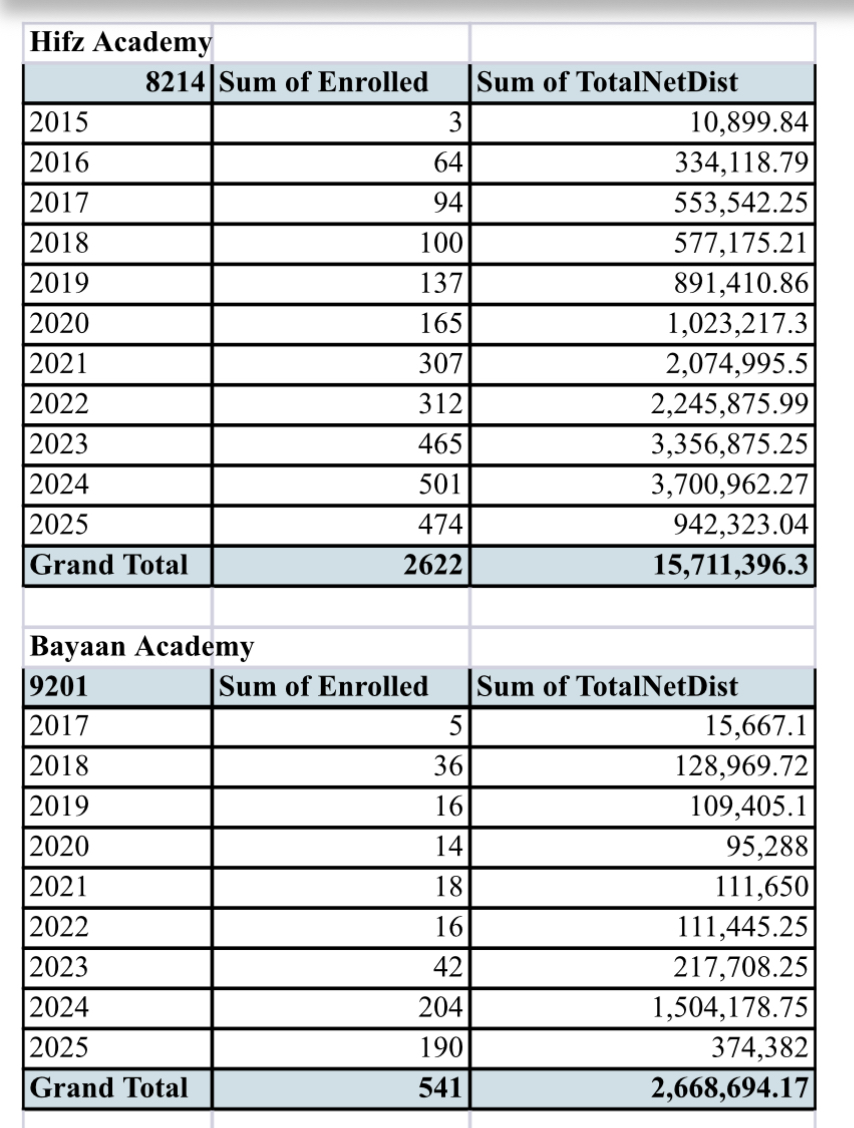
Hifz Academy has brought in $15,711,396 since 2015. Its biggest year was 2024, when parents used $3.7 million of Department of Education money to send their students to the Tampa school, which enrolled 501 students that year. Bayaan Academy has brought in $2,668,694 since 2017. Its wealthiest year was also 2024, with a $1.5 million state distribution for its 204 students.
Parents, not Step Up, decide which schools the funds go to.
The data come after Florida Attorney General James Uthmeier, Chief Financial Officer Blaise Ingoglia, and Agriculture Commissioner Wilton Simpson publicly questioned whether it was legal for schools supposedly promoting Sharia law to receive these vouchers.
Although there’s no evidence that Hifz and Bayaan teach or practice Sharia law, Islam’s legal system derived from the Quran. Uthmeier amplified his concerns on social media Monday, responding to a right-wing organization’s article claiming that one Bayaan employee is related to a founder of the U.S. Muslim Brotherhood.
Florida’s school choice programs were largely expanded under a 2023 law allowing any Floridian, regardless of income, to apply for vouchers for private schools accepting these scholarships. This built off of a 1999 law providing these vouchers exclusively to low-income students.
As of this year, the program applies to 2,278 private schools, while 82% of participating students attend a religious school. Roman Catholic schools are the single largest religious recipients.
The programs provide an average of between $7,700 and $8,500 to students attending non-public schools. More than 122,000 new students started using vouchers in the 2023-24 school year.

Tallahassee, FL