Q&A: Law enforcement must always remember who it works for, says retiring sheriff lauded as ‘legend’
Nov 29, 2026 | 8:00 am ET
Description
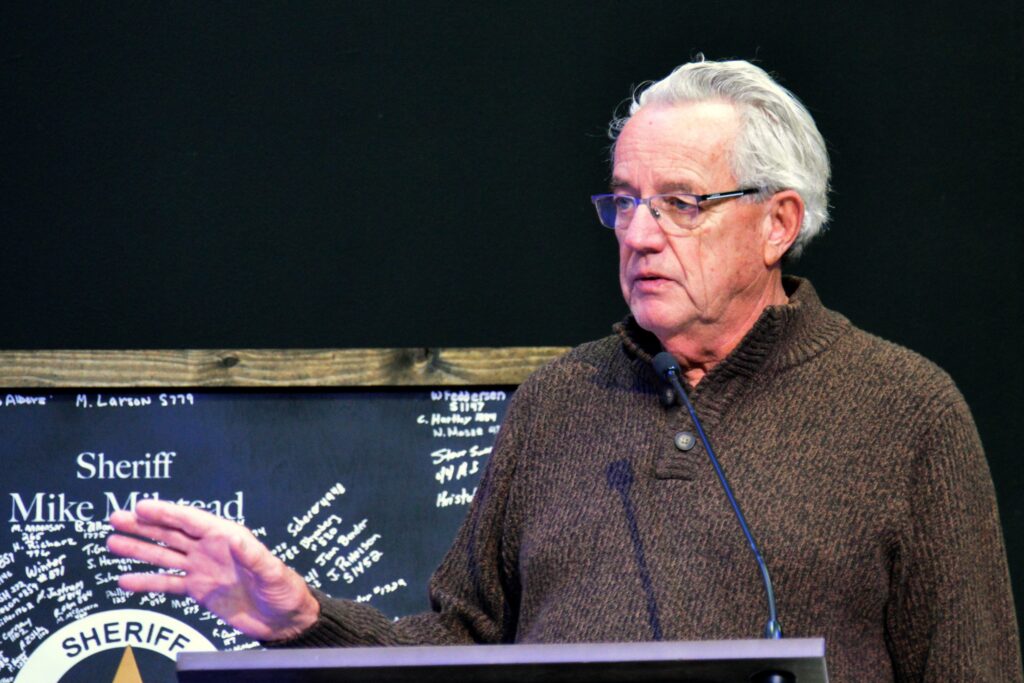
Former Minnehaha County Sheriff Mike Milstead speaks at a retirement ceremony on Nov. 17 at the Military Heritage Alliance in Sioux Falls, South Dakota. (Photo by John Hult/South Dakota Searchlight)
In 1986, as a young patrol officer for the Sioux Falls Police Department, Mike Milstead arrested a fire department battalion chief for drunken driving.
The fireman was upper management in a department that worked closely with police. He asked Milstead for a “break” as a “professional courtesy,” according to a 1987 article on the incident in the Argus Leader.
“I told him he was being arrested,” Milstead told a civil service board at a hearing on the battalion chief’s suspension. “He told me I’d better hope that my house doesn’t catch on fire.”
Ten years after that hearing, Milstead was appointed as Minnehaha County sheriff.
He went on to become the longest-serving sheriff in history for South Dakota’s most populous county, running unopposed six times.
Forty years later, as Milstead prepared to retire, he told South Dakota Searchlight it was “very difficult” to arrest someone who “quite frankly, was a friend of mine.”
“But I had to do the job I was supposed to do,” Milstead said. “That’s what people put me in place to do.”
Milstead said he hadn’t thought about the drunken driving incident for years until questioned about it by Searchlight. What he still thinks about often, he said — and what he said he trusts now-Sheriff Josh Phillips to keep thinking about as he takes the reins — is the idea that law enforcement is the people’s work.
Since taking over the sheriff’s office in 1997, all his department’s supervisors have come to know Milstead’s “Minnesota Avenue rule,” a reference to one of the busiest streets in Sioux Falls. When faced with a dilemma, he’d tell them, imagine stopping the next 100 cars on the thoroughfare and asking the occupants how best to handle it within the bounds of the law.
“We try to follow that guidance throughout our decision-making process,” said Milstead. “Because that’s who we work for, right?”
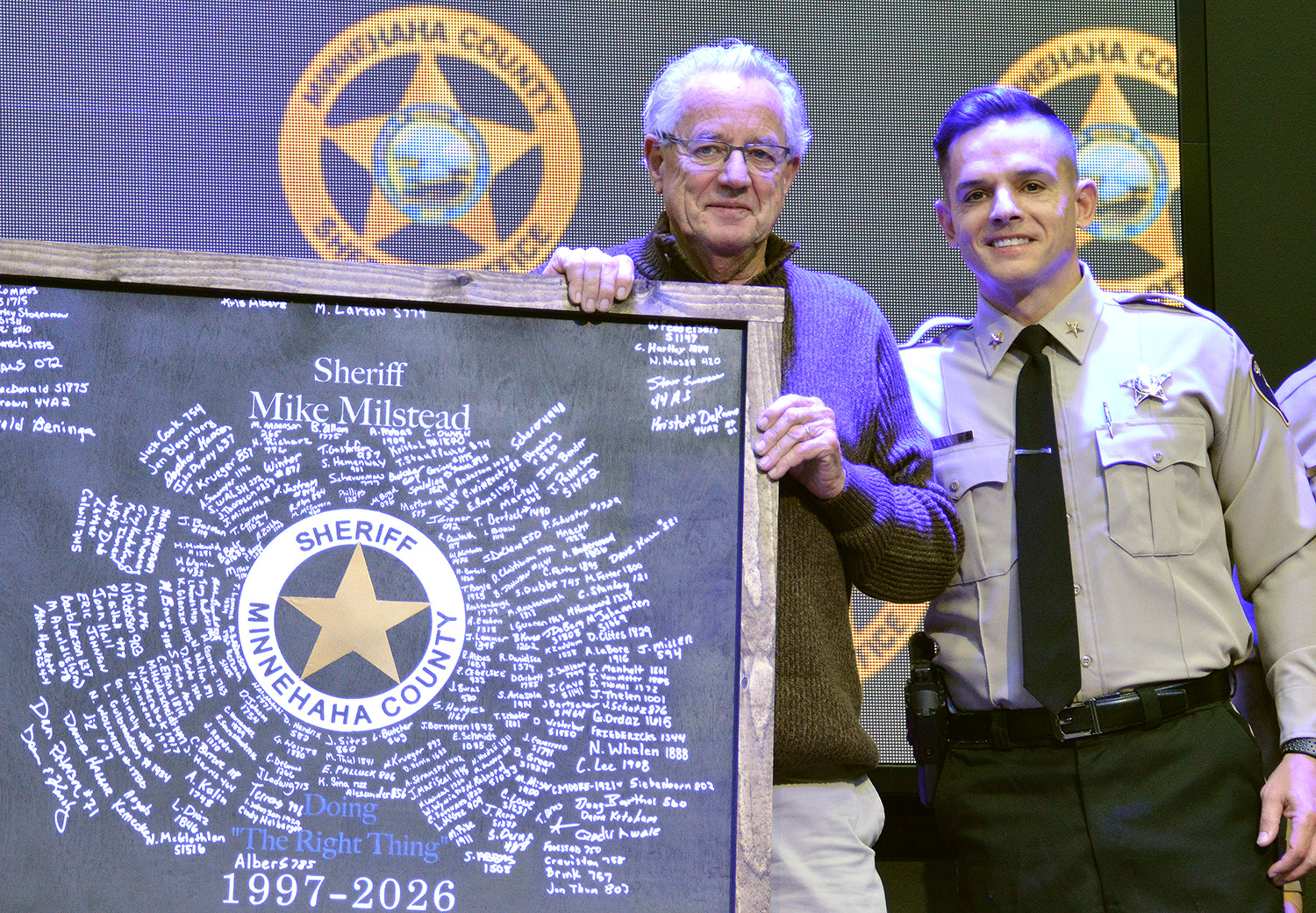
Milstead, 72, retired on Nov. 17 after a 53-year policing career, 29 of which were spent as sheriff. Hundreds showed up for his formal send-off at the Military Heritage Alliance in Sioux Falls that day, which doubled as a swearing-in for Phillips.
The U.S. attorney for South Dakota, Ron Parsons, said Milstead’s face would belong on a Mount Rushmore of state law enforcement. Gov. Larry Rhoden declared Nov. 17 “Mike Milstead Day” in a proclamation read aloud by state Department of Public Safety Secretary Bob Perry, who described Milstead as “a legend” whose voice carried weight beyond the borders of his county.
“I’ve appreciated his leadership, and I’ve appreciated his advice — not all of it solicited,” Perry said. “I say that with a smile, but sometimes that’s the most important advice you get.”
The following interview with Milstead, conducted earlier this year, has been edited for length and clarity.
You worked the night shift for the Sioux Falls Police Department for a lot of years. How did that inform the way you supervise and train deputies?
I spent a lot of my career in the Sioux Falls Area Drug Task Force as a supervisor, in particular night shift. I would remind my coworkers and staff on a regular basis, “hey, when you’re going from call to call, nobody’s calling you to tell you that they’re having a great night. You’re going to see the worst of the worst. You’re going to see tragedies. Don’t get a distorted view from that. Don’t burn out.”
When I got this job, that stayed with me. With new jail officers, new deputies, it’s like “look, these people, in particular in the jail, are probably going through the worst days of their life. And they have moms and dads and sisters and brothers. Treat them with dignity and respect. Be a professional.”
One of the things that I tried to make sure that I did, and we remind our new staff to do, is to have friends outside of law enforcement. Law enforcement is a brotherhood. We like to socialize. But if your only friends on the outside are people you work with, what are you going to do when you socialize? You’re going to talk about work, right? So we really try to stress that: Do things with your friends in law enforcement, but also have friends outside of law enforcement to help kind of keep you centered.
You’ve talked a lot over the years about the importance of local media. Where did that philosophy come from?
Back in the late ’90s, early 2000s, the County Commission approved the building of a $20 million, 400-bed jail. Well, $20 million back in those days was unheard of, and it’s referable to the voters. But not one person went and took out a petition to say, “Let’s put this to a vote, because we don’t want to do it.” And the whole reason is the media. The Argus Leader did multiple pages, full-page runs with pictures of the jail interior, where the assaults were happening, where people were hanging themselves and dying in our jail. At least one of the local TV stations showed it, too, like “look, here’s the environment.” They educated the public.
Later in my career, we had to expand that jail, and that’s a $40 million project. And once again, by educating the public through the media, the project wasn’t referred.
Some in law enforcement look at the media like, “oh my gosh, stay away from them. Don’t talk to them.” It’s like, “you don’t understand the value that they can bring to the public.”
You’re the only sheriff in South Dakota to have supervised a former governor and congressman in your jail, after Bill Janklow ran a stop sign and killed motorcyclist Randy Scott in 2003. What do you recall from that time?
I knew Bill Janklow quite well. He and I had a lot of meetings. We talked. We had a very good working relationship. Then this unfortunate tragedy occurred. I ultimately housed him in my jail for 100 days (after he pleaded guilty to involuntary manslaughter). It was a media storm when he was booked in, and then again after when he was released, but it was uneventful when he was here.
He was the most well-behaved inmate I had. I wish I’d had more like him. He was easy to manage.
Wasn’t there some concern about having someone as high-profile as a former governor in the general population?
Well, we had some smaller housing units. Not isolation cells, like he’d be locked in a cell, but we had a smaller housing unit, so it worked fine.
You were first hired by the Sioux Falls Police Department in 1973. What are some of the biggest changes you’ve seen over the years?
When I started, the blood alcohol limit (to legally operate a vehicle) was roughly 0.15. Then it went down to 0.12, then 0.10, and now it’s down to 0.08. So if you had somebody that was drunk, they could be pretty drunk and still under the legal limit. The standards have changed so much.
State will pay extra for county jail space amid crackdown on alleged parole violations
There were also no mandatory arrests for domestic abuse. Most times there was no arrest. If there was, and you had kids in the house, you brought them to the police station and put them with the front desk officer. Back then, it was not uncommon for the front desk officers to be babysitting three kids that were taken away from their family because we had no shelter. The Children’s Inn (a shelter for families and domestic violence victims) was just a godsend to us. It’s a critical part of the resources that we have, because the laws have changed. We have mandatory arrests. We have protection orders. We really recognize the importance of having good laws on domestic abuse and good resources for the victims of domestic abuse.
We also have a lot of people struggling with mental health issues out on the streets, and we were never trained back then on how to deal with mental health. Now, we focus on crisis intervention training. We have a mobile crisis response team. In rural South Dakota now, they have laptops or tablets that they can get instantly in touch with a physician or counselor.
How do you look at mental health differently as a supervisor?
Suicide in law enforcement is very difficult for me. I’ve lost four officers in my career here to suicide.
All our staff spends an hour with a mental health provider every year. It’s a mandatory hour. Now if they want to spend the hour talking about baseball, I don’t get a report back. What I get says that this employee did come in for their hour. It just gives them an opportunity to just bare their soul and maybe get some help if they need it.
So I think that’s an important step. So is the crisis intervention training that our deputies now have, as they learn how to deal with people in depression or with mental health issues or co-occurring disorders, drug or alcohol abuse, whatever it may be. (The deputies) are learning that they’re susceptible to these things, too. It’s just a huge change.
If you could talk to a 42-year-old version of yourself, what’s the first bit of advice you’d give?
I think it would just be to let your faith guide you, and do what’s in the best interest of the people.
It took me a while to understand the value of the position of elected sheriff, which is that I don’t really have to ask anybody if I can say something to the media or to the public. I don’t have to ask if I can implement a policy or a procedure or a new standard for my department.
The County Commission has tremendous authority over me in one area. They have the power of the purse. That’s a lot of authority. But I’ve been blessed with county commissions that have allowed me to do what the citizens expect, and that is that you elect the sheriff to make those decisions. They didn’t elect the County Commission to make the sheriff’s decisions.
What comes next for you?
I’ll tell you what I’m not going to do. People asking, “Are you going to run for the Legislature?” And the answer is no. “Are you going to run for County Commission?” The answer is no. I don’t want to run for office. I think the people allowed me to be elected into this office for a reason, and that’s because my area of expertise is in law enforcement.
And quite frankly, the Legislature meets in the dead of winter in Pierre, South Dakota. I have zero interest in taking that step.

Pierre, SD