Arizona legislative leaders seek to appeal trans birth certificate ruling
Oct 21, 2025 | 1:08 pm ET

Description
Photo via Getty Images
The Republican leaders of the Arizona Legislature want to appeal a federal judge’s decision striking from state law a requirement for transgender people to undergo sexual reassignment surgery before they can change the gender markers on their birth certificates.
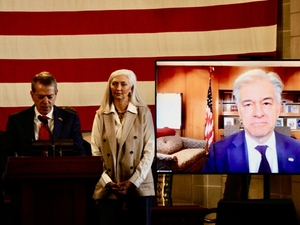
Arizona Senate President Warren Petersen and House Speaker Steve Montenegro on Monday asked a federal court for permission to intervene in the case, in place of Democratic Attorney General Kris Mayes, who they said had not made a decision on whether to appeal — and had not answered their questions about whether she would.
The legislators argued that time was running out to file an appeal, and that they are tasked with defending the state’s laws, and should be allowed to do so in court if the attorney general doesn’t.
“Arizona’s laws are not optional,” Montenegro said in a statement. “When a federal court rewrites a statute, the Legislature has a duty to defend it. If the Attorney General won’t defend Arizona’s laws, we will. The ruling now opens the door for anyone to change the sex marker on a birth certificate with just a doctor’s note, erasing decades of statute and undermining the integrity of vital records.”
On Sept. 30, Arizona District Court Judge James Soto permanently struck the word “operation” from an Arizona law that required people to go through a “sex change operation” before they can be issued a new birth certificate that aligns with their gender identity.
He ordered the Arizona Department of Health Services to comply with his order within 120 days and allow transgender people born in Arizona to obtain an amended birth certificate, as long as they get a recommendation from a doctor. This means a trans person who wants to obtain an amended birth certificate could go through a “social transition” by changing their name, the way they dress and their pronouns, along with possible hormonal treatment, without a requirement of a surgical operation.
Montenegro and Petersen said in a Monday statement that they had attempted several times since Soto’s decision to find out whether Mayes, who defended the law in previous proceedings, planned to appeal, but she kept saying that she hadn’t decided.
Mayes declined to comment for this article.
So, the lawmakers requested that the court give them permission to file an appeal instead. They also asked the appeals court to block the implementation of Soto’s decision until their appeal is decided.
Petersen and Montenegro argued that they should be able to defend the law in Mayes’ place because “Legislative Leaders have a crucial interest — bestowed by the people of Arizona through their elected representatives in the Legislature — in defending the constitutionality of state statutes.”
In their request to the court, the Republicans argued that Soto’s decision made a “dramatic departure from a state law that, for more than 50 years, required a ‘sex change operation’” to change gender markers on a birth certificate.
Defending the law would actually be a new tactic for Montenegro and Petersen. In June, they asked the judge to strike down the entire law — barring anyone from changing the gender on their birth certificate — instead of removing the word “operation.”
In response, Soto wrote that it was clearly the legislature’s intent, at the time the law was passed, to allow people to change the gender on their birth certificates, so striking the law completely would undermine the legislature.
And had he done so, it would have rewritten state law to do what legislation that Montenegro and Petersen both supported earlier this year would have done: bar amendments to birth certificates. Gov. Katie Hobbs vetoed it.
Petersen and Montenegro argued in their motion on Monday that Soto’s decision was “based on a view of legislative intent that differed dramatically from the Legislative Leaders’ understanding” of the intent of the legislators when writing the law.
Soto had argued that if legislators at the time hadn’t wanted anyone to be able to change their gender markers, they wouldn’t have passed the law in the first place. Additionally he pointed out that the current legislators’ intent isn’t necessarily the same as the intent when the law was first passed, long before either of them were elected to the legislature.
They also argued that a stay of Soto’s order directing the state to begin issuing amended certificates without surgery would cause “irreparable harm” to the state.
“Without a stay, the Court’s order will force (the Arizona Department of Health Services) to issue amended birth certificates to individuals who were not eligible for amended birth certificates under the original statute,” they wrote.
Petersen and Montenegro said that would cause the state irreparable harm because then the state would have no way of revoking the birth certificates that were issued, if the lawmakers win their appeal.

Phoenix, AZ