Amid government funding battle, Mainers call on Congress to provide health care stability
Sep 18, 2025 | 11:41 am ET
Description
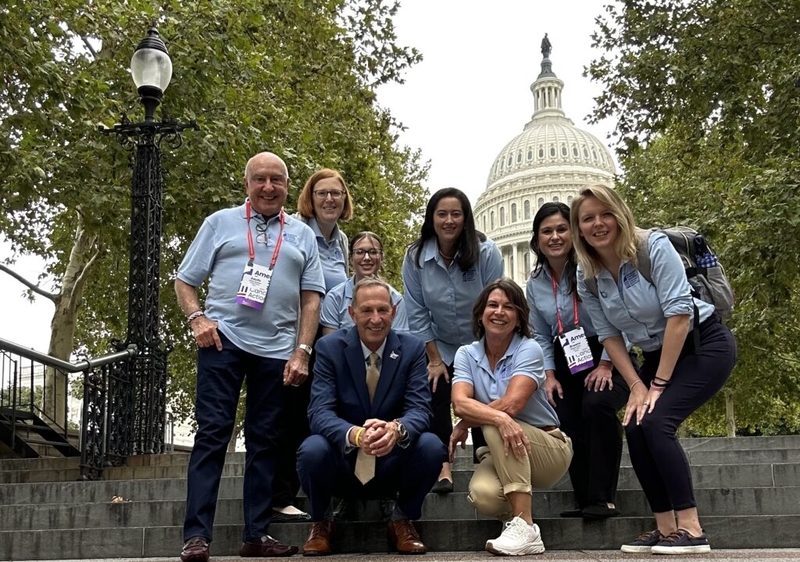
Mainers speak with their congressional delegation in Washington, D.C., as part of the American Cancer Society Cancer Action Network’s annual lobby day. (Courtesy of the American Cancer Society Cancer Action Network)
Almost four years ago, when Scarborough resident Shawna Ackley had her hands full chasing around her then three-year-old, the last thing she had expected was to get diagnosed with cancer at 38 with no known risk factors.
She knows first-hand that life can be turned upside down in an instant, but she hopes there can be consistency for those accessing treatments as well as for researchers working toward a cure.
“Health should not be about wealth,” Ackley said.
Ackley was one of several Mainers associated with the American Cancer Society Cancer Action Network who met with Maine’s congressional delegation in Washington, D.C., this week to push for federal funding for cancer research as well as an extension of health insurance subsidies ahead of the September 30 deadline to pass spending legislation.
Republicans in the U.S. House of Representatives on Tuesday released a short-term plan to fund the government until late November, but Democrats are holding out on demands that any spending extension address the expiring health care subsidies and roll back Medicaid cuts made in the GOP spending bill this summer.
The group of advocates from Maine asked the state’s congressional delegation to back the highest possible funding for the government’s medical research institutions, to get a bill that would allow Medicare coverage and payment for multi-cancer early detection screening tests over the finish line, and to extend the subsidies.
But the way Congress goes about addressing those demands also matters, they said. They warn that a short-term fix would cause harm to current and future cancer patients because of possible disruptions to affordable health care and research into the most effective treatments and side effect management.
“What we want is a full-year funding bill,” said Topsham resident Mikala Bousquet, the organization’s lead ambassador for Maine. “We want there to be predictability, so that the market can make plans, that patients and families can make plans, that hospital systems can make plans.”
Health care and research cuts so far
Predictability has been upended under President Donald Trump’s second term.
Millions of people are expected to lose health insurance as a result of the tax cut legislation Trump signed on July 4. The administration has also suspended and cut many National Institutes of Health and other federal grants, and has been slow to distribute funding for medical research that was congressionally appropriated for the fiscal year that ends this month.
Many of the research cuts made by the Trump administration have been in pursuit of a goal to eliminate government waste and what the administration deems diversity, equity and inclusion programs.
Trump’s big proposed cuts to health and education spending rebuffed by US Senate panel
A third-party grant tracking project reported that a DEI-related grant termination to Jackson Laboratory in Maine was sustained following the U.S. Supreme Court’s decision last month. The 5-4 decision allowed the Trump administration to cancel hundreds of millions of dollars nationally that were awarded by the National Institutes of Health.
Jackson Laboratory declined to comment on that grant termination, as well as the delayed disbursement of its NIH awards. Some other states’ institutions that have seen terminations of DEI-related grants have similarly been mum on the topic.
Republican Sen. Susan Collins of Maine, as chair of the Senate Appropriations Committee, has come under particular fire by many constituents for her approach to addressing funding cuts, though Jackson Laboratory has also repeatedly declined to comment on Collins’ performance.
When Maine Morning Star spoke to voters this past spring, some criticized Collins for trying to reinstate cuts on an individual basis, arguing such an approach won’t be effective in deterring the president as he convoluted the federal government’s system of checks and balances.
Collins has long been a vocal proponent of federal funding for medical research. But her ability to deliver on that front, among others, has been tested during Trump’s second term.
Future access to care
As congressional committees have considered 2026 spending proposals, they’ve largely rejected Trump administration proposals to slash funding for medical research grants and health initiatives. Now the crux of debate to avoid a government shutdown has become the future of the enhanced premium tax credit that thousands of Mainers rely on.
The tax credit, established during the COVID-19 pandemic and scheduled to expire at the end of this year, lowers the cost of health insurance for people who buy coverage through the marketplace. In Maine, about 61,000 people are enrolled through the state marketplace, CoverME.gov.
Mills calls on Congress to extend tax credit to help Mainers afford health insurance
Ackley said early detection and access to timely care saved her life. Now, as Mainers and others across the country who buy insurance through the Affordable Care Act marketplace face the possibility of steep cost hikes that could lead to an inability to afford coverage, she worries about late detection and postponed treatment. And, in northern Maine, costs can be even higher because of access issues in the more rural areas of the state.
Ackley also knows from personal experience that the cost of cancer doesn’t end when active treatment ends, as oncologist visits, scans and bloodwork continue. “Survivorship is expensive,” she said.
Bousquet, who is an oncology social worker, said her patients are already struggling with the cost of health care and cautioned against removing subsidies at a time when health insurance premiums are seeing sharp increases.
“Many of my patients, they get a diagnosis and they’re more stressed about the potential financial impact than they are the diagnosis,” she said. “It shouldn’t be that way. They shouldn’t have to be worried about that.”
When Bousquet was 20 years old, her mother died of metastatic breast cancer. Then, last year, her sister was diagnosed with cancer at age 29 and is still in active treatment.
“All of the medications in her treatment regimen, every single one of the drugs that she’s on, is a direct result from NIH-funded research,” Bousquet said.
In sharing her hope for her sister to have a long and healthy quality of life, Bousquet also cautioned that many of the lifesaving drugs she relies on have toxicities that aren’t yet fully understood.
“We are still learning about those toxicities, and as such a young survivor, she will rely on research to make sure that she stays happy, healthy, and is able to cope with the effects of her treatment and her medications over time for a very long time,” Bousquet said.

Augusta, ME