Five GOP gubernatorial candidates talk energy prices, tax burden and child welfare
Sep 17, 2025 | 9:57 am ET
Description
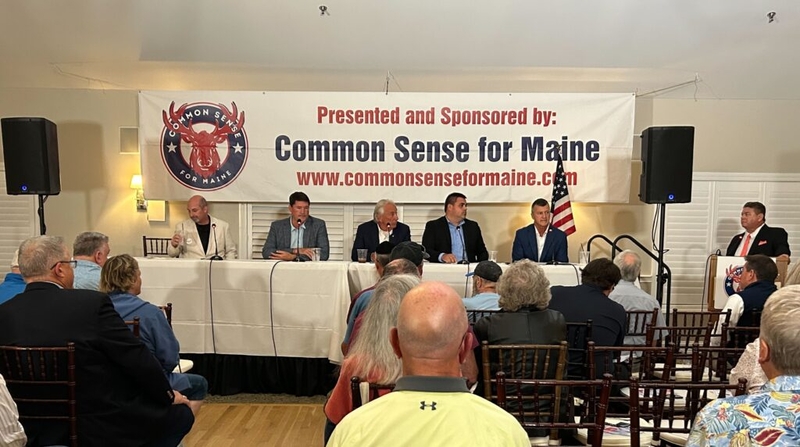
Republican gubernatorial candidates Robert Wessels, Jim Libby, David Jones, Owen McCarthy and Ben Midgley (left to right) participated in a debate in Old Orchard Beach, Maine on Sept. 16, 2025. (Photo by AnnMarie Hilton/ Maine Morning Star)
Five Republicans running for governor took to the debate stage Tuesday evening to talk about some of the state’s most pressing issues.
“If any one of us win, we all win,” candidate Ben Midgley said during his closing remarks, in a nod to the broad agreement shared among those on the stage on many of the topics.
The debate was hosted by Common Sense for Maine, a political action committee that formed earlier this year by a group of businesspeople seeking change in the state with the 2026 elections, and moderated by WLOB radio host Ray Richardson. Midgley, the former president of Planet Fitness, was joined in discussion on energy prices, immigration, tax burden and more by Owen McCarthy, David Jones, Jim Libby and Robert Wessels.
They will first face all other Republican candidates on June 6 in an open primary to determine who will be nominated for the November 2026 ballot. Though they didn’t participate in Tuesday’s debate, Kenneth Capron, Bobby Charles and Steven Sheppard are also running as Republicans.
With a noticeable presence from local police, the event was dedicated to conservative activist Charlie Kirk who was assassinated at Utah Valley University last week. In early August, Kirk attended an event hosted in the same venue as the debate Tuesday, the Dunegrass Country Club in Old Orchard Beach.
Here’s a closer look at how the candidates said they would approach child welfare, the state budget and more.
Energy prices
The candidates all lamented the rise of electricity prices, and said they would support the construction of small modular nuclear reactors in the state.
State law stipulates that any new nuclear energy system would need to be put to voters through a referendum to be brought online. All candidates said that law should be overturned, but Libby, a state senator, acknowledged that nuclear power would be a long-term solution. He said increased use of hydropower (which other candidates also voiced support for) and generating electricity with organic matter, or biomass, could help in the short-term.
“You need help right now and lower costs right now,” Libby said.
Multiple candidates including Midgley and McCarthy, a University of Maine trustee from Gorham, said the state should repeal its solar incentive program known as net energy billing.
Immigration
There are no circumstances in which any of the candidates in Tuesday’s debate would sign a bill that would bar police from cooperating with law enforcement in other states.
Additionally, they all said they would veto a proposal currently on the governor’s desk, LD 1971, which prevents state and local law enforcement from detaining someone solely on the basis of a federal immigration-related request.
Wessels, a small business owner from Paris, said like multiple other candidates he would not support Maine becoming a sanctuary state. He said he also wouldn’t allow state funds to flow to cities that decided to become sanctuary cities.
When discussing immigration, McCarthy and Midgley said the state has a problem with drug activity and overdoses that needs to be addressed.
State budget
Some candidates said they would like to replicate President Donald Trump’s Department of Government Efficiency to help reduce the state budget. Wessels said he’d like to see deregulation across sectors and the end of certain programs such as the Office of New Americans.
“We have to look under the hood and find what we are spending money on,” said Jones, who owns F.O. Bailey Real Estate in Falmouth, and previously founded a commercial construction company.
McCarthy proposed a one-year commission to review every program or project in the state and determine if it should be kept, fixed or closed. He said he would get rid of the Governor’s Office of Policy Innovation and the Future — which Democratic gubernatorial candidate Hannah Pingree had led under Mills — and require other department commissioners to make a case for refilling every position that becomes vacant.
Midgley said he’d like the state to do zero-sum budgeting, which is a process of specifically allocating every dollar and justifying expenses at the start of each budgeting cycle, rather than rely on the previous year’s budget.
Abortion
While Jones and Wessels labeled themselves as pro-life, McCarthy said Republicans have lost too many elections over abortion, in what may have been a reference to former Gov. Paul LePage’s loss to Mills in the 2022 election.
Outlawing abortion wouldn’t work because it has been part of society for many years, Jones said, but “we need to work together to get into the hearts and minds of women so that they understand… [having a child is] the most important thing on earth you can do.”
With the U.S. Supreme Court’s Dobbs v. Jackson Women’s Health Organization decision returning abortion regulation to the states, Midgley said Maine can’t be counted on to be a pro-life state, but there are guardrails that could be put in place. In general, candidates opposed late-term abortion and requiring MaineCare to cover abortion costs.
Though he said he would always recommend life, Libby said that if he were elected governor and presented with a bill that banned all abortions, he would let it become law without his signature. He said he feels people should be led by faith, but the government shouldn’t impose mandates like that on people.
Tax burden
Candidates agreed taxes in Maine are too high. They all said they would repeal the state’s new paid family and medical leave program, calling it another tax on business, but there was some divergence on how to address the tax burden overall.
Jones supports a consumption tax, or a value-added tax, because he said it will divert the tax burden from Maine citizens to the state’s visitors. If income tax could be eliminated, Jones asked, “why not?” He argued that Maine is losing residents to places without income tax, like Florida, so the state needs to make better efforts to retain those residents.
Libby doesn’t agree with a value-added tax, arguing it would drive businesses to neighboring New Hampshire. Rather, he would reduce income taxes by $1 billion and triple the homestead exemption.
Who will replace Janet Mills at the helm? Here’s the latest on Maine’s race for governor.
Wessels supports lowering income tax, but would start by making cuts to property taxes.
Child welfare
Challenges in the state’s child welfare system is the number one moral issue in the state because it involves children, Midgley said during the debate.
“First thing that has to happen is whoever’s governor has to get out there and admit there’s a problem and put a lot of sunshine on it because I think people are going to be horrified,” he said.
His counterparts echoed his concerns about children dying while under state custody. While Libby and Jones also said they would like to separate the Office of Child and Family Services from what they described as a bloated Department of Health and Human Services, Midgley specified that he’d like to see it put under the Department of Public Safety to better integrate the law enforcement component of the system.
McCarthy said the agency needs a “wartime leader” with a high sense of urgency who is willing to make major changes.
Infrastructure
All of the candidates bemoaned the state of Maine’s roads, electric grid, bridges and other infrastructure.
Last December, the Maine Section of the American Society of Civil Engineers gave the state an overall infrastructure grade of C, which was the highest it’s seen since 2008 and places the state just above the national average.
With a career background in construction, Jones said he understands infrastructure, so he would ensure the state gets the “best bang for our buck.” Libby said he would focus on bringing investment into the state and lowering taxes, rather than increasing welfare programs, to increase the state’s resources to spend on roads and other infrastructure.
McCarthy would like to attract more outside investment in the state. He specifically mentioned developing artificial intelligence datacenters and having those entities pay for upgrades to the power grid.
Augusta, ME