Minnesotans will pay for these tariffs and the tax cuts for billionaires
Apr 14, 2025 | 10:10 am ET
Description
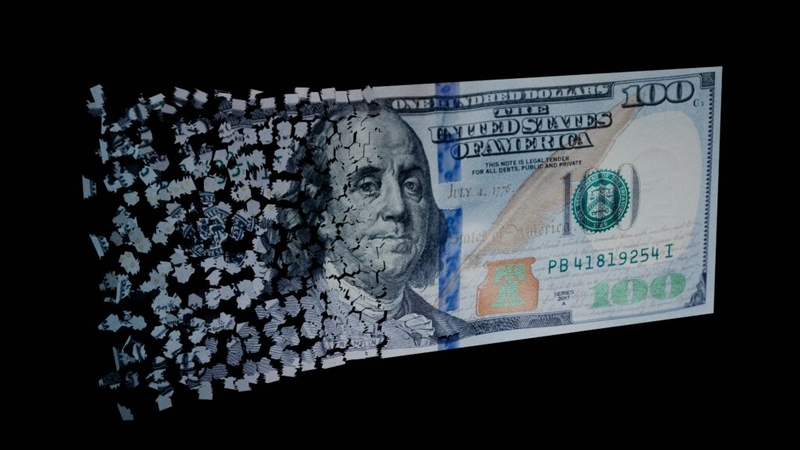
Tariffs and the Trump administration's unreliability threaeten to undo the dollar's status as the world's reserve currency. (Photo illustration by Getty Images)
While a student studying economics, my professors often said that our national debt was nothing to worry about. This was the late 1990’s; the national debt was $5 trillion. They argued that deficit spending was an investment in our economy and in government programs that benefit people. The U.S. was politically powerful and wealthy so we could manage our debt and interest payments, no problem.
In 1946 our debt was 121% of the country’s total economic output, mostly due to WWII, but fell to 32% by 1974. This drop was not a consequence of paying off the country’s debt. It occurred because our economy grew much faster than our accumulating debt.
Today, there is more public concern about the country’s debt level, likely because it is a political talking point. But also because gross debt has grown to $36 trillion. Tax cuts are one of the primary drivers of our growing debt, even though most of the debate is focused on government spending.
The tax cuts to corporations and the wealthy enacted during the first Trump administration increased our national debt by $2.5 trillion. In fact, tax cuts enacted since 2001 are responsible for 57% of the increase in the debt ratio (debt as a percent of economic output). If these tax cuts were never enacted, the debt ratio would be declining, rather than increasing.
Managing the country’s debt is more difficult when the economy slows. The nonpartisan Congressional Budget Office recently released its long-term budget outlook report. The CBO projects that the economy will grow more slowly as the labor force shrinks. And the recently enacted tariffs are forecasted to slow the economy even more, potentially causing a recession.
Now is not the time to have a weak economy. Unlike corporations, the U.S. cannot declare bankruptcy or ask banks to forgive our debt. And selling residency gold cards for $5 million, as President Trump proposed, will not raise sufficient revenue.
The smartest way to manage our debt is to support policies that encourage a growing economy with a strong middle class, political stability and confidence in the U.S. dollar.
To achieve this, Congress needs to work toward a fair tax system. It is short-sighted of Republicans to support large tax cuts for billionaires and profitable corporations. President Trump has proposed reducing the corporate tax rate to 15%, well below the average tax rate of 24% for other developed countries.
Many corporations are only paying effective tax rates of 9%. Minnesota companies Target, General Mills and UnitedHealth Group each had an average effective tax rate of 20% over the past five years, even though their total profits were $60 billion in 2024. In 1993, the top corporate tax rate was 38%, but was as high as 53% in 1942.
Profitable corporations need to pay their fair share: They benefit from good roads, a trained workforce, antitrust oversight and national security. And billionaires do not need a tax cut. Furthermore, it has been shown that cutting taxes does not trickle down or spur economic growth — this did not happen in Kansas or with the Tax Cut and Jobs Act.
Extending tax cuts to corporations and billionaires is a priority for Republicans this year. But these tax cuts fail to solve any problem; tax cuts do not lower costs for Minnesotans. They do not lower the price of eggs, increase the supply of housing, or lower the cost of health care and child care. Instead, Minnesotans will be paying for these tax cuts by cuts to public schools, Social Security, Medicaid, Head Start, the Supplemental Nutrition Assistance Program, Meals on Wheels and cancer research. Minnesotans will sacrifice safe food and drugs, services for veterans, good roads, safe bridges, rural broadband and clean energy.
Tax cuts are so important to Republicans that they are not only threatening to cut programs like Medicaid, Social Security, and services for veterans, but are attempting to use a budget gimmick that assumes the tax cuts are budget neutral. They are not. To pay for the tax cuts, Republicans will be adding trillions to the country’s debt and will need to raise the debt ceiling to $41 trillion.
Minnesota corporations should consider whether tax cuts are worth cutting vital programs for Minnesotans and increasing the debt. Corporate CEOs should realize that it is working Minnesotans who purchase their goods and keep our economy chugging along. Unfortunately, Minnesota families are struggling already and are in no position to pay for large tax cuts for billionaires and corporations.
Tariffs will further harm Minnesotans. Tariffs are a tax on goods that will add 2.5% to consumer prices, cost Minnesotans $5,200 per year, increase unemployment and hurt farmers. The tariffs will only raise $600 billion in revenue, not sufficient to cover the $5 trillion needed for the proposed Republican tax cuts to corporations and billionaires.
The Minnesota CEOs lobbying for tax cuts should rethink their strategy and instead spend their resources convincing Republicans of sound economic policies. Countries are retaliating against U.S. tariffs; China issued a 125% retaliatory tariff tax on U.S. imports and barred an additional 11 companies from doing business in China. Countries are also removing Minnesota products off their shelves and labeling American-made products so their customers may boycott them. These blanket tariffs — including on our longstanding friends and allies — are not sound economic policies; they harm Minnesota businesses, farmers and consumers.
Minnesotans will be harmed by other federal policies that have already been enacted or are in the works to set the table for the tax cut. Minnesota is expecting to lose significant federal funding as the Trump administration cancels grants and closes federal agencies.
Federal funds comprise 35% of Minnesota state revenue, or $23 billion annually. Minnesota could easily lose billions. The federal government rescinded $226 million in federal grants from the Minnesota Department of Health. The University of Minnesota and Mayo could lose $117 million in NIH funding. Minnesota could lose billions in Medicaid funding and expects federal funding cuts for education and human services. All of these cuts will be detrimental to Minnesotans, particularly the most vulnerable.
Other threats could be more consequential than tariffs. Foreign governments may respond to tariffs or other threats by divesting of U.S. Treasury bonds or not holding U.S. dollars in reserve funds. (Currently the dollar is used in approximately 90% of global foreign exchange transactions and nearly 60% of global foreign exchange reserves.) The chaos and uncertainty from Republican leaders will have severe consequences that may damage confidence in the U.S. dollar and decrease our ability to manage the country’s debt.
If President Trump threatens to force foreign governments to swap U.S. Treasuries for cheaper bonds to reduce interest payments; continues to say that there is fraud in the U.S. Treasury debt payments; or interfere with the independent Federal Reserve Bank (like Trump did with the independent Federal Trade Commission), it could undermine U.S. credit worthiness, upset the global financial system, make U.S. Treasury bonds —the world’s safest asset — risky, increase interest rates, cause stagflation, devalue the dollar, and lead to a deep recession.
And then the executive branch could leverage catastrophic economic instability to centralize more power.
The bottom line is that we need a strong and growing economy to manage our debt. To achieve this we need sound economic policies, a fair tax system, financially strong working families and accountable elected officials.
I hope Minnesota Republicans start prioritizing the people they represent, and Minnesota executives lobby for economic policies that benefit their customers and their country, and push back against tariffs.
We need to work together to face our challenges and to continue the journey of realizing the idea of America for all. For our country to succeed, working people need to succeed. This is one lesson we should have learned by now.

Saint Paul, MN