Colorado immigrant protection bill focuses on data protection, ICE access restrictions
Apr 09, 2025 | 2:47 pm ET
Description
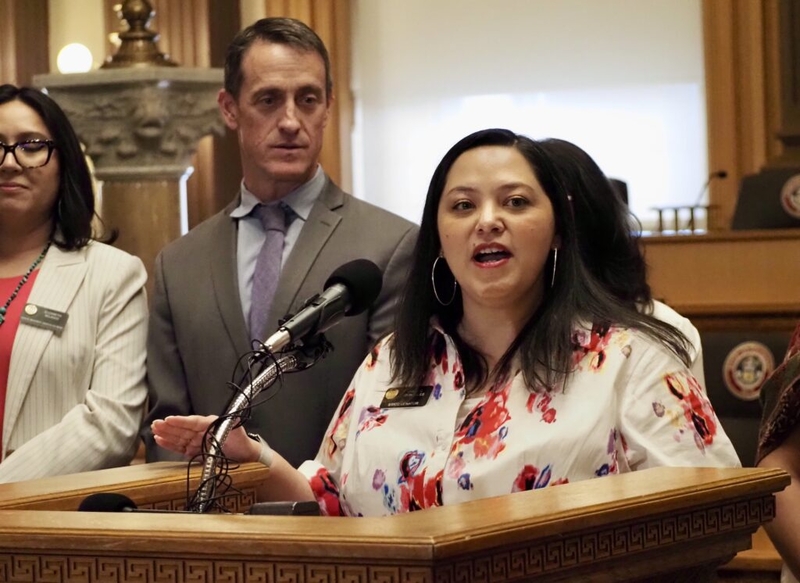
Sen. Julie Gonzales, a Denver Democrat, speaks ahead of a committee hearing on a broad immigrant protection bill at the Colorado Capitol on April 8, 2025. (Sara Wilson/Colorado Newsline)
Democrats in Colorado intend to expand existing protections for immigrants in Colorado who lack permanent legal status as the Trump administration continues its mass deportation efforts.
Senate Bill 25-276 passed its first legislative committee on a party-line vote Tuesday night. It needs to clear the Senate Appropriations Committee before getting a full debate on the chamber floor.
“We’ve seen the Trump administration wield attacks against immigrants, regardless of their immigration status, with increasing frequency and with less and less regard for due process,” Sen. Julie Gonzales, a Denver Democrat, told supporters and journalists ahead of the committee hearing.
“This bill creates clarity amidst the chaos, confusion and uncertainty that our communities are facing,” she said.
Gonzales is running the bill alongside Sen. Mike Weissman, an Aurora Democrat, Rep. Lorena Garcia, an Adams County Democrat, and Rep. Elizabeth Velasco, a Glenwood Springs Democrat.
It comes in the wake of immigration raids in the Denver metro area and the arrest of immigration activist Jeanette Vizguerra outside her work in March. Colorado university students have had their visas revoked, following a national push by the Trump administration to target students who have protested against Israel’s war on Gaza and other contentious issues.
A CBS 60 Minutes report recently found that of the over 200 people that federal authorities transported to a prison in El Salvador, only about 22% have a criminal history in the United States, mostly for non-violent crimes. Some of the people detained in Colorado also had no criminal record, as reported by Colorado Public Radio.
“What we know about the administration’s actions thus far — and good luck trying to find the truth right because it’s a new thing every day — they’re not targeted just to people who’ve committed offenses, despite what they say. They put fear into a broader universe of people,” Weissman said.
Builds on previous laws
Colorado has existing laws that restrict local law enforcement cooperation with Immigration and Customs Enforcement, prohibiting them from arresting a person on behalf of immigration authorities or holding them in jail past their release time so ICE can pick them up. SB-276 would further clarify that local law enforcement cannot delay a person’s release for an immigration enforcement operation. It would also restrict ICE from physical access to non-public spaces in a jail without a warrant.
“When a person posts bond, they need to be released. That’s it. That’s how we roll in the United States of America. And so when those jails are holding people for up to six hours to facilitate ICE apprehension, the jail and the county commissioners for that jail are looking at a Fourth Amendment lawsuit,” immigration lawyer Hans Meyer said. “This is a way for us to make sure that those lines are clear. I don’t like ICE, but ICE can do their job as long as they’re doing their job lawfully.”
State agencies are not allowed to share personally-identifying information — data that is not publicly available such as a birthday, tax identification number, vehicle registration information or fingerprints — with immigration authorities. The bill would extend that prohibition to local governments.
It would also repeal requirements that a person without permanent legal status submit an affidavit saying they intend to, or already have, applied for status when seeking in-state tuition at a public university in the state or for a driver’s license.
“These affidavits serve no constructive purpose, no public benefit, all while collecting sensitive data and private information that potentially exposes individuals to constitutional rights violations,” Velasco said.
Additionally, the bill would prevent federal immigration officers from accessing non-public spaces in schools, hospitals and child care centers without a warrant. Many supporters testified on Tuesday that fear of detention and deportation has created a chilling effect in the immigrant community, creating fear around attending school and seeking medical care.
The bill would also allow immigrants to ask a court to vacate a guilty plea for some additional misdemeanors not currently allowed under law, traffic violations and petty offenses if they weren’t advised by their lawyers of immigration consequences of that plea.
Guilty pleas can make it nearly impossible for immigrants to obtain legal status, such as a green card and eventually apply for citizenship. Aubrey Lesso said her husband’s marijuana conviction from a decade ago prevented him from getting permanent residence after their marriage.
“My husband wasn’t advised of the immigration consequences of this petty offense, so he pleaded guilty and, as he was a minor, all he needed to do was pay a fine instead of going to more court dates,” she said. “We have spent almost four years trying to clean up my husband’s record, but he still doesn’t have a pathway to status.”
That has created a ripple effect, she said, because her husband can’t get a Social Security number or work authorization.
“I always fear that my husband will be detained by ICE, leaving me and my son alone,” she said.
Republicans vote against bill
The bill would set civil penalties, up to $50,000, for violations that would go to the state’s Immigrant Legal Defense Fund. The Colorado Municipal League asked for an amendment Tuesday to exempt local government employees from that liability.
The testimony on Tuesday was almost entirely in support of the bill, including from immigrant rights groups, education advocacy organizations, and groups like the ACLU of Colorado.
Three organizations are officially registered in opposition to the bill: the town of Castle Rock, Strong Advocates For Enforcement in Colorado, or SAFE Colorado, and the Colorado Association of Chiefs of Police.
“This bill is not about civil rights, as its supporters claim. It is about shielding criminal illegal aliens under the guise of virtue signaling,” said John Fabbricatore, a former ICE regional director and leader of SAFE Colorado.
Republican Sens. Rod Pelton of Cheyenne Wells and Byron Pelton of Sterling voted against the bill in committee, a likely foreshadow to universal Republican opposition in the Senate.
Democrats hold majorities in both the Senate and House and do not need Republican votes to pass legislation. The bill now heads to the Senate Appropriations Committee.
Denver, CO