Jury hears details of secret recording during Tina Peters trial
Aug 06, 2024 | 10:19 am ET
Description
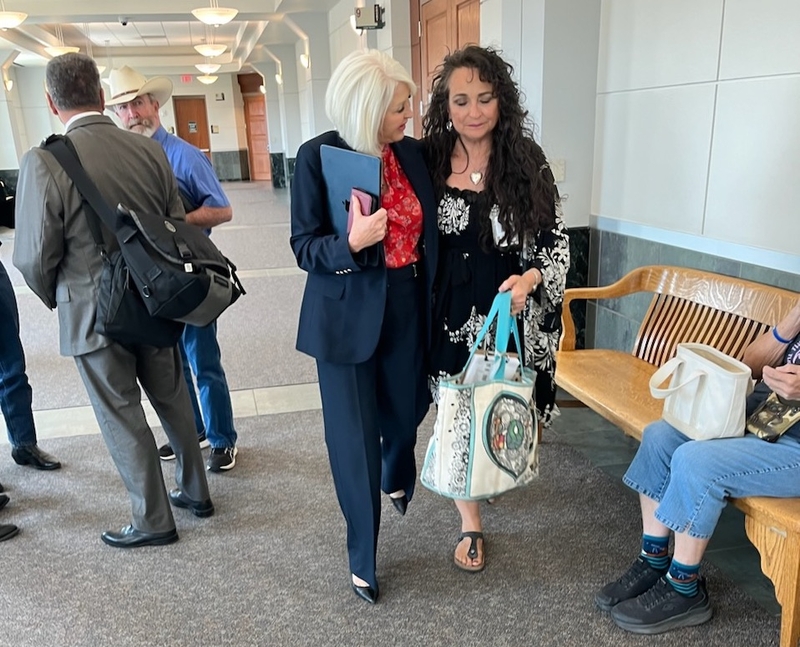
Former Mesa County Clerk Tina Peters, in red shirt, is seen outside the courtroom during her trial in Grand Junction with an unidentified person, Aug. 2, 2024. (Sharon Sullivan for Colorado Newsline)
Stephanie Wenholz did not want to attend an elections conspiracy presentation by math teacher and nationally known election denier Douglas Frank on the evening of April 23, 2021, at a Grand Junction hotel. Wenholz, Mesa County’s front-end elections manager, had been told by her boss, then-Mesa County Clerk and Recorder Tina Peters, that attendance was mandatory, Wenholz testified Monday during Peters’ criminal trial.
“Honestly, the information was kind of like a revival,” Wenholz told the jury. “I was very uncomfortable at this event. I felt my safety was in jeopardy while I was there.”
Earlier that day at the Mesa County elections office in Grand Junction, Wenholz had attended a meeting that included Mesa County Elections Director Brandi Bantz, Peters, Frank, then-deputy Clerk Belinda Knisley, former back-end elections manager Sandra Brown, Peters’ friend and prominent election denier Sherronna Bishop, and attorney Maurice Emmer. Wenholz secretly recorded the meeting, and prosecutors played clips from the recording in court Monday.
Wenholz identified before the court speakers in the recording.
“I think it’s a feather in your cap if you can say, ‘We discovered this corruption in our county and we cleaned it up,'” she identified Frank as saying. Frank is also heard saying, “I’ve been helping people find these phantom ballots,” and “I would be glad to help you. I’ve been going around the country helping lots of people, and Mike Lindell pays me to do that.”
Lindell, the MyPillow CEO, is a prominent election conspiracy theorist.
He’s also heard responding to Bishop’s suggestion of doing an election audit, saying, “I don’t think I’m your guy to do that audit, but I know the team — and they’ll do it for you, and they’ll come in with the best in the country. Because we’re practiced at this now.”
Eventually, Peters told Bantz and Wenholz to leave the meeting.
Key witness takes stand in Tina Peters election security trial
In 2022, a Mesa County grand jury charged Peters, a Republican, with three felony counts of attempting to influence a public servant, three felony counts of conspiracy to commit criminal impersonation and one felony count of identity theft. She also faces three misdemeanor charges of official misconduct, elections violations and failure to comply with the Colorado secretary of state’s office — crimes allegedly committed in a quest to prove that her elections machine were faulty.
Peters is alleged to have participated in a scheme to make a copy of election system data, which resulted in secure passwords and other sensitive information associated with Mesa County’s election system being posted on the internet.
She pleaded not guilty on all counts, saying the charges are politically motivated.
Robert Shapiro, first assistant Colorado attorney general for special prosecutions, is part of the prosecution team, which also includes Deputy Attorney General Janet Drake, Mesa County District Attorney Dan Rubinstein, and investigator James Cannon.
When Shapiro began asking Wenholz about a meeting that occurred in August 2021, she became emotional, prompting Shapiro to ask why mention of the meeting had that effect on her.
“That was the day we received a press release that the secretary of state’s office was investigating our office,” she said. “I pride myself on my abilities that I do. And that day was extremely emotional for all of us … I was crying. It was absolutely heartbreaking … We found out that our passwords were leaked and it was just devastating.”
I was crying. It was absolutely heartbreaking ... We found out that our passwords were leaked and it was just devastating.
The Colorado secretary of state launched an investigation after images of passwords inside the county’s secure elections tabulation room were taken and given to a person who posted the images online. The secretary of state’s office believed the security breach occurred during a May 25 software update, also known as a “trusted build.”
Peters wanted the public to attend the trusted build, but was denied that request. Wenholz testified that Peters was upset and said as clerk she “should be able to do what she wanted to do.”
Wenholz testified that trusted builds had never been a public event, and with the COVID-19 pandemic happening public gatherings were discouraged anyway.
“Best practice is to have a trusted build be closed,” Wenholz said. “It was not a law at that time, but it is now.”
Defense attorney John Case jumped on that point, saying, “So it was not illegal in 2021? If the public had been present it wouldn’t have violated Colorado statute?”
To which Wenholz answered, “It would not have been a crime.”
Also, in 2021, it was not against the law to have surveillance cameras turned off — that’s changed, too, since the Mesa County election systems breach.
The identify theft charge comes from an alleged scheme to use the identity of Fruita resident Gerald Wood to allow a California man named Conan Hayes to access the secure trusted build.
Cameras turned off
Andrew Wetzel, who works in Mesa County’s IT department, also took the witness stand Monday. He testified that then-deputy clerk Knisley requested surveillance cameras be turned off just days before the trusted build on May 25. Wetzel said it had been customary for surveillance cameras to be left on in the tabulation room 24/7.
“I’ve never seen or been requested to turn cameras off,” Wetzel said.
The final witness on Monday was Danny Casias, the secretary of state’s senior voting system specialist, who was present during the trusted build. Casias recalled how “Tina Peters showed up with a man she introduced as Gerald Wood.”
Wood testified Friday that he had not been present at the trusted build, though an access badge had been created for him and was used to access the secure elections area.
Casias said he would have stopped the trusted build immediately if he knew there was an unauthorized person present, or had noticed someone taking images inside the tabulation room.
After the conclusion of Monday’s testimony and the jurors had left the room, defense attorney Dan Hartman argued for allowing information be brought up that had already been deemed inadmissible as evidence.
He claimed that Hayes was a government informant and that Peters had promised to conceal his identity. Hartman said Peters believed she had the authority to execute her public duties to prove machines were corruptible, and that she felt obligated to conceal Hayes’ identity.
Mesa County District Court Judge Matthew Barrett wasn’t buying it, however. He called Hartman’s arguments confusing, prejudicial and a waste of time.
The trial resumes Tuesday.
Denver, CO