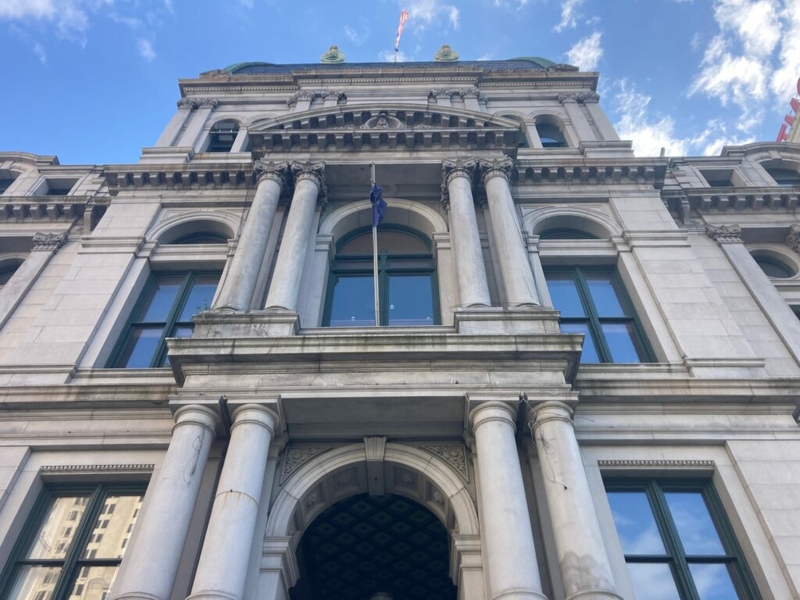
Providence City Hall. (File photo/Rhode Island Current)
The proposed removal of a two-way bike lane on Providence’s South Water Street has the city’s mayor Brett Smiley pedaling uphill against public opinion.
Add the Providence City Council to the list of those opposed to Smiley’s plan, which would cost an estimated $750,000. The City Council voted 10-0 Thursday night to approve a resolution sponsored by Councilor John Goncalves opposing the removal of the bike lanes and the use of Capital Infrastructure Plan funds to do so.
Councilors Juan Pichardo and Pedro Espinal abstained. Councilors Jo-Ann Ryan, Mary Kay Harris, and Oscar Vargas were absent.
The removal of the bike lanes is part of a comprehensive plan Smiley unveiled Wednesday meant to relieve traffic congestion caused by the Washington Bridge closure, although he has called for the removal of the bike lanes since 2022.
“I think it’s worth looking at whether that is in the right place,” Smiley told The Providence Journal reporter Amy Russo in December 2022, a week before he was sworn into office. “At a minimum, I think the parallel parking adjacent to the bike path … is challenging.”
At the time, Smiley said he was “not afraid to ask” whether relocation is necessary, but said a decision “won’t be without consultation of bike advocates as well.”
Smiley proposed that the sidewalk next to the current bike lane be retooled into a new bike lane.
‘Flawed since its inception’
“The Mayor acknowledged that the design of the current bike path on South Water was flawed since its inception and these flaws have only been exacerbated by the increased traffic volume we are seeing as a result of the Washington bridge closure,” Josh Estrella, a city spokesperson, said in an email.
“To be clear, this is both a removal and a replacement of the bike lane on South Water Street. The City will be engaging with the community this summer to gather feedback about the design process for this project which will include a dedicated bike path and a sidewalk. The new urban trail designed with input from our community is an opportunity to develop a permanent bike path that improves both safety and traffic congestion.”
But Smiley has backpedaled before. The mayor got his way — sort of — last year when he announced that PVDFest would be held in September instead of June, and at a new location by the Providence riverfront and pedestrian bridge.
Since 2015, the city’s signature arts festival had brought thousands of people in and around Kennedy Plaza in downtown Providence for three days of artists, concerts, street vendors, food trucks and libations. Smiley not only moved PVDFest to 195 District Park, he made open containers of alcoholic beverages verboten, along with the block parties hosted by downtown businesses. The new riverfront location drew mixed reviews, as businesses complained their revenue declined from previous years, according to Providence Business News. So Smiley’s office announced the 2024 PVD Fest would be back at Kennedy Plaza.
“This is not just about a bike lane,” said Dylan Giles, an organizer with Providence Streets Coalition, during Thursday’s public hearing period. “This is about a part of the city that owes its very identity to the walkability and human scaled nature of infrastructure and development that takes place there.”
Councilor Althea Graves, whose Ward 12 previously voted down a proposed bike lane, said the installation of such amenities should go by the wishes of the people living in the ward. But Graves voted to support Goncalves’ resolution, saying the estimated $750,000 cost of Smiley’s plan was too expensive.
“I want the people in Ward 12 not to hang me, because we voted against a bike lane,” Graves said. “But it has nothing to do with the bike lane. And it has to do with the fact that it’s already there…It makes no sense to tear up something that’s already there.”
The council said the removal of the bike lane would go against its Vision Zero resolution committing to end traffic fatalities and serious injuries by 2030, which Smiley endorsed in February. At the time, officials said Vision Zero was an agreement and commitment to redesign city streets for the safety of all who walk, bike, ride, and drive. Goncalves’ resolution shared statistics that bike lanes can reduce fatalities, annual crashes and pedestrian injuries.
It stated: “The introduction of two-way protected bike lanes, including on South Water Street, has notably resulted in a 10% decrease in fatalities, a 21% decrease in total crashes per year, a 22% decrease in injuries per year, a 55-61% decrease in pedestrian injuries, and a 53-63% decrease in serious injuries, underscoring the significant impact of these lanes on enhancing public safety, as evidenced by an analysis of crash data from 2014-2023.”
Council President Pro Tempore Juan Pichardo, who abstained from the vote, noted lukewarm feedback about the bike path on Broad Street from his constituents and businesses in the area.
“If it’s affecting our residents and community, we should also be able to hear them out,” Pichardo said.