Marianne Raimondo on what’s needed to turn around embattled St. Mary’s Home for Children
Feb 12, 2024 | 4:26 pm ET
Description
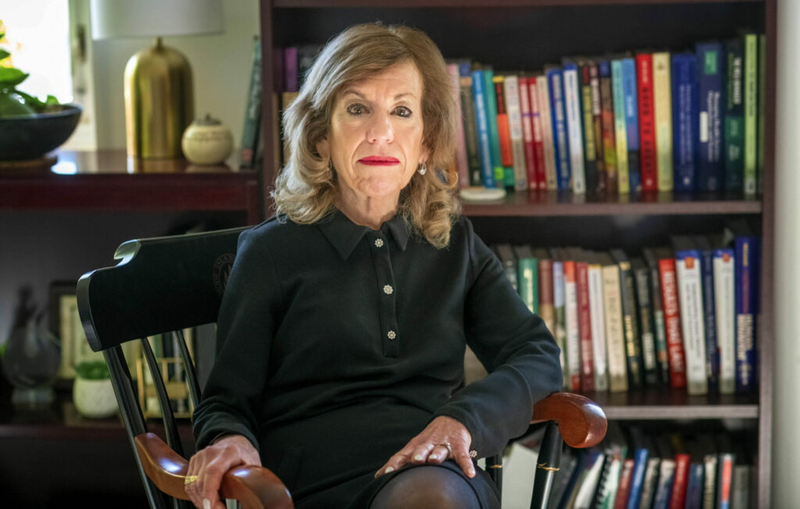
Most of my Marianne Raimondo's career involved consulting to health care organizations, giving her a background in leadership, strategic culture, team building. Now the Rhode Island College Dean of Business is the newest member of the governing board at St. Mary’s Home For Children. (Michael Salerno/Rhode Island Current)
St. Mary’s Home for Children is a familiar sight for Marianne Raimondo. She drives by it every day on her way to work at Rhode Island College, where she serves as dean of the School of Business.
Like many Rhode Islanders, Raimondo was shocked by what’s been going on behind closed doors at the North Providence residential facility — the only one statewide that’s contracted by the Department of Children, Youth and Families (DCYF) for youth psychiatric and behavioral care.
A report from the Office of the Child Advocate released in December detailed no shortage of incidents going on at St. Mary’s, from abuse to imperfect security to overwhelmed staff. Subsequent publicity of the report was followed by the Jan. 4 exit of then-CEO Carlene Casciano-McCann and the Jan. 8 installation of interim CEO Charles Montorio-Archer.
‘We trusted them to care for our neediest, most vulnerable children. And they failed.’
Now, Raimondo — whose sister is Gina Raimondo, former Rhode Island governor and current U.S. Secretary of Commerce — is joining the effort to make over St. Mary’s Home. Raimondo said she was approached by St. Mary’s to join the board of directors, which currently counts 14 members, with six of them officers.
Raimondo holds degrees in chemistry, epidemiology, social work, and her doctorate from University of Massachusetts Amherst is in public health, policy and management. Her credentials also include being a licensed clinical social worker. Hospitals, nursing homes, health centers and doctors’ offices have been some of the places where she’s worked as a consultant on leadership, strategic culture and team building.
Aside from the addition of Raimondo, St. Mary’s announced Monday afternoon the hiring of two new clinical staff: Steven Bonauto, a doctor who will fill the new role of interim medical director, and Brianna McShane Narodowy, who will serve as clinical director for residential services. St. Mary’s is looking to hire more staff as well, with 12 job postings on Indeed.
Raimondo has yet to attend her first board meeting — the next one is Feb. 20 — but she shared some thoughts about her upcoming work with St. Mary’s Home in a Zoom interview.
The interview has been edited for length and clarity.
What made you say yes to St. Mary’s invitation to join its board of directors?
I thought, you know, I’ve had some expertise and knowledge and compassion and would like to help. Here at Rhode Island College a number of years ago, I created the Institute for Education in Healthcare. Through that institute we actually work with a lot of social service agencies to provide training and workforce development. So I’m aware of the needs of these families and children.”
How do you see your experience with health care and social work informing your new role on the board?
When I came to the college, while I came here to teach health care management. I was impressed with the other health care programs here at the college. We have a school of social work. We have a strong mental health counseling program. We have a program in psychology, community education, community health education. My vision at that time was, if we collaborated interdisciplinarily, we could better serve the community. So since that time, we have done that.
While I had not worked directly with St. Mary’s, I have worked with other social service agencies in the state: Tides Family Services, Community Care Alliance, Family Service of Rhode Island. In working with managers, staff, clinicians, in these organizations, of course I’m aware of the needs. So I bring my knowledge of leadership, my years of experience with systems, with policy, with leadership.
I had started teaching religious education in my church and my parish. I then took on the job of director of that program. And at that time, a family started coming to me for help: special needs children, marital problems, substance use problems. I could help them navigate the health system that had been my whole career. I did what I could spiritually. At the end of the day, they wanted counseling. So I came back to school, I was 50 years old, and came back and got a master’s in social work…I had [known] a family with children who ended up in state custody, and St. Mary’s Home was involved in helping this mom, helping these kids. So I’ve always had a heart for the work St. Mary’s does.
[When] I became a licensed clinical social worker, I took a job as a hospice medical social worker. So I was working with people at the end of their life. I had so many dying clients who had had trauma from childhood. Their whole lives were impacted. Here they were, sadly dying, still not having a good life because of that childhood trauma. If I can help impact that in some way at St. Mary’s, then I would like to do that. So that’s a long history of my interest.
What were some of the things in the Child Advocate’s report that surprised you? What was your reaction to that report?
I think, like anybody, “How did this happen?” I feel terribly for the children, the teens and the families impacted by this. Mostly compassion and “Why?” Something went wrong obviously. My mind does always go to leadership. This needs to be corrected because the need is great.
You’re on the board and I’m not sure what exactly each board member can do individually, but what’s your approach to fixing some of these problems?
I’m aware the role of the governing board is not to meddle in day to day operations. So I’m aware that it’s not my job. I’ve only had one meeting with Dr. Charles [Montorio-Archer, the interim CEO], but so far, I’ve been impressed with what he’s already done, his background, his experience. I do place my trust in the management team. I know he’s made changes. I think my job at first is to listen, to assess, because I don’t know — I’m not going to go in and tell people what to do. I don’t know the root causes. I don’t know what led to these bad outcomes. So first I want to learn and then ask some tough, challenging questions, which Dr. Charles has invited me to do. I was happy about that, to dig a little bit, and then to offer support and guidance in their path of improving and moving forward.
What are some of your suggestions for changing the public perceptions of St. Mary’s — which have not been particularly charitable since the report came out?
I think this is part of it: to let the community know that action is being taken. You know, it all rests with the governing board. They’re ultimately responsible. They’re responsible for the lives of the children and teens and families served. The governing board is responsible for fiduciary responsibility, ethical responsibility, so the buck stops with the governing board. I think letting the community know that leadership is changing at that level. I think movement on the executive director, you know, Dr. Charles’ position, letting the community know new leadership is on board.
In my career I’ve worked with lots of organizations who had issues — all kinds of issues, whether it was patient satisfaction, bad clinical outcomes, financial woes. It all starts with leadership, right? In much of my consulting work, change required changes at the top. And I think that’s happened, and so that leads to now a path towards bringing in a strong management team and figuring out what we need to do to support the frontline: workers who day to day interact with the children and adolescents. Whether that’s training, whether it’s new policies, whether it’s more support to those frontline workers — empowering them, listening to them, building a culture of care, compassion and competency — that’s the role I hope to play. But I think assuring the public through news media outlets like this, to let the community know that the organization is committed to doing a better job and preventing this in the future.
Reading the report, it sounded like a lot of St. Mary’s staff were overwhelmed by the environment. How much can leadership affect that at a daily level? What are the logistics?
I think first: ‘What are the values of our organization? What kind of culture do we shape as leaders?’ [With] good leaders, first off there’s a culture of listening to people who deal with those we serve on a day-to-day basis. Leaders need to be open to when employees say ‘We’re overwhelmed, we need help. We don’t have this training, this is more than we can handle.’ I don’t know if that happened [at St. Mary’s]. Sometimes in organizations, employees are afraid to speak up. They fear they’re either not listened to or they’re blamed for the problems. I don’t know what happened, but the first step is creating a leadership practice that’s open and empowering. We gotta listen to these people who do the job every day, who are closest to those we serve. They know where the problems are. They have ideas for improvement. We need to first listen to them if they say, ‘We need more staffing, we need more training. We need a different structure.’ Then we need to respond to that. It could be recruitment practices, hiring practices, training. It could be they don’t get the day-to-day support when they encounter a problem, somebody they can go to to say, ‘I need help here.’ It could be any and all of those. We have to look at that.
What else would you like to emphasize about your new role on the board?
I’m just very committed to this. As I said, my heart is with those kids, and I’m confident we will move forward and hopefully achieve much more positive outcomes.
Providence, RI