With the Voting Rights Act gutted, what’s next for elections?
The U.S. Supreme Court’s decision in Louisiana v. Callais altered Section 2 of the Voting Rights Act.
The decision could upend American politics and hold sweeping consequences for how states and local governments draw district lines at all levels of government, from Congress to school boards.
What does that mean for this year’s midterms, as well as future elections?






In Episode 27, you’ll hear from Jonathan Shorman, democracy reporter for States Newsroom’s D.C. Bureau. From lawmakers scrambling now to redraw congressional maps to the pause of Louisiana’s U.S. House primaries, Shorman has been watching how the states are reacting to the decision.
Then, Professor Rick Hasen unpacks how this could re-shape future elections, and what would need to happen to prevent even more drastic changes. Hasen is an expert on election law and teaches at UCLA School of Law.
Finally, Evening Wrap newsletter author Danielle Gaines shares the top stories she’s watching.
Episode produced and edited by Mallory Cheng. Music for Stories From The States composed by David Singer.
Got questions? An episode idea? Email us at [email protected].
Subscribe to Stories From the States on Apple Podcasts, Spotify and Youtube.
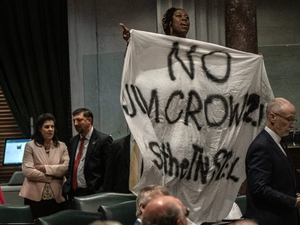
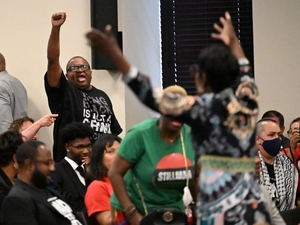
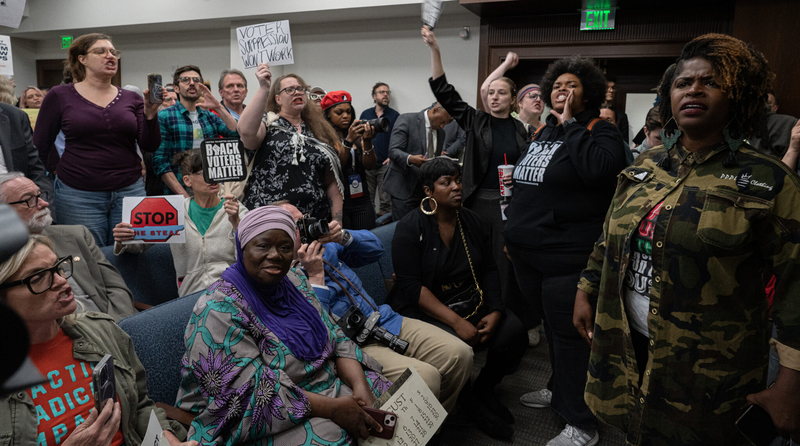
Photo: A crowd fills the Senate State and Local Government Committee meeting on May 6, 2026, to protest against legislative maps that split Memphis from one into three districts. (Photo: John Partipilo/Tennessee Lookout).
Stories From The States is a production of States Newsroom, the nation’s largest state-focused nonprofit news organization, with reporting from every capital. At this pivotal moment in American democracy, our veteran journalists from all 50 states are reporting the consequences of government decision making. By zooming into one story each week, Stories From the States contextualizes and gives a human voice to what is happening now.
Transcript was created using an automated software.
Alabama State Senator Merika Coleman
The court didn't tell them that we need to come into a special session. The court didn't tell them to spend taxpayers dollars. This is a power grab. So hell no, we not gonna let it go. Power to the people, y'all. Power to the people.
Protest crowd
Two seats now. Two seats now. Two seats now.
Chris Fitzsimon
Th...
Transcript was created using an automated software.
Alabama State Senator Merika Coleman
The court didn't tell them that we need to come into a special session. The court didn't tell them to spend taxpayers dollars. This is a power grab. So hell no, we not gonna let it go. Power to the people, y'all. Power to the people.
Protest crowd
Two seats now. Two seats now. Two seats now.
Chris Fitzsimon
This is Stories From The States. I'm Chris Fitzsimon. Here at States Newsroom… we know there’s a lot going on around the country in every state capital…thanks for being here. Today we're talking about the dramatic changes to the Voting Rights Act of 1965. The U.S. Supreme Court's recent decision in Louisiana versus Callais weakened Section Two of the Act that's designed to prevent racial discrimination. Now state and local governments could redraw district lines at all levels. Alabama is already holding a special session. As protesters, as you just heard, rallied outside the state house against it. But what does that mean for this year's midterms and future elections to come?
Professor Rick Hasen
What we're going to see in the short term is going to be more partisan gerrymandering, more gerrymandering. That's going to make it harder for minority voters to elect their candidates of choice.
Chris Fitzsimon
But first, how are other states reacting to the overhaul of the Voting Rights Act?From states scrambling to redraw congressional maps to the pause of Louisiana's US House primaries, States Newsroom, democracy reporter has been covering what's going on. We'll hear from him in a moment.
Chris Fitzsimon
The US Supreme Court has gutted the Federal Voting Rights Act with its decision in a case called Louisiana versus Callais. The decision could upend American politics and have sweeping consequences for how states and local governments draw district lines at all levels of government, from Congress all the way down to school boards. Joining us now to help us understand what all this means is Jonathan Shorman. He's the democracy reporter for States Bewsrooms, DC Bureau, and he's been covering how states have been reacting. Just a programming note, we're recording this episode on Wednesday, May 6, so there may be some additional changes after we record. Hi Jonathan.
Jonathan Shorman
Hey Chris.
Chris Fitzsimon
Well, quite, uh, quite a week or 10 days for you, I am sure, for folks who don't follow this day to day, like like you do, how significant is this decision in determining not only how we vote but who we can vote for?
Jonathan Shorman
I would say it's probably one of the most consequential Supreme Court cases as it relates to voting rights ever, but certainly one of the most significant actions relating to voting rights, at least dating back to the actual passage in 1965 of the Federal Voting Rights Act.
Chris Fitzsimon
And so what does it mean? The obvious thing, I think that a lot of people are getting from this, is that, and we can talk about which states and how it's working, is that southern states who are covered by this will be scrambling, either this year or in two years, to draw districts that will be, well, for lack of a better word, whiter than they have been.
Jonathan Shorman
Right. So kind of the Voting Rights Act in 1965 did a number of things. Some of those things have been weakened over the years, but what was kind of at the core of this decision is previously, or at least what's been in place for several decades, was these protections for what we call majority minority districts, essentially congressional districts, but but sometimes Statehouse districts, school boards like we were talking about, districts where most residents were from a more minority group. Often that was a Black residence, but it could be Hispanic or any other minority group. And when that is the case, often those districts receive kind of greater protection from what we call gerrymandering, or the idea that you're going to redraw these lines for political benefit or some other kind of advantage. And that the reason behind that was basically to ensure that Black voters who, for obvious reasons, have been historically kind of disadvantaged when it comes to race. You know, suffered under Jim Crow laws that they were able to elect politicians of their choosing. And so now this decision says you really can't consider race anymore when you are drawing these districts. So these districts are free to be kind of carved up, split apart in ways that will, over time, most likely limit the ability of Black voters to elect Black members or any other politicians of their choice to Congress or other offices.
Chris Fitzsimon
You know, when I was reading about the before this case was decided, when it was argued, I think the conventional wisdom among the pundit class, for lack of a better word, was that this wouldn't have much effect on the '26 elections. This is a question for '28 and yet, as you have reported and others, it looks like some of these southern states are now scrambling to try to or at least considering scrambling to affect this this upcoming election.
Jonathan Shorman
Right. I'll admit, kind of before the decision, I kind of expected the consequences for this year to be somewhat limited, just because of the timeline, but we've really seen in the last week just kind of an extraordinary move to from some of these southern states to act quickly to the extent that Louisiana has even, we have great reporting from our partner, The Illuminator down there. You know, they have even gone as far as to set aside some 42,000 votes that have already been cast in their primary election. That's, that's extraordinary. There's litigation over that. So that that kind of illustrates the kind of lengths that are some of these states are going toward to be able to put these maps into place, and President Trump has explicitly urged these states to do so, saying, you know, I'm paraphrasing here, but even if you need to vote twice to get these maps in place, go and do it.
Chris Fitzsimon
You mentioned the 42,000 I guess, absentee ballots in Louisiana, I thought that was unbelievable. And I guess there's no there's no recourse for those voters, other than there is litigation that's been filed. But I'm not sure what the remedy would be.
Jonathan Shorman
Right. I think there is at least one lawsuit in state court in Louisiana that seeks to basically say, 'No, you have to keep going with the election.' So the remedy would basically be saying, you know, you have to complete this election. You have to count these votes.
Chris Fitzsimon
So I noticed, let's talk about some of the other states. Tennessee have had a very controversial session. Florida already passed a law. Seems like they knew the decision was coming. Just saw some of our reporting that South Carolina is considering. Alabama. It really is. It's not just one or two states.
Jonathan Shorman
Right. So, so we have those, those states that you mentioned, I think Mississippi, they have not opened up to congressional redistricting, but they are kind of, interestingly enough, going to have a special session on their state Supreme Court districts later this month, and we'll, we'll see if that gets expanded. But, yeah, Tennessee, Alabama, Florida has already enacted. Louisiana, which, you know, Louisiana arguably has the strongest case to act because, I mean, their map was actually at the center of this Supreme Court decision. So you mentioned Florida's already acted. We'll see what South Carolina does. You know that we have about roughly half a dozen states in play here, and that's just this year. But really, when we talk about the real fallout and the real big consequences from this decision, after 2026 you're going to see this kind of expand nationwide, where more or less any state is going to have an opportunity to kind of go and try to redraw their map. So when you think about the kind of redistricting, the gerrymandering wars that we've had over the last few months, even before this decision, that's just kind of a preview of what we're going to see next year. It's actually I would expect it to be even more intense and even more sweeping next year.
Chris Fitzsimon
And I guess in that case, some of the blue state governors were already saying, if, if a lot of these states draw out all the Democrats or all the Black members of Congress, they will then do the same to Republicans. Is that what we're talking about?
Jonathan Shorman
Right. Right. So this year, before Callais you had voters in California and Virginia basically vote to codify Democratic gerrymanders. There's discussions ongoing in New York State, obviously, because of their large population, there could be a number of seats at play there. There's discussions in other New England states, ironically, some of those states tend to be the ones that have restrictions on gerrymandering, that have either adopted independent commissions or have provisions in their state constitutions, kind of limiting what you can do. So it's actually in some of the for some of those Democratic gerrymandering gerrymanders, it's going to be more difficult for state legislators to kind of get at those maps. Or either going to have to find ways to work around these restrictions or ask voters first to suspend some of these provisions.
Chris Fitzsimon
But I'm old enough to remember, as the saying goes...When redistricting was generally only done after the 10 year census. I guess there were, there were some exceptions, but it feels like that's completely out the window. Now we're not only doing it in mid decade. We might be doing it twice in the middle of a decade.
Jonathan Shorman
Right. Basically, before this, you might have one state where they had a court case over a map, and the map was thrown out, and they had to redraw mid, mid decade, but, but basically, there has been this norm, like many other things in the Trump era, there's there was essentially been a norm against mid decade, mid decade redistricting, and this year, or really last year, Trump said, you know, I want Republican states, beginning with Texas, and then he went on the other states that redraw their maps for partisan advantage. And states started doing it. And basically, we've, we've found out that there's really no legal there's nothing legally stopping states from doing this. So this might become more of a feature of our politics going forward.
Chris Fitzsimon
It used to be. It doesn't seem like it was that long ago, not to keep referring to my age, but that Republicans and Democrats, citizens, at least, thought it was a good idea to have those restrictions that you mentioned, and that, I guess Iowa was one of the first states where, let's have a fair whatever that means, but a non partisan commission or somebody to look at these districts and sort of divide them up, regardless of the politics and where people live, that seems like such a novel concept at the moment.
Jonathan Shorman
Right. I think it's, it's kind of clashes with a growing awareness in recent years that that all of this happens these parties act with with kind of a national map in mind. So if you, if you kind of handcuff yourself as a state, you're basically, you know, the thinking goes, that's great, but really, you know, you have to think of this as kind of a national contest for control of Congress, control of the US House. And so it doesn't really do you any good, necessarily, as a as an individual state to kind of handcuff yourself and limit your options. Opponents of gerrymandering are still, even if they're maybe have squishy feelings about some of this kind of pushback, they are still very much against gerrymandering. But I think there's a growing recognition that, I guess, the solution to gerrymandering at a national level is going to have to come from Congress. Congress almost certainly has the authority to ban mid decade redistricting. They probably have the authority to require states to use independent commissions and set some other criteria and how they draw their maps. But we've all seen how kind of tough it is to get major legislation through Congress. So even that path is going to probably would take years before something like that could happen. But I think there is a growing recognition that ultimately gerrymandering is going to have to be solved by Congress at some point.
Chris Fitzsimon
And maybe ending where we began, in terms of the Voting Rights Act. I suppose that would take, I don't know if, Congress could act and the court would have to strike it down, or the Democrats, or people who who favored the Voting Rights Act or wanted to keep it more intact, would have to wait on a new court?
Jonathan Shorman
Not necessarily a new court. I think most Democrats want to pass what's called the John Lewis Voting Rights Act, after the late congressman and civil rights activist. The key that that bill does a few things, some of those might be impacted by Callais, but the key thing that that bill does is restore pre clearance, which essentially is the idea that states with a history of racial business discrimination, voting used to have to obtain federal permission before they made major changes to their election procedures or voting rights laws, that the Supreme Court put a pause to that on 2013 in 2013. They did not strike down pre clearance. They said the criteria for pre clearance was outdated, because it really hadn't been updated since the 60s. And so there's some hope that if we passed, if Democrats passed, a bill that basically set new criteria for pre clearance, that that would be a way of restoring a major protection for voting rights.
Chris Fitzsimon
Well, it's such a historic moment, we appreciate you covering it so well and bringing us up to date. Thanks for being with us.
Jonathan Shorman
Thanks for having me on.
Chris Fitzsimon
To stay up to date on how your state is reacting to the changes to the Voting Rights Act. You can always go to newsfromthe states.com. With all that's happening in the states now, what could this mean for upcoming elections? In a moment, we'll chat with election expert and UCLA School of Law Professor Rick Hasen about what he's preparing for. We'll be right back.
Moses Esheit
At a time when so many communities are losing their local news outlets. States Newsroom is filling a gap. We are now the nation's largest state focused nonprofit news organization with reporters based in every state capital and Washington, DC. But we can't do it without your support. Your contributions allow us to produce award winning journalism and deliver it to you for free. No pop ups, no pay walls. This is a crucial time to support local journalism, and every bit helps to give go to statesnewsroom.com/donate.
Chris Fitzsimon
The United States Supreme Court recent decision in Louisiana versus Callais was an earthquake in the election law world, the Voting Rights world, the Civil Rights world. But what does that all mean for the midterms and future elections to come? What about other attacks on voting rights and election integrity as we head toward the midterms? Joining us now to talk about all that is Rick Hasen. He's an expert on election law and teaches at the UCLA Law School. Rick, thank you for being here.
Professor Rick Hasen
Good to be with you.
Chris Fitzsimon
I want to talk about larger election law, but first, what was your reaction to the Supreme Court decision that, in effect, gutted the last major part of the Voting Rights Act? Were you surprised?
Professor Rick Hasen
Well, I would say that I was not surprised, but I was disappointed with the ruling. The writing was on the wall ever since last summer when the Supreme Court didn't decide the Callais case after it was first argued and set re argument and put the Voting Rights Act in the crosshairs. What was most disappointing about the decision was that it comes across as though it is simply re working or updating the law, when, in fact, what it's doing is making it virtually impossible for minority voters to be able to bring claims that would show that they've been denied their opportunity to elect their candidates of choice.
Chris Fitzsimon
Yeah, for folks who don't follow this, and you know, most Americans are just voters, and they're consumers and they're busy. Can you give us some kind of historical perspective? I mean, it wasn't before the Voting Rights Act. It was fairly unusual to have Black or Hispanic lawmakers in either state level or federal level seats.
Professor Rick Hasen
So the Voting Rights Act was first passed in 1965 and it accomplished some very important things, for example, Black voter registration in Mississippi in 1964 was under 7% and in 1968 after the passage of the Voting Rights Act, it was almost 60% so that was very dramatic, but it was clear, after a few decades of the Voting Rights Act being in place that there was still a problem with minority representation. So if you took a place like the city of Mobile, Alabama, which was the subject of a famous Supreme Court case, there were about a third of the population was Black, two thirds white. They voted for different candidates, and they voted in at large elections, and that meant that every candidate on the city council was a white preferred candidate. So there was an amendment to the Voting Rights Act in 1982 to Section Two of the amendment. That was what was at issue in Callais, and that amendment provided that minority voters should have the same opportunities as other voters to participate in the political process and to elect representatives of their choice. What that's meant in practice until Callais is that under certain circumstances where white and minority voters prefer different candidates and where the group is geographically concentrated, there's sometimes a requirement to draw a district where the minority voters have a fair chance to elect their candidate of choice. That has led to a great increase in minority voting rights, it has led to more minority preferred candidates being elected in Congress, in state legislatures, as well as in local bodies like city councils and county boards of supervisors.
Chris Fitzsimon
And obviously, the second part of that is without this in place. Do you expect we will if all things stayed the same, according to this ruling, if we were talking in four years or six years, would there be? Will there be far fewer people of color in office at all levels of government?
Professor Rick Hasen
So I think that both the Republican Party and the Democratic Party will have an incentive to try to unpack these districts that has spread. These voters, especially Black voters, are among the most reliable voters for the Democratic Party. There's a huge overlap here between race and party, which was a big part of what the court talked about in Callais. And so what's going to happen is, and it's already happening now, is that Republican states that had been forced by the Voting Rights Act to draw districts for Congress or for other bodies where where minority preferred candidates can be elected, they're going to dismantle those districts. And they're going to crack those populations and probably create more districts that are going to be represented by white Republicans. Democrats, too are going to have some incentives to spread these reliable Democratic vote voters out, perhaps creating more Democratic districts, but fewer districts where minority voters get to get their first choice for who is elected to office.
Chris Fitzsimon
So is this the the end of the Voting Rights Act? Or there I've seen different analyzes written, obviously this was a was the third big decision that whatever word you want to use, gutted it or eviscerated it, is the Voting Rights Act still a viable act that can be used to battle discrimination and electoral law?
Professor Rick Hasen
Well, the Voting Rights Act has other components. There's a component, for example, that requires that ballots to be and other ballot materials be provided in different languages when there are significant numbers of language minorities. There's a part of the Voting Rights Act that bans literacy tests to be used for voting. So there are still parts of the Voting Rights Act that are still in play, but the two big pillars of the Voting Rights Act, Section Two, which we've been talking about in Callais and Section Five, which was a part of the Voting Rights Act that required jurisdictions with a history of race discrimination to get federal approval before they make changes in their voting rules. That part of the Voting Rights Act was killed off by the Supreme Court in the Shelby County versus Holder case in 2013. So it's fair to say that the Voting Rights Act has been denuded of its major powers, and the way that the Supreme Court wrote the decision, it's going to be difficult for Congress to come back and write a new voting rights act that at least in front of this court would be found to be constitutional under the 14th Amendment's Equal Protection Clause and the 15th Amendment ban on discrimination and voting on the basis of race.
Chris Fitzsimon
So it sounds like the recourse for folks who are upset about this ruling or wish the Voting Rights Act could be restrengthened or taken back to its previous impact would be to wait for a new court, or is that, though, is that what actually will happen?
Professor Rick Hasen
Well, one way that this could change is if the court's personnel changed. Another way that this could change is if Congress passes a new law and basically dares the Supreme Court to strike this new law down. That would be, I think, an important political message that would be sent. There may be other ways of trying to deal with the problem of minority representation. One way, for example, would be to move towards more proportional representation systems, where people could vote for parties. There could be lists of members of the parties, and then those lists could then provide more diversity in who the candidates are. I think we're just at the very beginning of things. What we're going to see in the short term is going to be more partisan gerrymandering, more gerrymandering. That's going to make it harder for minority voters to elect their candidates of choice. But it's hard to know where this ends up, because I think this kind of earthquake in American politics is likely to provoke a counter reaction. It is potentially likely to spur new movements towards greater civil rights.
Chris Fitzsimon
And finally, before I let you go, and we appreciate your time, but you have written extensively about election law, not just the Voting Rights Act. And I wondered, here we are approaching the summer, the midterm elections are just around the corner. The 2028 elections are coming, and it feels like people might be confused as to what they read about mail in ballots. Are votes going to be counted? Are the elections going to be safe and have integrity? What are you what are your primary concerns about the midterm elections, given the political climate and the legal challenges that we're all facing.
Professor Rick Hasen
Well, the important thing to recognize is that it's mostly states that have the control over how ballots are to be cast, and so in those states that have adopted mail in voting, that mail in voting is going to continue, we see very little fraud with mail in ballots. We see very high rates of compliance with the law, and so really the big question mark now, I'd say there are two. One is the Supreme Court has pending before in a case called Watson, where the court might say that even if states allow for ballots to arrive after Election Day, they can't be counted in federal races. We're not sure if and when the court is going to rule on that case, but it's always prudent if you're going to vote by mail, to vote as early as possible to make sure your ballot is received and is fairly counted. The other question mark is Donald Trump, who has put forth a second executive order related to voting, and this one would try to change some of the rules that the United States Postal Service would use in order to when it would deliver mail in ballots. This executive order, which is not a law, it's just what the President is directing internal parts of the federal government to do, has already been challenged in court, and I think it's very unlikely that anything that he's trying to do in that measure that would affect mail in balloting would actually be in place in time for the 2026, midterm elections.
Chris Fitzsimon
And finally, along those lines, you mentioned the president, there's been a lot of publicity about the Department of Justice requesting voter rolls from states. Obviously they confiscated ballots in Fulton County, Georgia. I realized that elections are ruled by the states. But is there, are there things that you're worried about the federal government sort of stepping in, either in 2026 or 2028 indicated by all these sort of machinations we're seeing?
Professor Rick Hasen
I do have concerns. There's no legitimate reason why the Department of Justice is trying to seize ballots from the 2020 election, or try to get information about election workers who worked in 2020. The 2020 election was fairly conducted. There have been numerous investigations. There's been no evidence whatsoever of any kind of fraud or inaccuracy in what the results were in Georgia or elsewhere. Either this is some kind of way of placating the president, who seems to be somewhat obsessed with having lost in 2020 or it's a way to further undermine people's confidence the election process, which might be important for Donald Trump if, in fact, Democrats retake control of the House of Representatives, he might try to delegitimize Democratic victories by claiming without evidence, that it's because of fraud or most worrisome is the possibility that this is kind of a test run for 2026 and I certainly hope that steps are going to be taken to ensure that the federal government can try to seize ballots in an election that is still ongoing where we still don't have a final decision. And or whether maybe ballots that would be subject to a recount. So we're in this odd position where states have to protect themselves from the federal government in 2026 to assure the integrity of American elections.
Chris Fitzsimon
Well, thank you so much for helping us understand all that and all the work that you're doing. Thank you so much.
Professor Rick Hasen
It was great to talk to you.
Protest crowd
Capitalism! Turn me around. Turn me around. Turn me around. Ain't gonna let capitalism. Turn me around, I'm gonna keep on a-walkin', keep on a-talkin', marchin' out to freedomland.
Protest crowd
Shame! Shame Shame!
Chris Fitzsimon
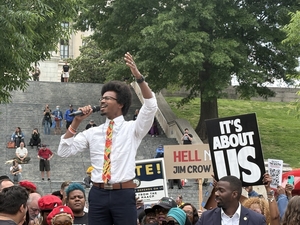
Many voters aren't too happy with their state representatives on this move to eliminate majority minority districts, what you're hearing are protests that have erupted in Tennessee. More is to come with the fallout of this Supreme Court decision to stay up to date on how your community and others across the country are reacting to the redistricting scramble. You can go to newsfromthe states.com. We'll be right back.
Chris Fitzsimon
I don't know about you, but the first thing in the morning I like to have some coffee and try to catch up on all the news that I missed. One of my favorite new morning newsletters is Daybreak from States Newsroom. Daybreak gives you a quick 50 state snapshot on vital issues and how they're affecting state policies around the country. Start your day informed. Subscribe to Daybreak at statesnewsroom.com/subscribe.
Chris Fitzsimon
And joining us now, as she does every week at this time, is States Newsrooms Evening Wrap newsletter writer Danielle Gaines. Hi, Danielle.
Danielle Gaines
Hi Chris. How are you?
Chris Fitzsimon
I am well, quite a week in the news business. I make interested to see what you what caught your eye?
Danielle Gaines
So much news, and I'm interested to listen to your conversation from earlier in this podcast, as we just see more and more stories about redistricting. So I figured I'd go a different direction and start us off talking about some water issues in the West.
Chris Fitzsimon
Interesting.
Danielle Gaines
Yeah, yeah. So we had this story this week out of Utah, right along the Wyoming border at the Flaming Gorge Reservoir, and our reporters talked with the owners at a marina on the reservoir, and folks kind of all throughout the small community surrounding it, about a plan by federal officials to release about a third of the water from that reservoir and send it downstream. So the water needs to be sent downstream to go to Lake Powell, which is hundreds of miles away in Utah and Arizona. A dam at Lake Powell generates electricity for more than 350,000 homes that is currently imperiled by the drought conditions in the West. And both of these bodies of water are part of the Colorado River Basin, which is, you know, dealing with drought, climate issues, it's providing electricity and irrigation to wide swaths of the West, drinking water for 40 million people within that basin. And this was just a story about what really happens. It really illustrated the dynamics and the fallout as you start moving water around these different communities. So Flaming Gorge Reservoir is a community that relies on recreation, and losing a third of their water is going to be a really big issue for them.
Chris Fitzsimon
I think a lot of folks, including me, who live in the east, have until you really think about it, don't understand just how giant a deal is water, especially in the West. I mean, it has really defined so many of their debates.
Danielle Gaines
Well, and the states, we're supposed to come together on new allocations for how they use that limited Colorado River water. And of course, they couldn't reach a decision on their own, so the federal government is stepping in. Is going to make a decision by October 1st. But we've had a lot of water stories this week. And, you know, something else we talked about on the podcast, data centers, and how that's impacting this is just adding a whole nother layer onto an already really complicated issue.
Chris Fitzsimon
Yeah, absolutely. It feels like every week there's another giant data center either approved or a protest that has erupted. What about something coming up?
Danielle Gaines
Yeah, something that I'm watching. We'll stick with the West a little bit. I guess we'll stay in Colorado this time. And the state was sued, or there were two lawsuits filed in the state this week challenging gun control laws. So the first was challenged by the Trump administration to the state's ban on high capacity magazines for rifles. The state has restricted the sale and possession of magazines over 15 rounds since the awful mass shooting in the Aurora movie theater in 2012 and the Justice Department also sued the city of Denver over its assault weapons ban, which has been in place since 1989.
Chris Fitzsimon
I had no idea.
Danielle Gaines
Yeah, longer than a lot of listeners of this podcast have been alive, maybe. So they sued. This was a lawsuit brought by the Justice Department's Civil Rights Division, as it exists in the Trump era, because it's a violation of the Second Amendment, they argue. Denver officials called it baseless and a clear overreach. The State Attorney General had said this lawsuit is part of the Trump administration effort that basically turns the mission of the Civil Rights Division on its head, and they are vowing to fight we also had one other interesting story about gun control this week. If I could share it?
Chris Fitzsimon
Sure, absolutely go ahead.
Danielle Gaines
And that is a group of attorneys general, Democratic attorneys general from across the country. 22 of them are challenging this US Postal Service rule that's in the rulemaking regulatory process that would allow you to send guns through the mail.
Chris Fitzsimon
I read that and couldn't.. That's bizarre.
Danielle Gaines
That has been a law since 1927 nothing new. And AGS are concerned about this just making it easier for guns to get in the wrong hands of the wrong people.
Chris Fitzsimon
1927 that is definitely before a lot of people listening to the podcast were born, probably. And what about one last thing?
Danielle Gaines
Yeah, one last thing. We had this story this week. It kind of just tugged on my heart strings a little bit, because it's an issue I'm familiar with, and that's the issue of problem solving courts. I don't know if a lot of people know about them. I was a longtime reporter in Maryland, and I shadowed a problem solving court in Maryland for a whole year. So these are court systems that are set up to help people avoid incarceration by instead kind of coming into court, being under a judge's supervision, they usually attend once a week and check in with prosecutors, defense attorneys, judges. They have to make progress on, if it's a drug court, which is what I followed, for example, on counseling, on treatment, on any, you know, community service component of of what they're doing. And the state of Nebraska declared May problem solving courts month, and they had a ceremony. It was very interesting. The state has been growing its problem solving courts aggressively. So 43 judges in the state watch over 35 problem solving courts. There are drug courts like I talked about. There are DUI courts, veterans treatment courts, where you can help veterans who are having any number of issues connect with the resources that they need. Family treatment courts, which help families get through issues. And as part of this, a recent graduate of a drug court was there with all of the state Supreme Court justices getting recognized, and I thought that was an incredible testament kind of to this system.
Chris Fitzsimon
Yeah, nice to hear something that helps the community and works,
Danielle Gaines
Yeah! And he actually, he became a mentor in his in his drug court by the time he had graduated, it is now helping other folks.
Chris Fitzsimon
Very, very cool. Well, thank you. As always, Danielle, we appreciate it.
Danielle Gaines
Thank you.
Chris Fitzsimon
Thanks for listening to Stories From The States. I'm Chris Fitzsimon. Mallory Cheng produced and edited the podcast. David Singer produced our theme music, a special thank you to Ralph Chapoco from the Alabama Reflector, and Holly McCall at the Tennessee Lookout. If you liked what you've heard today, please leave us a rating and review. It means a lot to know what you think about the podcast. To stay up to date on the latest episodes, subscribe now to Stories From The States, a podcast from States Newsroom. Available wherever you listen to podcasts. We'll talk to you soonn