Keeping ICE in check, how Memphis and Minneapolis are doing it
In the days since Jan. 7, when Renee Nicole Good was killed by ICE agent Jonathan Ross in Minneapolis, the public is getting a closer look at how many communities are resisting the Trump administration’s immigration crackdown.
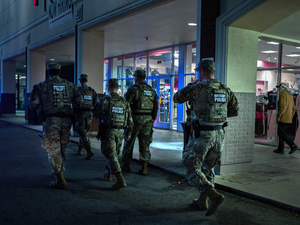
Building on resistance efforts in Los Angeles and Chicago, volunteer rapid-response teams and loosely organized patrols in Minneapolis and other cities are tracking and following federal immigration agents to disrupt operations and alert neighbors with whistles and car horns.
The work has become increasingly risky as tensions soar and confrontations between federal agents and volunteers escalate. Yet even after Good’s death, volunteers continue to mobilize in targeted neighborhoods.
In Minneapolis, a Minnesota Reformer reporter rode along on a recent patrol and spoke with several volunteers determined to keep up their work.


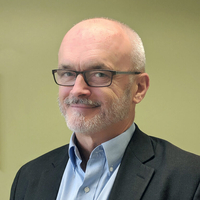


In Episode 11, you’ll also meet Carlos Ochoa. He is a volunteer for Vecindarios 901, a rapid response network reporting on Immigration and Customs Enforcement activities.
They were established during the first Trump term. Now in Trump’s second term, Vecindarios 901 has kicked into high gear to document the activities of the Memphis Safe Task Force. The multi-agency law enforcement force launched September 15, 2025 by President Donald Trump.
Then, you’ll hear from Minnesota Reformer reporter Madison McVan who has been reporting on the ground in Minneapolis.
Finally, Evening Wrap newsletter author Danielle Gaines shares the top stories she’s watching.
Episode produced and edited by Mallory Cheng. Music for Stories From The States composed by David Singer.
Subscribe to Stories From the States on Apple Podcasts, Spotify and Youtube.
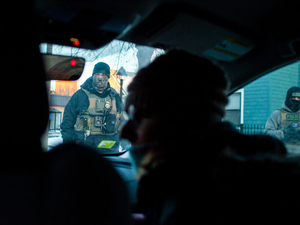
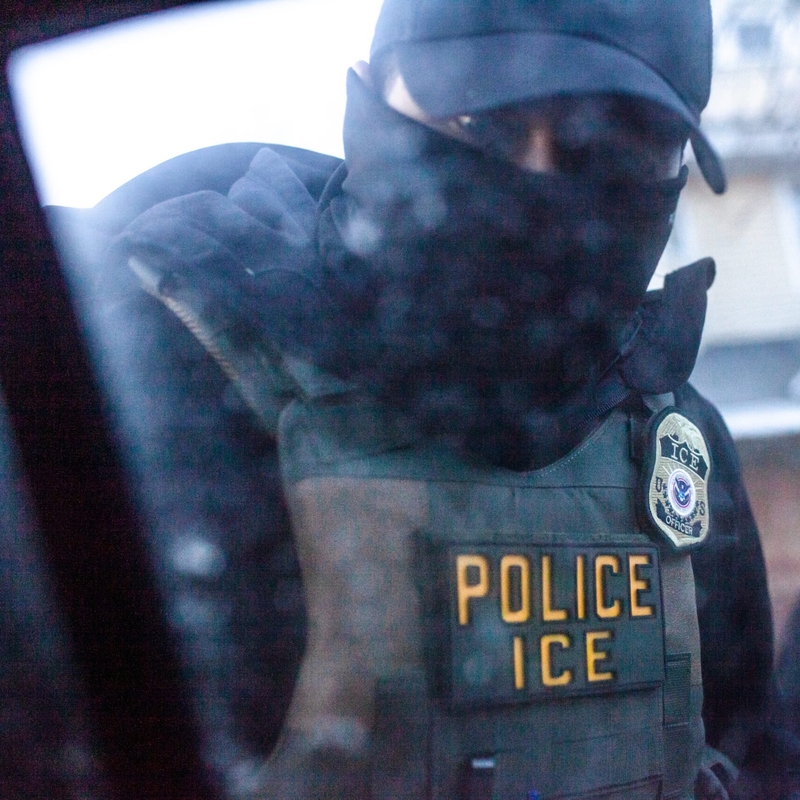
Photo: A masked ICE agent knocks on the window and tells observers in Minnesota to stop following ICE vehicles while on an early morning watch Monday, Jan. 12, 2026. (Photo by Nicole Neri/Minnesota Reformer)
Stories From The States is a production of States Newsroom, the nation’s largest state-focused nonprofit news organization, with reporting from every capital. At this pivotal moment in American democracy, our veteran journalists from all 50 states are reporting the consequences of government decision making. By zooming into one story each week, Stories From the States contextualizes and gives a human voice to what is happening now.
Transcript was created using an automated software.
Chris Fitzsimon
This is Stories From The States. I'm Chris Fitzsimon. Today we're talking about the Trump administration's aggressive enforcement of immigration rules and the violence that is following that. But we're also going to check in on how some communities are helping keep ICE in check, or trying to. In the days since January 7, when Rene...
Transcript was created using an automated software.
Chris Fitzsimon
This is Stories From The States. I'm Chris Fitzsimon. Today we're talking about the Trump administration's aggressive enforcement of immigration rules and the violence that is following that. But we're also going to check in on how some communities are helping keep ICE in check, or trying to. In the days since January 7, when Renee Nicole Good was killed by ICE agent Jonathan Ross in Minneapolis, the public is now getting a closer look at how many communities are resisting the Trump administration's immigration crackdown. The work has become increasingly risky as tensions soar, and yet, even after Good's death, volunteers continue to mobilize in targeted neighborhoods. We'll check in with a Minnesota reporter who followed along. While over in Memphis, they were in the national spotlight when President Trump sent the National Guard to what he said was to, quote, "clean up crime", a volunteer group continues to document ICE activity there and support those left behind in the immigration raids. In a moment, we'll chat with the member of Vecindarios 901 about their efforts.
Chris Fitzsimon
In September 2025 the Trump administration launched the Memphis Safe Task Force in what they said was an effort to combat violent crime in the city. The task force is made up of hundreds of state and federal law enforcement officers working in conjunction with local law enforcement. ICE and Border Patrol agents are also among them. In the frenzy of the sudden presence of federal law enforcement, Memphis community groups rallied together to document the arrest conducted by ICE and BPAs. One volunteer group called Vecendarios 901 operates a hotline for Memphis residents to both report immigration enforcement activities and support those left behind. The group, also known as V901 has said that ICE raids have only continued unabated. Carlos Ochoa is a volunteer with Vencendarios 901 he joins us now. Hi Carlos, thank you for being here.
Carlos Ochoa
Hi Chris. Pleasure to be here.
Chris Fitzsimon
So first of all, tell me what things are like in Memphis there in terms of this effort. One of the things that seems to happen is we have a lot of publicity nationally about a new city where activities are happening, and then the attention focuses on another place. What? What's happening in Memphis now?
Carlos Ochoa
Well, what's happening now is the same thing that's been happening since the task force has arrived. We see massive drag nets across our city, and we see they start releasing some figures about how 90% of all immigration arrests or detentions that are made, that are being made, are originating from traffic stops. So we're seeing just a huge what we would consider a violation of our Fourth Amendment rights.
Chris Fitzsimon
And that data saying that almost 90% of immigration arrests by the Memphis Task Force were originating from traffic stops was from the Daily Memphian. Are these traffic stops like a road block, or are they just are they targeting specific people or ethnicities?
Carlos Ochoa
They're not roadblocks, but in a city that's majority Black, majority Brown, they are using pretextual stops in order to stop people and from our perspective, yeah, they are targeting Black and Brown neighborhoods. We've got some data to back that up, we're not really seeing the majority of these stops originating in predominantly white neighborhoods.
Chris Fitzsimon
And what is this meant to the communities? What is life like now in these Black and Brown communities in Memphis with all this going on?
Carlos Ochoa
Well, it's scary for a lot of people. I will say Memphis has its problems. It's it's had a lot of problems throughout its existence. Martin Luther King Jr was assassinated here. You know, that's a legacy that we live with, and people don't really feel the kind of investment from the state in the city, and there's not a whole lot of local legislative autonomy here either. So people don't feel safe, and so some people feel that the Memphis Safe Task Force is going to make this community safer. But what the reality is is that the majority of the stops that the Memphis Safe Task Force is making are not violent criminals. The majority of the people who are being taken into federal immigration custody, they're not violent criminals. These are law abiding people who love this country, and so no matter how you slice it, people are scared here.
Chris Fitzsimon
What does your day look like as a volunteer for V 901? Tell us about that.
Carlos Ochoa
We're a rapid response hotline. We take calls from people who witness ICE's presence, and then we go to verify and observe. We're non interventionists, but we do have legal observers to make sure that ICE is following the law and that people can feel safer in their own communities. Sometimes I take calls as a dispatcher, not very often, but the times that I do take calls, you're really hearing a lot of stories from people who are experiencing the worst crises of their lives. People are calling in to report that their father was being detained on his way home from work, and they don't know how to get in touch with him, and he has high blood pressure, and he needs his medicine. And they are people are really scared because they can't contact people. People who have been here for 30 years, who have children here, are being detained, and their families call trying to figure out, like, what is going on? Where? Where's their husband? Where are their wives? Where are their brothers and sisters? It's really, truly heartbreaking. What's happening and the kinds of calls we're receiving.
Chris Fitzsimon
People who don't follow this when they hear somebody has been detained or arrested or picked up, whatever verb you want to use, I think some people still go back to their minds of, 'oh, they're in the county jail, and I can go see them, or I can get them a lawyer'. But, as you were just pointing out, it's not only that, but they don't even, oftentimes, know where they are, right? I mean, they don't. They have no way to know if they're even in Tennessee or Memphis or what part of the United States.
Carlos Ochoa
Yeah, yeah, absolutely. And the federal processes for intake of these people who they're claiming are here without permission slips to be here, they make it really difficult for friends and loved ones to find them. Sometimes they misspell names of the people that they're detaining, they might transpose numbers on their birth year and all kinds of little pieces of information that are required in order to find someone. The federal government is really botching that, and so it makes it really hard to find where members of families are being detained. And so there's just a huge hole in these, in families, lives, who's, you know, they've had their whole lives disrupted, torn apart. I mean, it's chaos, it's it's the worst of humanity.
Chris Fitzsimon
ICE agents are targeting people who they think are immigrants. I imagine that's causing a lot of fear in immigrant communities.
Carlos Ochoa
Yeah, absolutely. And that might be part of the the intention of the federal government here is to instill some fear in the community. And we, we do receive those kinds of calls. People are not going to work, people are not going to doctors visits, people are not going to the grocery store, people are not sending their kids to school because they're afraid that that might be the last time that they see them.
Chris Fitzsimon
What's it been like for you doing this work and hearing these reports, seeing this happening? What goes through your mind? I know you're concerned and afraid for the welfare of others, but it must take a toll on you as well.
Carlos Ochoa
Yeah, this work is definitely not easy, and I think if you ask anyone who's doing this kind of rapid response work, they'll tell you that there's tremendous burnout. There's a lot of personal fear that comes along with this. There's a lot of, like, real big concerns about the future of this country and of our lives. But there's also a lot of joy in resisting. People sometimes might say, Well, you got to find joy in order to resist. But what we've found, and I think is probably true for a lot of people, not just in Memphis, but there is a lot of joy in resisting itself. You find community, you find connection, you find out what you really care about in your own personal life. And that that's, I think, something that's not always talked about, but it's definitely true, and I think it helps kind of balance out some of those other negative feelings that we that we feel.
Chris Fitzsimon
Is there anything that you would want folks who are listening to know about what's what's happening there in Memphis that you don't think that it has been appropriately covered or communicated?
Carlos Ochoa
Yeah, I think what's happening in Memphis is it needs to be on people's radar, because they're using Memphis as a testing ground, as a blueprint for what is going to happen to the rest of the country. They are pressure testing the constitution that working families across the country all rely on. And we need to pay attention to what's going on here, because it really is a blueprint for what might happen elsewhere, and so we just need to keep our eyes on Memphis.
Chris Fitzsimon
Well, thank you very much for sharing your your information and your story with us. We really appreciate you being with us.
Carlos Ochoa
Thank you, Chris.
Chris Fitzsimon
According to reporting from the Tennessee Lookout, Republican state lawmakers are planning to introduce immigration related legislation crafted in collaboration with the White House and Homeland Security soon. To stay up to date on what's happening in Tennessee. You can visit newsfromthe states.com. While over in Minneapolis, residents there are looking for ways to push back against what many view as an occupation of the city by unwelcome federal forces. The effort to disrupt ICE operations has only grown in the days after ICE agent Jonathan Ross fatally shot Renee Nicole Good in her car. One way they're doing that is by driving around in immigrant neighborhoods and tracking where ICE agents are. Minnesota Reformer reporter Madison McVan got a chance to ride with a group on their patrol. According to her reporting, there are now at least four times more immigration agents in the state than there are Minneapolis Police officers. We'll chat with her in a moment about what's going on there.
Moses Esheit
At a time when so many communities are losing their local news outlets, states, newsroom is filling a gap. We are now the nation's largest state focused nonprofit news organization with reporters based in every state capital and Washington DC. But we can't do it without your support. Your contributions allow us to produce award winning journalism and deliver it to you for free. No pop ups, no pay walls. This is a crucial time to support local journalism, and every bit helps to give go to statesnewsroom.com/donate.
Chris Fitzsimon
In early January, the Trump administration announced that 2000 federal agents were being sent to Minneapolis to carry out a major immigration operation. Tensions, as you'd imagine, were high between federal agents and community members. Then on January 7, Renee Nicole Good was shot and killed in her car by an ICE agent Jonathan Ross in Minneapolis. By now you have surely seen the video and maybe heard the efforts of the Trump administration to actually blame Good, alleging she was trying to run over Ross. However, independent analysis of the videos don't support those claims. Since her killing, protests have erupted across Minnesota and around the country to remember Good and to call for an end to the Trump administration's aggressive tactics toward immigrants. Many local community members are leading a movement to disrupt ICE operations and more or joining them. Minnesota Reformer reporter Madison McVan followed along with one of those groups. The Minnesota Reformer is an outlet of States Newsroom. Madison, thanks for being with us.
Madison McVan
Thanks for having me.
Chris Fitzsimon
Tell us sort of what's happening now in the Twin Cities.
Madison McVan
We're seeing high concentrations of immigration agents, particularly in immigrant dense neighborhoods, in areas where immigrant owned businesses are operating. These response groups, as you mentioned, are tracking their movements. They are alerting neighbors when ICE is present. And so we're seeing kind of isolated skirmishes all over the city and the metro area as this is going on.
Chris Fitzsimon
Yeah, I've actually seen some of the videos that have been posted online, and read the Reformer's coverage. It does seem like occasionally there'll be flare ups. I see I've seen tear gas. I've seen people being pulled out of cars. What is it like in those in those immigrant communities now, just day to day?
Speaker 1
Well, lots of immigrants have opted to shelter in place, so the people who are fighting the ICE agents, a lot of times, are citizens who have basically taken it upon themselves to say, our immigrant neighbors are getting targeted and it's on us to go out and fight them. Because, you know, if immigrants or people who these agents think look or sound like immigrants, they might be at higher risk going outside.
Chris Fitzsimon
For you who were sort of immersed in covering this so intensively, but for folks who aren't there, it's so shocking. Not only was Renee Good killed outside of school, but I keep seeing reports of these activities near schools, near community centers. So it seems like it's disrupting every part of a daily life if you can't drop your kid off at school.
Madison McVan
Right. And Minneapolis public schools have now offered students the option to take classes online for about a month, and that could possibly be extended. We're seeing parents whose kids go to the same school organized to patrol the outside of schools during pick up and drop off times or escort parents or teachers to and from school, when, if those parents and teachers are immigrants who are worried about getting picked up by ICE on their way to or from school?
Chris Fitzsimon
Well, tell us about the your story. I want to dive into that some and maybe then get back to some more larger questions. Tell us about the group that you were riding with, or how this whole came about.
Madison McVan
Yeah, I think it helps to back up a little bit in time. When Trump took over for his second term, people who opposed his integration agenda started getting together, thinking about how to take action to prevent the mass deportation campaign that Trump was advocating for. The main solution that people landed on was something called Rapid Response networks. So that involved getting in touch with your neighbors, creating some kind of a group chat, and then notifying each other if ICE was spotted in the area, so that neighbors could come out protest, record, possibly inform someone who's being detained of their rights, that kind of thing. But what quickly happened is as ICE raids happened throughout 2025, particularly the bigger ones, you know where they it's dozens of agents, and they surround a business, and they kind of do a sweep of the inside. So many people are responding to these ICE raids. It was causing big clashes between law enforcement and protesters. So now, with this big surge in immigration agents arriving in the cities, they're taking different tactics. The ICE agents are getting in and out quickly. They're working in smaller groups. They're taking one or two people at a time and getting out of there before these rapid response groups are able to respond. So now the people who were in those rapid response groups are taking a more proactive approach. They're following the ICE vehicles so that if the agents get out, they can start recording immediately. In other words, they can be there before the arrests happen, and try and discourage those arrests or disrupt the operation in legal ways, such as making lots of noise, shouting at the agents and again, informing neighbors that ice is present.
Chris Fitzsimon
And so how did you come to ride along with this operation?
Madison McVan
Recently, I've been on the ground covering this for a while, and after the death of Renee Good, I responded straight to that scene. I stayed on the side of the shooting until the vigil was held that night, and afterwards, just meeting a lot of people who were wanting to take some kind of action, who were feeling very upset by the shooting and feeling like they needed to do something about the presence of ICE agents in the Twin Cities. Our photographer, Nicole Neri, was there. She was actually the one who set up the ride along. But, you know, we met with some of these folks in person, and they decided that they were willing to take us along for a ride and willing to put their names and their faces on this story. Ultimately, they felt that what they're doing is right.
Chris Fitzsimon
Well, both your your writing and Nicole's pictures were just amazing. And I wonder, tell us what it was like, some of those pictures are, are haunting.
Speaker 1
Well, it's a little anxiety inducing, in part, because, you know, we're in the back seat. We were observers, and we're not making decisions, right? It's up to these people to decide how far they're willing to push these ICE agents, knowing that they could possibly face retaliation. So it's, it's, it's certainly a little stressful. Your adrenaline gets pumping a little bit when federal agents surround the car and start threatening arrest to the people inside. But ultimately, we didn't get arrested.
Chris Fitzsimon
What do they threaten arrest for, is it obstructing or interfering with the federal agent? Is that the the crime?
Madison McVan
Yeah, that's that's the language they use. They say 'You're obstructing us'. Now, of course, the legal definition of obstruction is something that's being argued about in court right now with regards to these tactics. But legal experts say generally, following a law enforcement vehicle honking a horn, even yelling at an officer, is not obstruction. Now, physically blocking an agent with your car, with your body from making an arrest is obstruction, and that's illegal. But I didn't see any of that happening when I was out.
Chris Fitzsimon
Were the officers yelling at the drivers? I mean, at this point when they came up to the windows.
Madison McVan
Yeah and from everything I saw, it's clear that the agents are trying to intimidate the people who are following them, because these people are not breaking the law. I mean, some of them have been arrested in the act, but not charged. Intimidation is one of the tactics the agents are using to discourage this kind of behavior. So in one instance, I was in the car while these observers were following along a convoy of ICE vehicles. It was three ICE vehicles, and we were in the car directly behind them. The agents pulled into a side street, stopped their cars, blocking the observers cars ability to proceed. The agents got out, surrounded the vehicle, and one came up to the window and sort of lectured. He wasn't really shouting, but he was speaking strongly, telling the observers, 'stop following us. You're obstructing us. We're going to keep moving and turn the corner, and if you follow us, we're going to have to take you out of the car and arrest you'. He got back in the car, the observers looked at each other and said, 'You know what? We're not breaking any laws. Let's keep following him'. So the ICE vehicles move forward, the observers keep following them, and it soon becomes apparent that the ICE vehicles are driving to the observer's house. And sure enough, they arrive in front of the observer's house, and they stop seeming to indicate 'we know where you live'. They stayed in the car at that point, and the observers again, looked at each other and said, 'Let's just keep following them. Let's wait for them to leave'. The convoy takes off, and the two cars in the front split off. And then the observers kept following the third vehicle for a few minutes. And then after a while, they realized this vehicle is just returning back to the ICE headquarters. We can let it go and circle back to Minneapolis. At that point, the observer whose home the agents had driven to, got a call from her wife saying that agents had showed up and knocked on the door while the observers were following the ICE vehicle back to the headquarters.
Chris Fitzsimon
Wow,
Madison McVan
So that was a new tactic that that we witnessed. It's just a cat and mouse game, really a dark and dangerous one where it feels like both sides are antagonizing each other to see how far they can take it.
Chris Fitzsimon
Do you think these observers, I mean, do they realize they're in danger as well?
Madison McVan
Oh, absolutely. And I think a lot of people are asking themselves right now, what exactly they are willing to risk for this movement. They've thought hard about that question. Lots of them have decided they're willing to be arrested. Some of them have been arrested for this. There's, of course, always the threat of something like the Renee Good situation happening.
Chris Fitzsimon
Right, well, I wanted to circle back to that. You mentioned that you went to that scene, and I wondered if you could tell us what that was like, not not so much, what happened, because we've seen that as hard as it is to watch, but what was, what was the feeling on the scene there the other folks who were around, what was the reaction overall?
Madison McVan
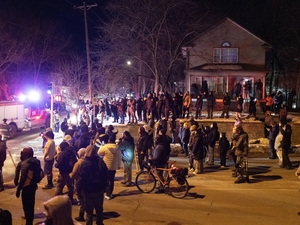
When I first arrived, maybe about an hour after the shooting had occurred, people were angry because ICE was still on the scene. So at that point, it had been long enough that a crowd had gathered. They knew that ICE had shot someone, and they were protesting the agents that were still on the scene. As the ICE agents left, they deployed tear gas and pepper spray on protesters in a residential area, and then Minneapolis Police, Hennepin County Sheriff's, the FBI, the Bureau of Criminal Apprehension, secured there was the scene after the ICE agents left, and then after that, there was still some protesting of law enforcement. People were concerned that Minneapolis Police were collaborating with ICE by securing the scene. But as the day went on, it really just shifted into a somber mood as people started to gather around the site of where the shooting occurred after the crime scene was kind of cleared and reopened to the public. People started placing flowers in the snow, where you could still see the blood, bringing notes, cards, whistles, which observers are using to alert people of ICE presence, chanting, singing. And then there was a more formal vigil that evening.
Chris Fitzsimon
Is the city must be, must still be on edge.
Speaker 1
It is on edge, but right now, the conflicts are very much concentrated in the immigrant heavy areas. They're not exclusive to those areas. But I also think there's a lot of people who live in the more affluent areas of the city, who live in the suburbs and commute into downtown to go to work, who can probably pass through the city without seeing what's going on. But when you start to spend time in some of these neighborhoods, you realize that ICE is everywhere they really are.
Chris Fitzsimon
What would you want people who are listening to know about this whole episode, not just the shooting, but the tension and the really trauma that's happening to an American city now.
Speaker 1
I think when you spend time in these cities and again, you see ICE almost constantly, you understand why a lot of people view this as an occupation of an American city. And what I found most powerful being out there was the sheer number of people who mobilized anytime they saw an ICE agent. It was really astounding the level at which people who live in these neighborhoods have decided they don't want ICE there. They have decided to yell at the agents, to honk their car horns, to record them, to do their best to intimidate ICE back, because they believe ICE is intimidating their neighbors. And so I think what people might not understand is the level to which that kind of resistance, not opposition, has really permeated throughout the city, particularly in these areas where ICE is is hitting them pretty hard.
Chris Fitzsimon
Well, thank you so much for well, all your great reporting. Please be safe yourself and and thank you so much for being with us.
Madison McVan
Thanks so much, Chris.
Chris Fitzsimon
Since we recorded our conversation with Madison, the Minnesota Reformer, has reported that a second person was shot by a federal immigration agent in Minneapolis. Scores of demonstrators showed up at the scene shouting expletives at federal agents and telling them to get out of Minneapolis. Federal agents deployed tear gas and flash bangs, while some protesters shot fireworks at law enforcement. To stay up to date on what ICE is doing in Minnesota and across the states. You can visit newsfromthestates.com. Coming up shortly Evening Wrap newsletter writer Danielle Gaines will join us with the top stories she's looking out for, and with One Last Thing.
Nelle Dunlap
Hi, it's Nelle Dunlap, product and engineering director at States Newsroom. At States Newsroom, we believe journalism should be fair, fearless and free, with reporters working on the ground in all 50 states and Washington DC, we provide non partisan coverage of the state issues that matter most to you. You can subscribe to our work by going to states newsroom.com/subscribe.
Chris Fitzsimon
Well, here comes our favorite part of every week on Stories From The States, our chat with Evening Wrap newsletter writer extraordinaire, Danielle Gaines, Danielle, how are you?
Danielle Gaines
I'm good. How are you?
Chris Fitzsimon
Good? Considering the events of the world and the week.
Danielle Gaines
Yes, it's been a rough one.
Chris Fitzsimon
It certainly has tell us what has caught your eye.
Danielle Gaines
We had a story this week out of North Carolina about the shortage of school psychologists and kind of the hardship that that's creating. So for the last few years, there are more than a dozen school districts in the state that have operated without a school psychologist. You know, these are staff members who are specially trained to provide special education evaluations, but then they also help with preventative and emergency health services. And national guidelines recommend one school psychologist for every 500 students in North Carolina, the number is more near above 1900. So we had stories of districts who have children in crisis and are waiting for help from outside of their boundaries. This can take days, it can take weeks, it can take hours, and most of those districts that are having real trouble with the hardships are in rural areas where you've got other issues that are compounding so high, poverty, limited infrastructure. It was a really interesting story, and pointed out an area where the state really needs to improve.
Chris Fitzsimon
Yeah, and even one in 500 seems like a lot, even though that's the guideline.
Danielle Gaines
Yeah it also it talked a little bit about, like, the lived experience of people who go into this work, and you know, what they were hoping to do, and what's really actually possible given the time and funding constraints.
Chris Fitzsimon
Okay, what about something coming up that you noticed?
Danielle Gaines
Well, I have my eye on a number of reproductive rights issues right now, so obviously this has been a big concern since Roe versus Wade was overturned and with renewed Republican control in D.C. So this week in Louisiana, the Attorney General obtained an indictment for a California doctor who sent abortion pills into the state or is alleged to have sent. She asked the governor to sign an extradition warrant for that. You know, pretty clear that California authorities won't cooperate. And at the same time, I think even on the same day, we published a story out of D.C. where lawmakers and advocates are pressing for more information about an ongoing Food and Drug Administration review of these common medications.
Chris Fitzsimon
Yeah, it seems like that's the next frontier in the abortion rights debate.
Danielle Gaines
That and then obviously there are court battles as well. So the Missouri ban is in court right now, in a two week trial, the outcome of that will affect access for women in pretty much all of the Midwest. So everyone's keeping their eyes on that as well, absolutely.
Chris Fitzsimon
Well, what about the favorite One Last Thing?
Danielle Gaines
Yeah, so the Nebraska Legislature has had a rough time recently. They were about to take a vote to expel a member, so it's kind of unprecedented tumult. But there was a little bright spot in the Capitol this week. The state swore in its first ever kid governor. So this is Charlie Couch. She is a fifth grader, and she was elected by her peers in a statewide campaign. And she was sworn in, she got to come to the Capitol. There was lots of pomp and circumstance, the other children who ran for the office are now her cabinet, and they're all going to work together on issues that they think are important and highlight a more youthful voice behind policies.
Chris Fitzsimon
If only she were the real governor. Maybe, I don't know.
Danielle Gaines
yeah, and maybe she will become one. Who knows?
Chris Fitzsimon
That's right. Let's we can only hope. Well, Danielle, thank you, as always, for being with us.
Danielle Gaines
Thank you.
Chris Fitzsimon
Thanks for listening to Stories From The States. I'm Chris Fitzsimon. Mallory Cheng produced and edited this podcast. David Singer produced our theme music. If you liked what you've heard today, please leave a rating and review. It means a lot to hear what you think about our podcast. To stay up to date on the latest episodes, please subscribe now to Stories From The States, a podcast from States Newsroom. Available wherever you listen to podcasts, we'll talk to you soon.