WV Supreme Court considers lawmakers’ power over public education rules
Sep 22, 2026 | 5:09 pm ET
Description
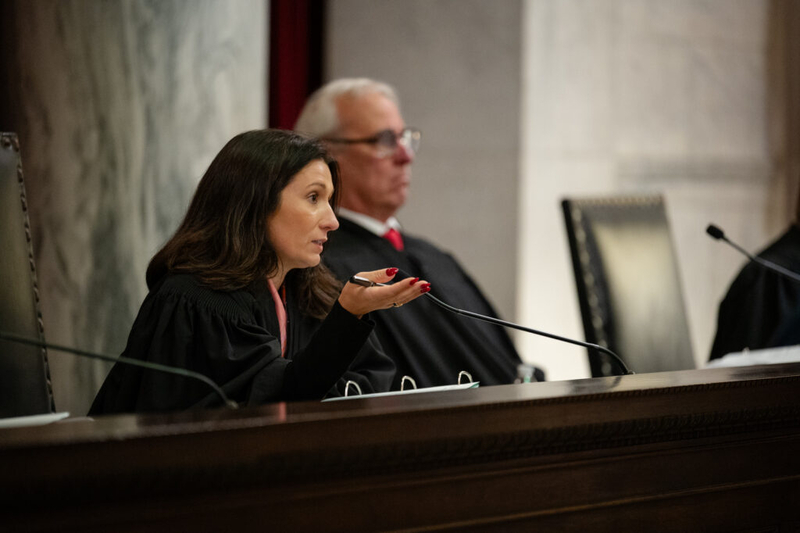
West Virginia Supreme Court of Appeals Chief Justice Haley Bunn speaks during oral arguments in the West Virginia Supreme Court Chamber on Sept. 22, 2026.
(J. Alex Wilson - Supreme Court of Appeals of West Virginia)
The West Virginia Supreme Court is considering whether the Legislature has the ultimate authority over school board policies that govern public schools.
A 2025 Republican-backed bill gave a group of lawmakers the authority to approve or reject education rules approved by the state board. Lawmakers behind the bill said they wanted more accountability on the state’s struggling school system.
The state school board filed a lawsuit against the Secretary of State’s Office — due to its authority over proposed rules — and asked the office to declare the legislation unconstitutional. The school board characterized the bill as a “power grab” by the Legislature, noting that West Virginia voters twice rejected a similar proposal giving lawmakers the power in education.
The legislation was designed to trigger litigation for a likely review by the state Supreme Court, and on Tuesday, the case was before the Justices for arguments.
“The Legislature understood that two times, it imposed constitutional amendments seeking to carve back the board’s power. Both times, West Virginia voters declined,” said Chris Smith, an attorney representing the West Virginia Board of Education. “ … The Legislature is trying to take the board’s rulemaking power, and this court should hold that the law that does so is unconstitutional.”
Michael Williams with the state Attorney General’s Office argued that there was nuance in the bill, which protected the education board’s rule-making power.
“House Bill 2755 thus doesn’t seize the board’s rulemaking power, but merely gives the Legislature one regular session to decide whether to in fact legislate,” said Williams. “ … All this bill allows the Legislature to do is to exercise its legislative function. The window is calibrated to guarantee at least one regular session and no more.”
Senior Status Justice Beth Walker sat on the bench by temporary assignment after newly-elected Justice Bill Flanigan was disqualified due to voting on the legislation in question while he served in the House of Delegates. Walker retired from the Supreme Court last year.
While state agencies submit rule changes to the Legislature for review, the state school board previously had autonomy to determine education policies.
House Bill 2755, which became law without the governor’s signature, requires that all legislative rules enacted by the board must first be authorized by the Legislative Oversight Commission on Education Accountability. The group of lawmakers now has authority to approve or reject education rules approved by the state board.
A proposed rule caught in the crosshairs of the legal challenge set specific design and equipment standards for school buses and other vehicles used by schools.
Smith cited the 1988 decision by the state Supreme Court of Appeals in West Virginia Board of Education v. Hechler, which determined that a 1983 law requiring legislative approval of state board rules was unconstitutional.
“In that case, this court struck down a law that enabled the legislature to veto, to amend, to alter, or ultimately pass a law or regulation by the board,” Smith said. “It essentially gave the board the legislature veto power.”
Williams argued that the case “is not Hechler.”
“The board still writes and adopts its own rules. The statute opens by affirming that under its supervisory duties,” he said. “The (school) board concedes that the Legislature retains its legislative function when it comes even to the realm of education.”
In court, Chief Justice Haley Bunn described Smith’s arguments about the school board’s authority as “awfully broad.”
“Doesn’t there have to be at some point where these powers give way? I mean, we have a Legislature with clearly the power of the purse, so don’t we have to look at what we’re dealing with in this particular case, rather than making broad, sweeping arguments that the Legislature can’t ever do anything as to the supervisory power?” Bunn questioned.
“This is not a case saying the Legislature can’t do anything, or the Legislature has no powers,” Smith responded.
Smith, standing before the Justices, held up a thick red book of laws governing public education passed by the Legislature.
“The Legislature has a tool in its toolbox, and that’s the legislative tool. If it doesn’t like a particular policy passed by the court, then it can enter into its legislative session, pass a bill through two houses of law, and pass a particular educational initiative that it wants to see done, and it’s done that time and time again.”
Williams said that the Secretary of State’s office is not “suggesting that the Legislature could go in and say the school board can no longer do anything.”
But, the Legislature is not powerless, he noted, and has tools outlined in the state Constitution over policies.
“ … The Legislature does continue to retain some amount of supervisory authority in itself, because otherwise, that ‘prescribed by law’ phrase wouldn’t actually mean anything; it would be an empty phrase,” Williams said.
Supreme Court Justice H.L. Kirkpatrick noted that the Legislature was ultimately responsible “for a thorough and efficient system of public education” in West Virginia.
In both 1989 and 2022, voters rejected constitutional amendments to give education rule-making approval to the Legislature. Fifty-eight percent of voters were against it in 2022.
“What the Constitution giveth, the legislature can’t take away. The voters do if they enter the Constitution. But they didn’t,” Smith said.
Charleston, WV