WV House approves bill that would impose jail time, fines for camping on public property
Mar 03, 2026 | 8:01 pm ET
Description
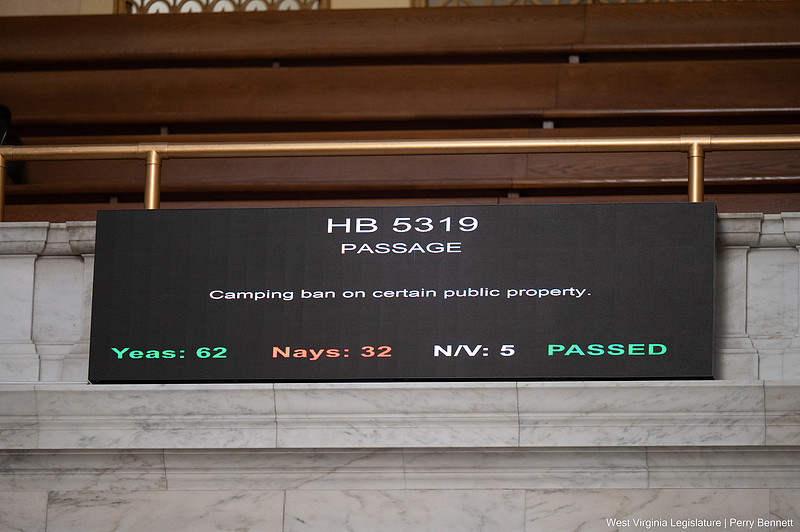
The West Virginia House of Delegates approved a bill that would impose jail time and fines for homeless people who live on public property throughout the state on Tuesday, March 3, 2026. (Photo by Perry Bennett/West Virginia Legislative Photography)
The West Virginia House of Delegates has approved a bill that would impose jail time and fines for homeless people who live on public property throughout the state.
Delegates passed House Bill 5319 with a 62 to 32 vote and five members absent.
The bill would impose fines of up to $500 or 30 days in jail for homeless people who camp or store personal property on any street, park, trail or any public property throughout the state.
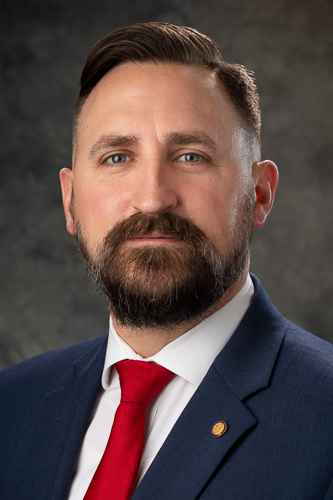
Del. Evan Worrell, R-Cabell, spoke against the bill while acknowledging that homelessness is a problem in many areas. The bill would impose separate offenses on people for each day that they’re living outside, he noted.
“I have an issue with this because where do they go?” Worrell said.
According to the bill, for a first offense, a person would be given a written warning and told where they can seek alternative shelter. That might be in another community, Worrell noted.
“But the other issue is, what is $200 to an individual who’s homeless?” Worrell said. “It might as well be $2 million. How can they afford that? And also, what about somebody who’s homeless at the current time, but turn their lives around and now they’re going to be guilty of a misdemeanor? That affects employment opportunities as well, (it) affects maybe seeking shelter somewhere else if they’ve been guilty of a misdemeanor.”
The bill would have a financial impact on the court system and the local law enforcement agencies, he said.
Worrell added that he would commit to supporting ways to reduce homelessness.
“There are multiple studies done that show that by providing housing for individuals, you actually save a lot of money, not only in corrections, but also in our hospitals,” he said.

Sen. Evan Hansen, D-Monongalia County, said camping ordinances and homeless initiatives should be left up to local governments to decide.
Several West Virginia cities — including Morgantown — have enacted camping bans since June 2024, when the U.S. Supreme Court upheld a similar ordinance in Grants Pass, Oregon.
“Whether you like a camping ban or dislike a camping ban, I hope you would agree that this is something that our city councils and our county commissions can take care of,” Hansen said. “I hope you would agree that there’s no compelling reason why every city in the state needs to have the exact same ban.”
Hansen added that camping bans criminalize homelessness by subjecting homeless people to fines and jail time.
“I don’t think criminalizing homelessness is the right approach,” he said. “I don’t think the right approach is putting people in jail because they’ve fallen on hard times.”
Proponents of the bill have argued that it’s permissive, meaning that municipalities have the option to enforce the law or not.
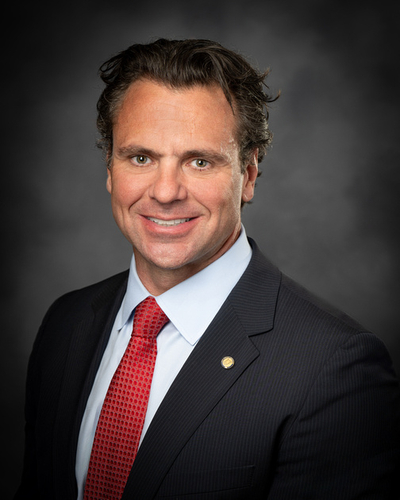
Del. J.B. Akers, R-Kanawha, spoke in support of the bill, saying that it would give police a tool to target “the criminal element” among people living outside who victimize other people. He referenced a Charleston homeless man who poured gasoline on a homeless woman and set her on fire, killing her, as she slept on a porch in 2017.
“It’s not to target people who are homeless,” Akers said. “I have more faith in our law enforcement to be able to make the distinction between those who actually need help or are down on their luck. It’s kind of insulting to me on their behalf to think that the police are just going to walk up and warn and fine someone who you can tell is simply just on the streets because they have nowhere else to go, but they’re hurting no one, versus someone who walks up with a can of gasoline pours it on a woman who’s asleep on a porch and sets her on fire til she burns to death.”
The House on Monday voted down an amendment that would have limited criminal penalties to areas of the state where there are homeless shelter beds available.
The camping ban bill is opposed by the American Civil Liberties Union of West Virginia.
In a statement Tuesday, the organization said that sleep is “a biological necessity, not a crime.”
“Rather than help struggling people get back on their feet, the House of Delegates has decided instead to criminalize their very existence,” the ACLU said in the statement. “At the same time, lawmakers are poised to cut taxes even further, depleting the state’s already underfunded services and driving more of its people into extreme poverty. We’ve said it before and we will keep saying it: We will never arrest our way to prosperity.”
Some homeless services providers have opposed camping bans as well.
Traci Strickland, director of the Kanawha Valley Collective, which operates a men’s shelter in downtown Charleston, is against the bill.
“I’ve said this for multiple legislative sessions: We need homeless legislation that solves the problem,” Strickland said Tuesday. “Ticketing people for sleeping outside is not solving any problem. It’s not creating shelter beds. It’s not creating safe, affordable housing. It’s just not. It’s not a solution to individuals sleeping outside.”
Strickland said her shelter is frequently filled or near capacity.
“I’ve spent years not being a proponent for building more shelter beds, because the solution to homelessness is housing,” she said. “But if we can’t have enough safe, affordable housing, then we need more shelter beds. Because I don’t have enough housing to house people that I have. And if every person that slept outside last night in Charleston came to me for a bed today, I have nowhere to put them.”
The bill will next go to the Senate for consideration.
Charleston, WV