World Day of Remembrance for Road Traffic Victims is a day to think ahead, too, to solutions
Nov 15, 2025 | 9:50 am ET
Description
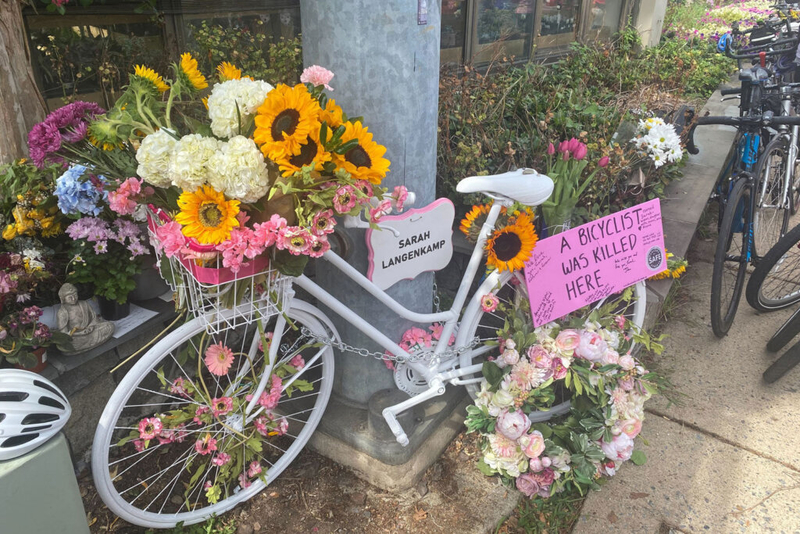
A memorial bike for Sarah Langenkamp. (Photo by Luke Lukert/WTOP)
I’ll never forget the elegant solution my wife, Sarah, came up with the day she died. She needed to get to the open house at our kids’ new elementary school while I went out of town, but our car was being shipped from abroad. “I’ll just ride my bike,” she said.
That was not a surprising solution for Sarah, whose fitness came not just from a love of yoga and salads, but from prioritizing movement — almost any movement — in her daily life. She took the stairs, she walked a lot, and on this day, rode her bike to our kids’ school.
She was killed because of it. Literally run over by the negligent driver of a 40,000-pound truck.
I later learned that more cyclists died on U.S. roads that year, 2022, than any in U.S. history. The number in 2022, at 1,086, has only been exceeded by the number that died in 2023: 1,166.
But it isn’t just cyclists who are dying. More than 7,300 people died walking on roads in America in 2023, close to a 40-year high. Some 40,000 people die every year in vehicle crashes overall. That’s more than 100 people per day, as many as a commercial airliner, making vehicle crashes a top form of preventable death in America.
Your opinion matters
Maryland Matters welcomes guest commentary submissions at [email protected].
We suggest a 750-word limit and reserve the right to edit or reject submissions. We do not accept columns that are endorsements of candidates, and no longer accept submissions from public officials or political candidates.
Opinion pieces must be signed by at least one individual using their real name. We do not accept columns signed by an organization. Commentary writers must include a short bio and a photo for their bylines.
Views of writers are their own.
Earlier this month, the Montgomery County Council passed a new law outlawing parking and driving in bike lanes. I thought about Sarah’s final ride when I read the flood of vitriol online responding to the news: “Another useless law … All of the biker lanes need to be removed … bicycles have no business being on the road … ”
Wow.
This Sunday is World Day of Remembrance for Road Traffic Victims. It’s a day to remember people like Sarah, and a day to think about solutions to this deadly problem.
Until my retirement and before Sarah died, she and I were U.S. diplomats — State Department foreign service officers — who had lived around the world. One thing I learned living abroad is that countries that are more pleasant and safer all do a good job of making it easy to walk, ride a bike, and get around in things other than cars.
Just before her death, Sarah and I spent six months in a city in a Polish city named Rzeszow (pronounced like JESH-ohv). It was a relatively mundane town by Polish standards, but it was wonderful to us Americans, boasting a lovely town plaza, a long walking street surrounded by cafes, restaurants and stores, and clean, punctual buses and trains that could whisk you almost anywhere in Europe.
Not only was this city pleasant, it was safe. And for most of the developed world outside the United States, it is normal.
Contrast this with the vast majority of American cities today, where you are between three and four times more likely to get killed walking on a road. Here in Bethesda, there is no way for my kids to ride their bikes to school without riding on a state highway. The walking street (Bethesda Row) is a single block long. And redesigning streets can set off battles that threaten political careers.
It makes sense that people care about their roads and infrastructure. But my view is that our debate shouldn’t be about bike lanes. It should be about the type of community we want to live in.
Do we want our kids to be able to roam freely in our neighborhoods? Do we want to be able to walk to the market and church on weekends? Or do we want to be entirely dependent on our cars to go everywhere?
Americans are making their choices, and the results are visible in our dangerous and congested roads, our less healthy lifestyles, our degraded environment, and our less pleasant cities.
Sarah made the right choice the day she died. I hope one day our community will catch up to her.
Annapolis, MD