Worcester County schools blend culture, tenure, individual attention to earn top test scores
Aug 31, 2026 | 5:00 am ET
Description
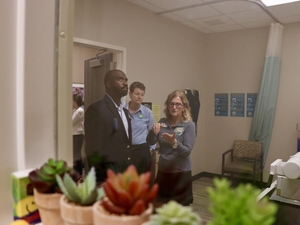
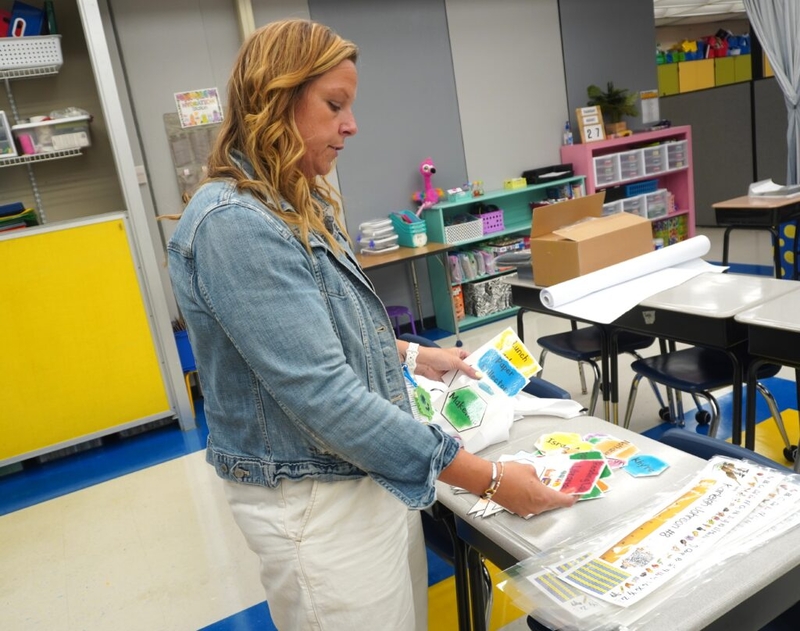
Pocomoke Elementary third-grade teacher Jennifer Copenhaver looks over the student job assignments Aug. 25 in preparation for the first day of school in Worcester County. (Photo by William J. Ford/Maryland Matters)
Jennifer Copenhaver was getting her colorful third-grade classroom at Worcester County’s Pocomoke Elementary School ready last week — big-screen Smart TV, an oversized blue bean bag and one pink flamingo propped on a light blue bookshelf, waiting for about 20 students Monday.
“I can’t wait,” Copenhaver, a 15-year teaching veteran who’s entering her second year at Pocomoke Elementary, said Tuesday. “It’s feels like a community here [in Worcester] because everybody’s so inclusive and loving and caring. Everybody really, really cares about the kids and wants to do what’s best for the students.”
That shows up in test scores for Pocomoke Elementary, a Title 1 school that receives additional resources due to the number of economically disadvantaged students there. It achieved a four-star rating out of five on a state report card.
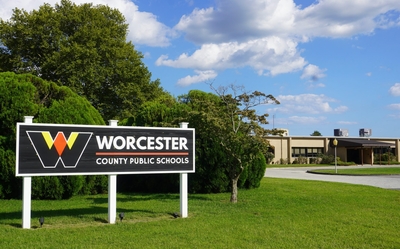
But Pocomoke is just one example of the “wonderful things going on” in the Worcester County school district, which has achieved the highest level of proficiency on the Maryland Comprehensive Assessment Program in math two years and in English for the last three years.
Nearly 70% of Worcester students were deemed proficient in English testing this spring, compared to 68.5% last year and 69.4% in 2024. The state proficiency rate this year was 52%.
Worcester students also had the state’s highest level of math proficiency at about 49% this spring — the state rate was 27% — and 47.7% last year. The district ranked second in the state two years ago, with a math proficiency rate of 39.3% of students.
About 7,130 students will be greeted by 650 teachers when doors open Monday morning.
Five of the county’s six elementaries were four-star schools in 2024-25 school year — the sixth was not eligible that year — as were all three middle schools. One of its three high schools got four stars while the other two received five stars on the state’s annual report card.
Sharon Donahue-Conway has had two children graduate from Worcester’s Stephen Decatur High School and go on to college, and her youngest child, age 12, will begin the sixth grade at Berlin Intermediate School. She said she’s been “very happy with Worcester County Public Schools and the teachers,” but added that parents must help teachers and administrators.
“At home, we reinforce the importance of education. The teacher is not there to just say you’re doing great when you suck,” she said in an interview Wednesday. “It’s like no one’s going to applaud you and give you a ribbon for doing the minimal. I think you just have to reinforce that not everything is easy and not everything is online. Real life happens offline.”
Donahue-Conway said one countywide initiative she’s pleased with is how the school system stresses the importance of test scores with student achievement.
“We were always prepared to know when the testing was going to happen, and that was great,” she said.
In-house assessments
The preparation for students to take standardized tests starts with schools conducting “in-house assessments,” which former Superintendent Lou Taylor stressed “is not teaching to the test.”
The assessments, Taylor said, allow staff to evaluate each student’s strength and weakness. It not only boosts student achievement, but also boosts students’ confidence in future test-taking. The reading assessments used are Kindergarten Reading Assessment, or KRA, DIBELS and i-Ready.
“Then teams of teachers take a look at every individual kid, where they’re weak and where they’re strong, and then aggressively working with those individuals to build those weak areas,” Taylor said. “So that when the Maryland assessments take place, we have spent some time in those areas. These are just proficiency skills that kids need at grade level.”
Taylor retired in June 2025, after nine years as superintendent. He worked in education for 41 years, all in Worcester County. He said the in-house assessments initiative began during former superintendent Jon Andes’ tenure between 1996 to 2012. Andes currently serves on the county’s school board.
Taylor, who won in this year’s Republican primary election for the District 6 seat on the Worcester County Board of Commissioners, said small class sizes are another reason for the school district’s academic success.
Pocomoke Elementary kindergarten teacher Katie Sipple said she will begin the school year with 15 students. While that could increase during the school year, she said, colleagues in neighboring school districts like Wicomico County have more than 20 students from the start.
“I’m able to meet with more kids than if I was to have 25 to 30 kiddos,” Sipple said in a classroom illuminated by some lamps and bright stars strung along the ceiling. “I’m able to pull kiddos, whether it’s one-on-one or in a small group. Just having that small class size, I’m able to sit at more tables and see more kids and talk to more kids.”
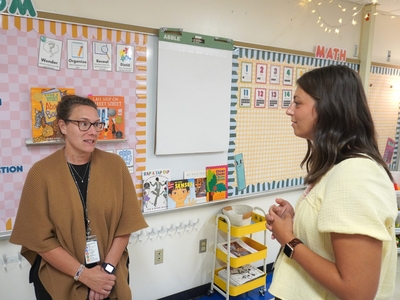
One of the new children that will enter Sipple’s classroom is the niece of Worcester County Superintendent Annette Wallace.
“Keep up the good work, but be ready for her. She’s something else, in a good way,” Wallace said to Stipple as they both chuckled.
‘We’re all educators’
Like Wallace, some of the teachers and administrators have longevity in the school district. Wallace graduated from Snow Hill High School in 1999, earned a bachelor’s degree in math from Salisbury University in 2003 and was hired by Taylor as a math teacher at Stephen Decatur High School.
After working as an assistant principal and principal at Pocomoke High School (and being named Maryland principal of the year in 2016), and then as chief operating officer and academics officer, Wallace succeeded Taylor to become the district’s first female superintendent on July 1, 2025.
Under her leadership, Wallace demands not only support staff, teachers and administrators help students succeed, but every single person that works in a school.
“I believe public education is a ministry,” she said. “I told our staff that … when I met with everybody. Whatever your religion is, or whatever you believe in, this is not a job. When you come here, you’re going to work harder than you’ve ever worked, but you’re also going to get to experience joy and a sense of being a part of something bigger like you’ve never had before. We’re all educators.”
One mantra Wallace continues to push: Name. Strength. Need.
Know every student’s name. Know every student’s strength. Know every student’s need.
“Why? Well, because everyone wants you to know their name, because when you know my name and you can say my name and you can identify me, then I know I belong here, by my strength,” she said. “I don’t want to be known by my needs. I want you to know my needs, but when you say to me, Annette Wallace, I want you to say all the wonderful characteristics about me. So, when we think about our kids, it’s the same story.”
When Wallace visits a school, the plan is to deliver some books to students. She continues to be irked that 109 third graders were not proficient in reading this past school year.
“That’s not OK,” she said.
Wallace’s passion was mentioned during last month’s state Board of Education by State Superintendent Carey Wright. During a brief interview Friday morning, Wright called Wallace “relentless,” especially when it comes to monitoring data.
“Annette is a very unique person. She could tell you down to the name of every third-grade student that wasn’t reading at grade level,” Wright said. “She makes sure all those kids get the intervention that they need. I think that’s one thing about her, is that she’s constantly looking for other ways to provide access and opportunity for her students to continue to grow and thrive.”
‘Some respect’
Working in Worcester County was the only place that made sense for some of the staff such as Pocomoke Elementary Principal Melissa Freistat, entering her 26th year in education in the county.
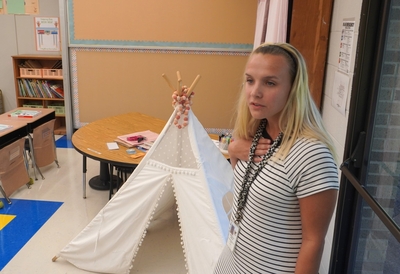
First-grade teacher Mckenzie Munson, also head coach of the Pocomoke High School’s field hockey team, is only going on her fourth year teaching at the school. She graduated in 2018 from Pocomoke High School down the street, and stayed on the Shore to earn a bachelor’s degree in elementary education from Salisbury University in 2022.
“She’s a baby,” Freistat said jokingly.
Even with the generational difference, Freistat and Munson both love Worcester schools. However, they said the district could be even better with some help from the state.
For instance, invest in dedicated spaces for early childhood education within or separate from a school building. A Judy Center that serves children from infant to age 5 moved back from Pocomoke High School to Pocomoke Elementary.
Besides encouraging visits to the district, Wallace had one simple solution for state legislators: “Put some respect on our name, is what I would say. Start asking people working in schools how things should be done.”
Copenhaver, the third-grade teacher who’s also trained in social-emotional learning, said the state should mandate that training for all teachers. She recalled times during her teaching career, at schools other than Pocomoke Elementary, when she’s had to deal with physical altercations between students.
Copenhaver said it’s important to teach not only academics, but also the right way to treat people.
“One thing I tell my students: You don’t have to like everyone, but you have to be respectful,” she said. “I know they can do the work … but if they can’t handle themselves in the appropriate way, there’s no way they’re going to learn everything they need to learn to be productive human beings in society.”
Annapolis, MD