Woman’s flair finally enters history-filled ‘Lawyers Room’ at State Capitol
Jun 18, 2026 | 5:00 am ET
Description
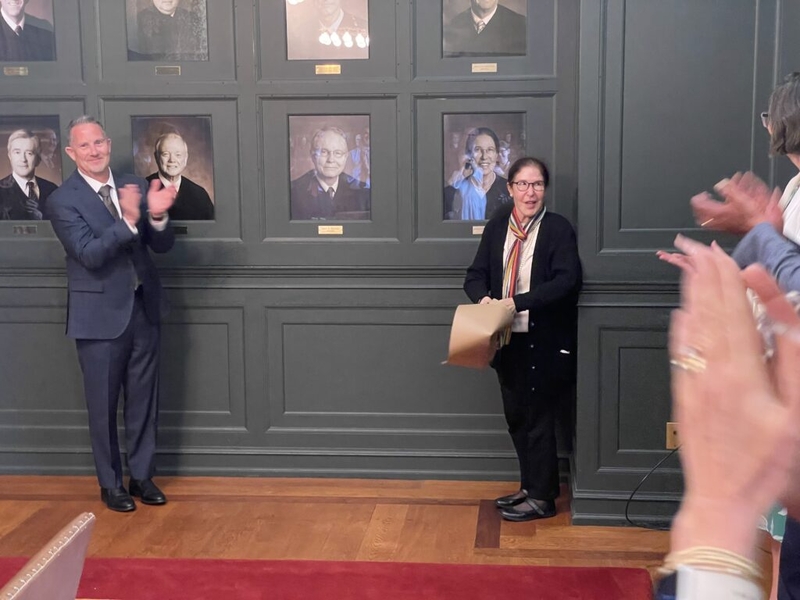
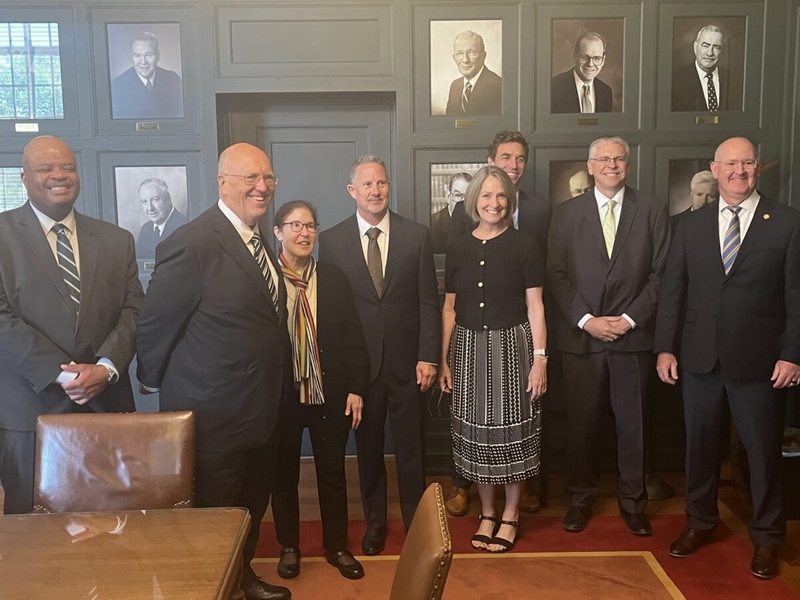
Applause follows the unveiling of retired Justice Lindsey Miller-Lerman's portrait in the State Capitol's "Lawyers Room," where about 70 photos of others who served on the Nebraska Supreme Court are displayed. Supreme Court Chief Justice Jeffrey Funke, shown here alongside Miller-Lerman, spoke about what he called her historic career. (Courtesy of Nebraska Supreme Court)
LINCOLN — For the century it’s been around, the storied “Lawyers Room” adjacent to the Nebraska Supreme Court chamber has been adorned with portraits of jurists who formerly served on the state’s highest court.
There was a common thread: All the faces were of men — until now.
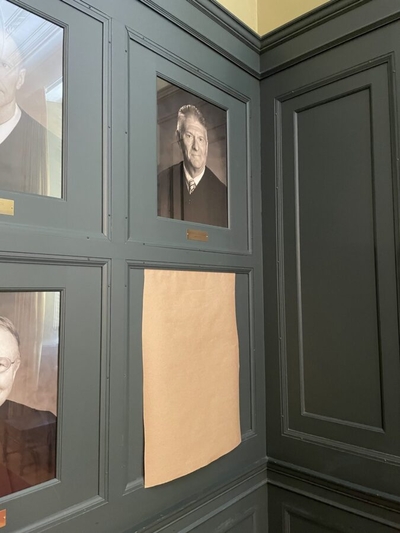
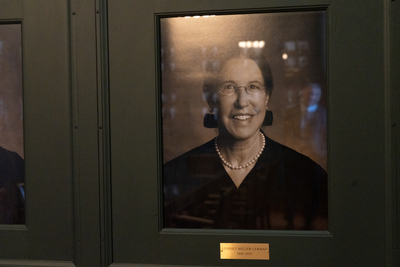
Unveiled last week was the newest and 70th portrait, that of Justice Lindsey Miller-Lerman, Nebraska’s first woman Supreme Court justice. She retired from the high court eight months ago after having served on it since 1998. The ceremony marked her official place on a wall of the room where attorneys prepare before they argue before the Nebraska Supreme Court or Court of Appeals.
Miller-Lerman was present June 10 to tear off the brown paper that revealed her picture amid the sea of male past Supremes. The bench service of the men in black robes dates back to the mid 1850s and Justices Fenner Ferguson and James Bradley, whose opinions ruled before Nebraska achieved statehood in 1867 and the original high court was referred to as the Territorial Supreme Court.
At one point, the oldest photos had to be condensed and clustered to make space for more. Miller-Lerman’s portrait filled the last available corner spot on a third wall, and she quipped that her retirement came just in time to get a female into the room: “We were running out of real estate.”
On a serious note, Miller-Lerman reflected on her time as a justice. She told the Examiner: “I’d like to think I made a difference on the merits of the subject matter and the ambience of the Court.”
‘Bullpen’
While the Lawyers Room is not typically open to the public, court officials say they often accommodate requests by groups of students, businesses or other organizations to view the space or meet there.
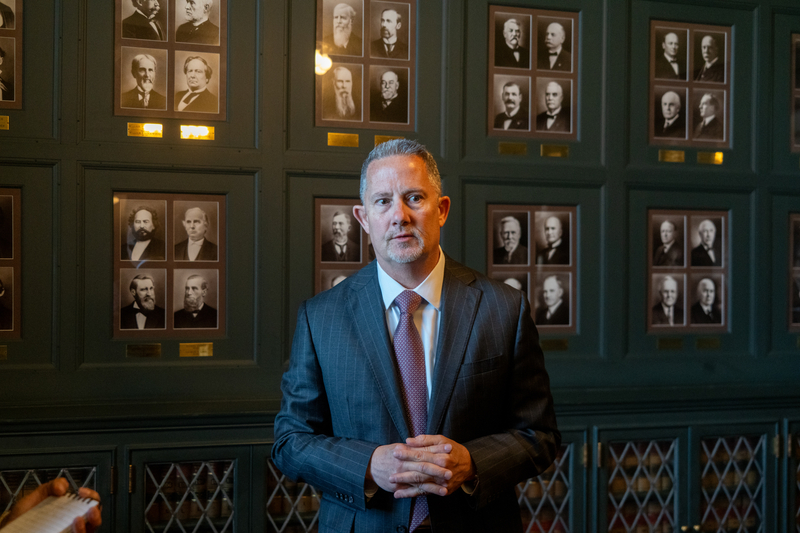
Chief Justice Jeffrey Funke told the Nebraska Examiner that the room is sometimes called the “bullpen,” referring to a warm up area in the game of baseball.
Instead of practicing a curveball or changeup, attorneys prepare to pitch their best oral argument to the Supreme Court or Court of Appeals.
Nebraska’s first woman Supreme Court justice hangs up robe, mulls next move: ‘I’ll be useful.’
Funke said the Lawyers Room is a place where the lawyers can look around and get motivated by the high-caliber legal minds and work ethic represented in the dozens of photo frames.
“It’s inspiring for lawyers, especially young lawyers, to say this is Nebraska – their judicial branch,” Funke said.
Aspiring lawyers or students who enter the room can absorb the history and decor, which now includes Miller-Lerman. Funke said it sends a message: “If I’m a female, I can say, ‘It’s happened. I can follow that path.’ I think that’s important and motivational.”
A mother and grandmother, Miller-Lerman wrote, participated or appeared in more than 5,800 career legal opinions before her retirement at age 78. She served 27 years on the Nebraska Supreme Court, appointed by then-Gov. Ben Nelson, the last Democrat to hold the governor’s seat in Nebraska.
Before that, Miller-Lerman served six years as an inaugural judge on the Nebraska Court of Appeals, which was established in 1991. Today, four of the six jurists on that appellate court are women, although one retires at the end of June and Gov. Jim Pillen appointed a male replacement.
Funke, who served with Miller-Lerman for about a decade, described her as a compassionate and “deep thinker” who he said was rated highly by lawyers and respected by litigants and colleagues.
To fill her Second Judicial District seat, Pillen appointed Douglas County District Court Judge Derek R. Vaughn, a Black jurist who is the high court’s first person of color.
Justice Stephanie Stacy, appointed by Gov. Pete Ricketts in 2015, was the high court’s second woman ever and now is the only remaining female on the seven-member Supreme Court, which consists of six associate justices who serve specific judicial districts and a chief justice who serves the state at large.
In Nebraska, the governor appoints justices who serve six-year terms before facing a “yes-no” retention election.
‘Light bulb’ moment
Roxanne Smith is tourism supervisor for the Office of the Capitol Commission, and for four decades has led guided tours of the State Capitol Building that was constructed between 1922 and 1932.
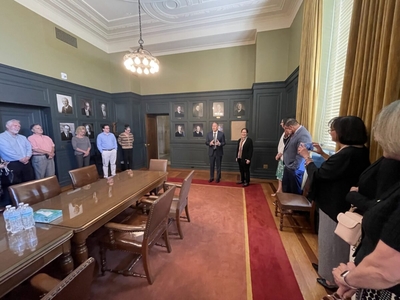
Smith said the Lawyers Room has always displayed photos of past Supreme Court members. Its dark green walls, tall heavy drapery and cranberry-colored carpet add to a Victorian-era ambiance, she said. A pair of wooden tables and leather chairs furnish the room, which Smith likened to a sitting room of a grand house.
When guiding student tours, she said she often stops in the Supreme Court chambers next to the Lawyers Room and quizzes youths about the court.
Smith recalled talking to a fourth grade class in 1998, noting that Miller-Lerman had just become the first female appointed to the Supreme Court — more than 130 years after Nebraska became a state. She said one boy started waving his arm to capture her attention.
It was like a “light bulb went off” in his head, Smith said, recounting him blurting: “You know, it’s almost like girls are as important as boys.”
‘High stakes’ in court composition, says nonpartisan policy group
Nebraska is among eight states in the nation that has only one female on its highest court, according to a November report by the Brennan Center for Justice, a nonpartisan law and policy organization that since 2019 has tracked the makeup of state Supreme Courts.
All states have at least one woman Supreme Court justice. (In Oklahoma, the high court that hears civil cases has two female members, but the state’s Court of Criminal Appeals has none.)
Twenty states have female majorities on their Supreme Court benches, the Brennan Center says. Collectively, women hold 43% of all high court seats.
State Supreme Court justices mostly are either appointed by a governor or voted in by the electorate.
The Brennan Center says the question of who sits on state high courts has high stakes, as the judicial bodies decide criminal cases, rule on civil rights protections and resolve conflicts between businesses, workers and consumers. Supreme Courts generally are the final word in interpreting state constitutions and other state laws, it says, and the center collects data to understand how closely courts reflect the makeup of their communities and the legal profession.
When judicial panels reflect various backgrounds and experiences — including racial, ethnic, gender, and professional diversity — it can strengthen decision-making, enhance the quality of deliberations, and improve public confidence in the courts and their outcomes, the center says.
Across all 50 states and Washington D.C., the center’s data shows that 21% of state supreme court seats are held by people of color; men hold 57% of high court seats, and 39% of sitting justices are former prosecutors while 10% are former public defenders.
Nebraska is among 15 states that have no Latino justices despite having populations that are more than 10% Latino, the center’s November update reported.
Lincoln, NE