Why WA’s certification process for home care aides is getting bogged down
Jul 28, 2026 | 7:01 am ET

Description
(Getty Images)
It’s been 15 years since Washington voters overwhelmingly approved a ballot initiative setting new standards for training and certifying home care aides.
But while the changes included in Initiative 1163 have improved safety for people receiving care, the certification process for aides has been rife with bottlenecks, according to a new state audit. Most prospective aides don’t even finish the process.
While Washington, like the rest of the nation, faces a shortage of long-term care workers, auditors don’t believe the issues have significantly strained the workforce further.
Home care aides support people who need long-term help with dressing, bathing and other activities of daily living due to age or disability. They work both in clients’ homes as well as adult family homes and assisted living facilities.
The initiative, passed in 2011, requires home care aides to get certified, with increased training requirements and testing, and FBI background checks for all long-term care workers, including these aides, nursing assistants and nurses. It also created a registry of aides who’ve had substantiated findings of abuse or neglect.
Previously, these workers only needed a Washington State Patrol background check, leaving a gap for those with a disqualifying offense committed outside Washington.
The goal was to protect a vulnerable population from unqualified aides who could take advantage of them.
Elements of the initiative, namely the FBI background checks, surely keep people safer, but the state lacks data to confirm this, according to the audit.
The problems
One issue delaying certification for new home care aides is the state has to verify the FBI’s background checks. This is redundant, provides little value and is costing the state, auditors say.
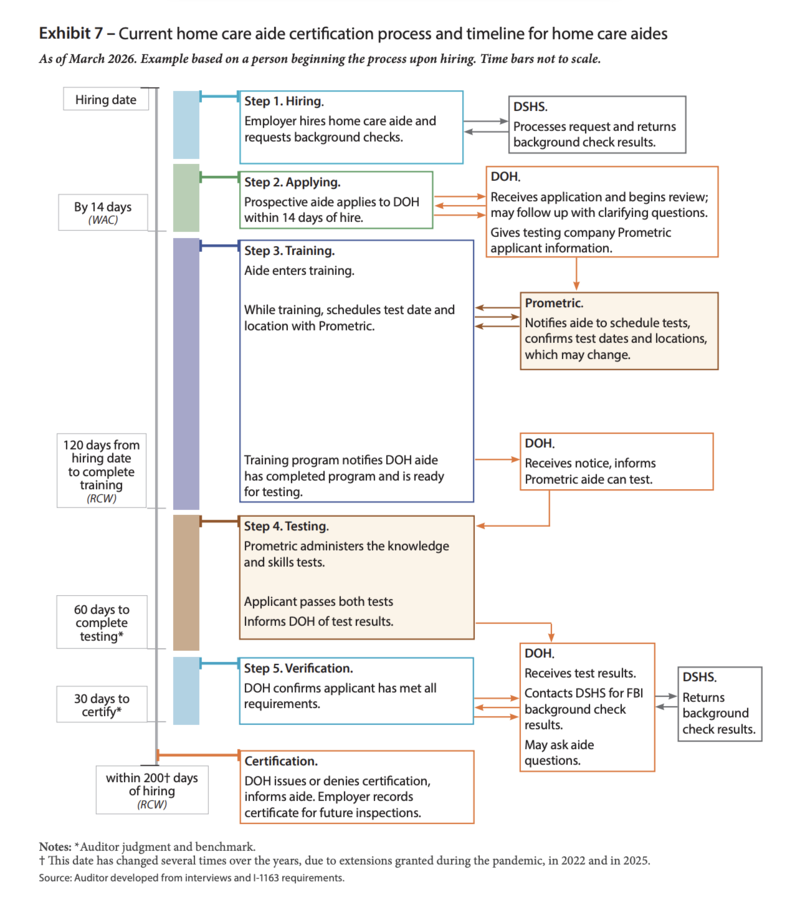
There are also delays between training and the required skills and knowledge tests needed to get certified as a home care aide, auditors say. More than two-thirds of applicants aren’t testing within 60 days of finishing their training. The more time between training and tests, the less likely aides are to pass.
Part of this is outside the state’s control, as its contracted testing vendor, Prometric, has caused delays. The state Department of Health has little leverage to force Prometric to improve access, according to the audit.
“We have been frustrated for many years at Prometric and the state’s oversight of Prometric. This has been, in our view, a subpar vendor for many years,” said Adam Glickman, secretary-treasurer for SEIU 775, the union for long-term care workers.
“We’ve talked to caregivers who have spent years, multiple years, trying to get tested,” Glickman added.
Though some progress is being made, as the Department of Health is working to allow applicants to test at the same place where they train. Auditors recommend changing state law to allow the agency to add more test proctors.
Access to training, meanwhile, isn’t seen as a barrier in the process. SEIU 775 is pushing the state to fund integrating the required tests into the training to avoid these barriers.
Just a fraction of applicants are getting certified within 200 days of hire, which was the previous requirement under state law. The state has extended this timeline, but it’s led to unintended consequences, like employers firing and rehiring aides to skirt the deadline, according to the report. For example, at one of the state’s largest long-term care employers, about half of its terminated home care aides between May and December 2025 were rehired the next day.
Some aides also move from job to job to avoid meeting the requirements, allowing them to work for years without testing.
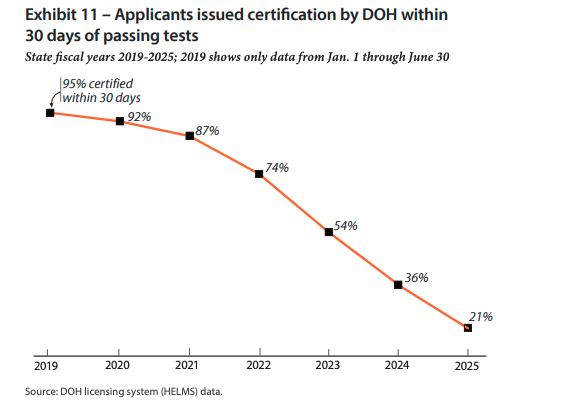
The Department of Health’s speed in issuing certification after applicants pass the required exams has dropped precipitously in recent years. In state fiscal year 2020, 92% of applicants got state certified within a month. In 2025, that was down to 21%, when it took an average of 86 days, according to the audit.
The department points to a few reasons for the delays, including issues in the rollout of a new computer system in 2024 and the redundant verification of FBI background checks, which the state has hired three full-time employees to deal with. The state also suspended certification deadlines during the pandemic, leading to a backlog. State officials say they caught up on the backlog in April.
Auditors suggest ending this practice of verifying the FBI checks.
Meanwhile, two-thirds of those seeking to enter the workforce don’t finish the certification process. This could be due to low wages, challenging working conditions or just realizing this type of work isn’t right for them. In fiscal year 2024, for example, the state received about 12,900 home care aid applications. Nearly 4,700 never completed training. Another 2,800 finished training but never passed tests. The number of abandoned applications has grown in recent years.
The Department of Health reviews thousands of applications from aides who have already abandoned the process. In fiscal year 2024, for example, more than half of applications the agency worked on were a waste of time, according to the report.
“While applicants may quit the process for numerous reasons, the system needs reconsideration and revision,” the audit reads.
Auditors recommend the department only accept applications after they’ve finished the required training and testing.
“It is possible to smooth the path for those who want to take on this challenging work, while continuing to protect the vulnerable Washingtonians who need and deserve their help,” state Auditor Pat McCarthy said in a statement.
Some employers give aides pay raises upon certification. Delays postpone those wage hikes.
Agency response
The Department of Health agrees with the auditor’s conclusions and “had already made some changes to our processes for certifying home care aides,” though many recommendations would need legislative approval, spokesperson Frank Ameduri said in an email.
In their official response, the leaders of the Department of Health, Department of Social and Health Services and the Office of Financial Management said the state continues to work “on ways to improve the credentialing process, coming up with creative solutions to address unique challenges.”
“Long-term care workers are critical in addressing the health needs of Washingtonians, especially as the number of people in need of long-term services and support grows due to age demographics and prevalence of disability,” the trio wrote. “We look forward to implementing the recommendations in this report and working together on improving credentialing processes.”
The auditor’s office has been reporting on this issue every couple years, consistently finding persistent challenges in the certification process, especially in testing.
“It sounds as if we have not made significant progress there,” Rep. Gerry Pollet, D-Seattle, said in a recent hearing on the audit.
Olympia, WA