While the votes are counted, the stitches go in
Nov 03, 2026 | 7:45 pm ET
Description
Photo courtesy of CT Mirror
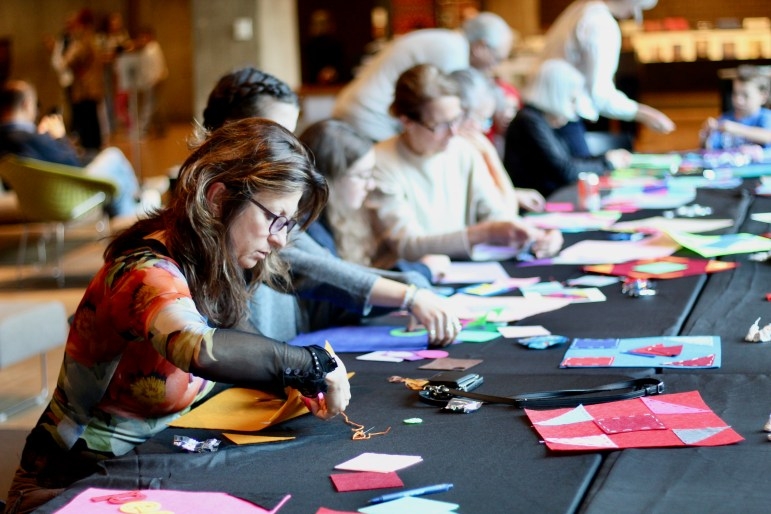
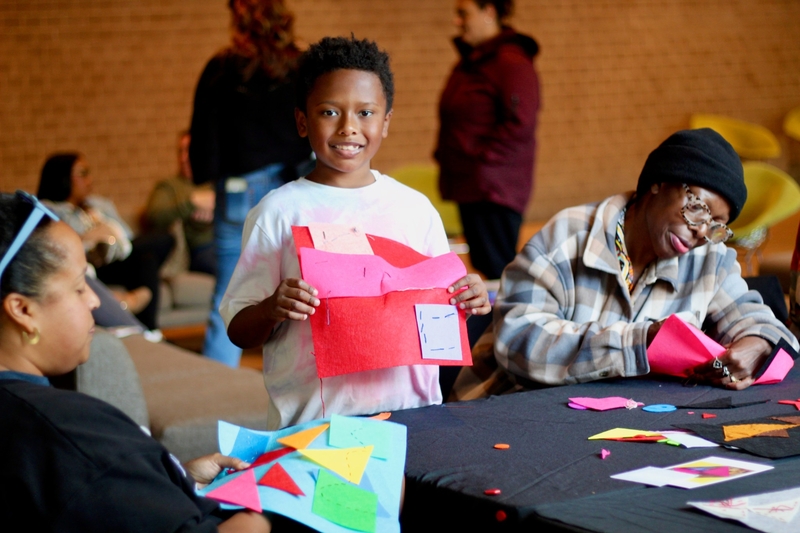
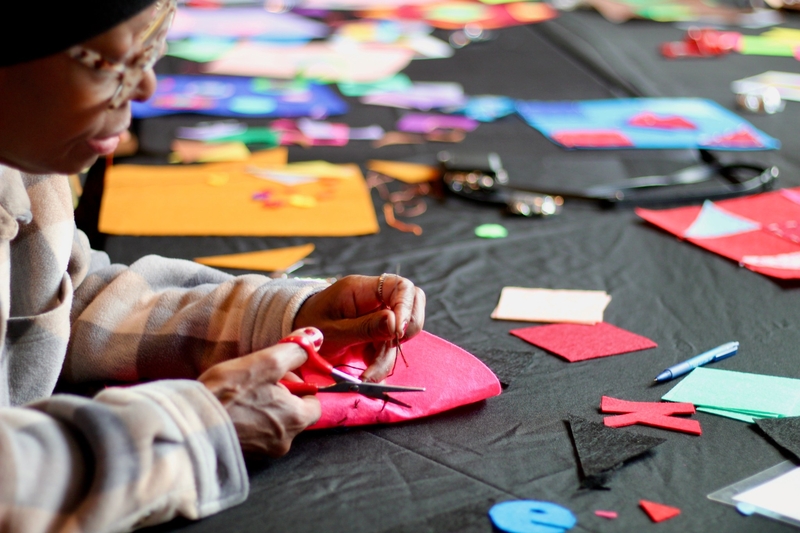
At a long, cloth-clad table inside the Yale University Art Gallery (YUAG), close to two dozen people focused their Election Day jitters on the needles and thread before them, sewing bright fabric triangles, whimsical flowers, button-sized circles and neat letter cutouts onto pre-cut felt squares.
The activity marks the gallery’s third annual Election Day Sewing Project, designed to create a meditative space on a day that can feel stressful and chaotic for some.
“The act of sewing, it’s a communal project,” said Molleen Theodore, curator of programs at YUAG. “And in many ways, that’s how our governments works … just being open to having your design next to somebody else’s, and having them live next to one another.”
The program began four years ago, after YUAG hosted a community sewing project with Indigenous artist Marie Watt, as part of its exhibition “Place, Nations, Generations, Beings.” That project expanded into the gallery’s “Sidewalk Studio,” a series of outdoor events that ran through the summer.
Theodore, who has held the position since 2011, remembered how excited she was to call the organization’s facilities team multiple times, to ask them to bring more tables out onto the sidewalk, to seat the waves of people who kept coming out.
“It was magic,” she said. She credited colleagues who have a sewing or quilting practice, including YUAG’s Bradley Associate Curator of Academic Affairs Sydney Simon and Documentation Photographer Jessica Smolinski, and quilter Jackie Gleisner, who worked at the Yale Center for British Art across the street.
When the 2024 election cycle came around, she proposed the same program to the gallery as a kind of nonpartisan pop-up that could stitch the community together no matter how folks voted — and provide a free, family-friendly activity when schools were closed on Election Day. The first one, in the midst of a divisive national election cycle, was such a success that she has kept them going each election day since.
Tuesday, three generations of sewers lined both sides of the table, hunched over their needles and thread as they worked through designs that ranged from blocky, geometric Christmas trees to half-rotated triangles spinning through two-dimensional space. At one end of the table, writer Rohanna Ssanyu Delossantos and her 9-year-old son, Leon, puzzled through their first designs together. Beside them, her mom, Rita Wagener, spaced out the “c” and “e” in a bright quilting square already set with the first three letters of the word “peace.”
Delossantos, a social studies teacher at New Haven Adult & Continuing Education who this year completed her first book of poetry, “The Maribou Who Crossed The Sea,” said she was grateful for the opportunity to tap into a free, kid-friendly public program on a day dedicated to civic engagement that can feel stressful.
As she spoke, new, neat lines of purple thread appeared through the felt, the needle poking its head up as if to announce itself and then disappearing again.
“I guess when looking at an election that can feel divisive, it’s a beautiful thing to be reminded that we all can sit together,” she said. To Delossantos, sewing feels like a necessary act as much as a meditative one: she will reliably mend an item of clothing before throwing it away. She’s not a seamstress, she said — that honor goes to her mom, who has been sewing for over three decades — but she can get the job done.
Next to her, Wagener celebrated the significance of Election Day with a stitched prayer for peace. An immigrant from Uganda, where she survived the brutal regime of dictator Idi Amin in the 1970s, Wagener said she thinks of voting as both liberatory and a chance to “express your feelings by putting them on paper.”
“It’s a freedom to find someone who believes what you believe,” she said.
Across the table, friends Mitali Temurnikar and Amrita Sridhur echoed that sense of gratitude for a calm moment. Sridhur, who was visiting from Boston, said the event gave her a chance to create a miniature, felted rangoli for the upcoming festival of Diwali, which they both celebrate. “I’m thinking about leaving it with her [Temurnikar],” she said of her friend with an encouraging smile.
On his way out, former New Haven Mayor John DeStefano and his granddaughters, Eleanor and Josephine, paused to soak in the moment. DeStefano, who has participated in many elections as both a candidate and a voter during his time in New Haven, smiled before helping the girls gather their belongings.
“Look,” he said, gesturing to where gallery staff had started asking attendees to clean up. “People are still around, talking to each other.”
Hartford, CT