When the last reporter leaves: Kentucky’s spreading news desert
Aug 05, 2026 | 5:30 am ET
Description
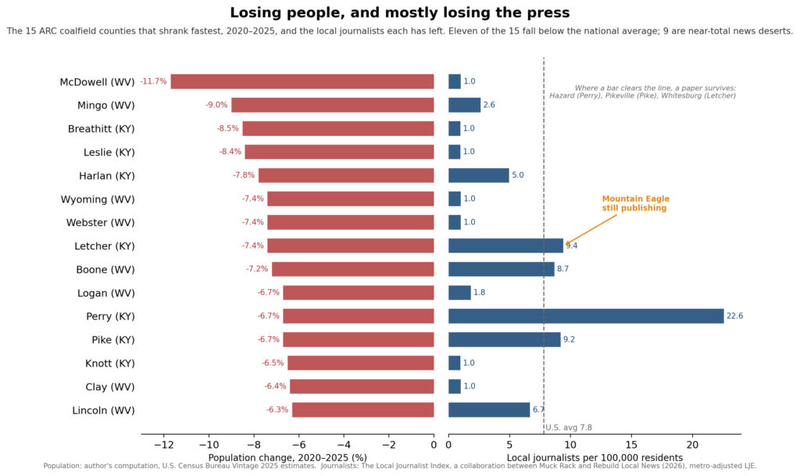
Population: authors’ analysis of U.S. Census Bureau Vintage 2025 estimates. Local journalists: The Local Journalist Index, a collaboration between Muck Rack and Rebuild Local News (2026).
In the late summer of 1974 somebody set fire to the Mountain Eagle in Whitesburg. The blaze took the offices, the files, the bound archives — most of the institutional memory of Letcher County that Tom and Pat Gish had been accumulating since they bought the paper in 1956 and changed its masthead from “A Friendly Non-Partisan Weekly Newspaper” to the two words that made it famous: “It Screams.”
When the next issue came out, Tom had changed the words beneath the eagle. Now it read “It Still Screams.”
A Whitesburg city policeman, Johnny Caudill, had paid two young men $50 apiece to pour the kerosene, in retaliation for the paper’s reporting on his department. He was convicted of arson in 1975 and given a year, suspended, by a judge who owned coal mines. In January 2022, Caudill filed to run for mayor of Whitesburg. The Eagle — Ben Gish now in his father’s chair — reported it straight, in a single sentence noting the conviction. He withdrew within days. That is what a local paper is for. Subtract it from a county, and the arsonist runs unopposed.
The Eagle survived the firebomb, the deaths of Tom and Pat, and the 2022 flood. What almost no paper like it can survive is the quiet economic erosion that has carried off close to a third of all American newspapers in a single generation. Northwestern University’s Medill School counts nearly 3,500 papers lost since 2005, and 213 counties now have no local news outlet at all. Nearly 80% of those news deserts are nonmetropolitan, and the digital startups filling the gap cluster in the metros. They do not, by and large, reach the hollows. The firebomb was an attack the Eagle could see coming. The news desert is an attack with no arsonist to name.
Advertising left Main Street when retail monopolies eliminated the local drugstores and groceries, then migrated to Google and Facebook. The cuts that followed made a thinner paper, the thinner paper shed readers, and lost readers drove revenue down again. Ben Gish says his news space is limited by another frightening fact: he has to print so many obituaries because of Letcher County’s aging population.
A 2025 landscape study commissioned by the Appalachia Funders Network found that where the average American county has 2.5 news outlets, rural Central Appalachian counties have 1.2. Ninety-three of the region’s 249 counties do not have so much as one full-time-equivalent local journalist working inside them, and of the 60 counties in the Appalachian Regional Commission’s original Central Appalachia, 39 have less than one.
Letcher is the exception, and a thin one. The Eagle’s full-time reporting staff is two people, Ben Gish and Sam Adams. That is enough to put Letcher at 9.4 full-time-equivalent local journalists per 100,000 residents, above a national average of 7.8 that stood near 40 in 2002. It is not a sign Letcher is well covered. It is a sign of how far the bar has dropped, when a two-person weekly clears it.
Kentucky’s coalfield and Cumberland Plateau counties have taken some of the worst of it. Around the turn of 2023, the Citizen Voice & Times and the Clay City Times published their last issues, and the Todd County Standard retreated online. Community Newspaper Holdings — owned by the Alabama state pension fund — folded its northeastern Kentucky weeklies into its Ashland daily, so that Morehead, a university town, lost its own paper. The Paducah-based Paxton Media Group has swallowed dozens of community weeklies, many now run with a single staffer. Much of Kentucky now reads what the industry calls ghost papers — nameplates kept alive to harvest the last subscribers, with almost no reporter behind them.
Population and press
Lay a second map over the first. Between 2020 and 2025 those 60 coalfield counties lost close to 49,000 people, and the counties bleeding population fastest are the same counties whose papers have gone dark. Our chart pairs each county’s population loss with the reporters it has left. Each starves the other. Once the paper is gone, so is the institution that recorded what the government did and told a young family whether the schools were worth staying for. The reasons to leave multiply. The reasons to stay go unwritten.
There are counterweights. In July, WEKU at Eastern Kentucky University and the Appalachia + Mid-South Newsroom launched the Appalachian News Exchange, a content-sharing network whose partners include Kentucky’s Nolan Group Media papers and the Kentucky Lantern.
Press Forward Blue Grass is the state chapter of a national coalition that has raised $400 million to aid local news. Press Forward has help pay for three Report for America reporters in Kentucky.
Press Forward is intent on building local news from the community up. For example, the group has helped the publisher of the Woodford Sun in Versailles to convert the family-run paper into a nonprofit. The idea, says Press Forward Blue Grass executive director Melissa Newman, is to help “newsrooms across the state look within themselves and into their communities to create a sustainable local news model that is unique to them.” In Eastern Kentucky, Newman says, the goal of Press Forward “isn’t to replace” existing news organizations, “it is to strengthen them.”
So Press Forward doesn’t seek to import reporters, but to bring emerging journalists in the community into the newsroom.
In Versailles, the publisher of the Woodford Sun donated the paper to the community this summer, the first legacy Kentucky newspaper to convert to nonprofit ownership. But the funders’ own study warns there is not enough philanthropy in the country to run a rural news industry on grants.
What the chains did to the mountain press is what absentee corporations did to the coalfields a century earlier — bought the local asset, took the cash it still threw off and ran it thin. The cure for absentee ownership of land is to put the land back into local hands. The cure for newspapers is the same. Rebuild Local News calls it replanting: helping local nonprofits and residents buy back the papers the chains have hollowed. It is, in plain terms, a homestead act for the press, and the rest of the menu — a payroll-tax credit to keep a reporter on staff, a set-aside of the state’s public-notice spending — is modest and nonpartisan. It is the difference between treating the news desert as weather and treating it as policy.
In March 2023, the Welch News, in McDowell County, West Virginia, printed its last edition. Missy Nester had bought it in 2018 to try to save it and went five years without paying herself. When it closed, McDowell lost its only independent record of what its government was doing — just as long-delayed federal money for the county’s failing water and sewer systems began to arrive, with no one left to follow where it went.
“Like, can any of y’all hear us out here screaming?” she asked an Associated Press reporter on her way out the door.
Sixty miles to the southwest, across the Kentucky line, the Mountain Eagle still screams. Two papers, one verb. The history of the Appalachian press in this last half-century lives in the distance between Tom Gish’s defiance and Missy Nester’s despair.
(Editor’s Note: the Kentucky Lantern recently received a grant from Press Forward Blue Grass to help fund a public policy partnership/intern program with UK.)
Frankfort