When data centers come knocking, counties should have a ‘wish list,’ officials say
Aug 15, 2026 | 5:39 am ET

Description
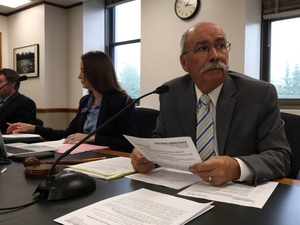
Ian Ullman, deputy director for Gov. Wes Moore's (D) energy office, said at the Maryland Association of Counties conference Friday that Maryland counties should consider the financial investments data center companies are willing to make to improve their counties, such as road or school improvements. (Photo by Christine Condon/ Maryland Matters)
Gov. Wes Moore’s (D) energy office has a message for all of the Maryland counties with temporary data center moratoriums: Make your wish list.
“Use the time that you have bought yourselves with your local moratorium, talk to other communities that have figured this out,” said Ian Ullman, deputy director of the Maryland Energy Administration. “And make your wish list. This is the time.”
If one thing was clear after the second major panel focused on the issue at the Maryland Association of Counties summer conference, it was that data centers are not going anywhere — at least not any time soon. So counties should start preparing.
“Counties willing to negotiate can extract meaningful investment in their community’s futures while mitigating impact to their communities and residents,” Ullman said. “New schools, road upgrades, community centers, long-term support packages for local initiatives — it’s all on the table.”
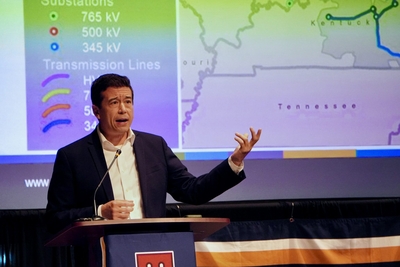
Constellation Energy, represented on the panel by senior vice president of government affairs Mason Emnett, agrees.
“Engage, roll up your sleeves, identify what matters to you, what matters to your community, and in our experience, you’ll find partners who come forward and want to be in the solution space and get to yes,” Emnett told the audience in Ocean City.
Just over a week ago, Constellation learned that data center developer Amazon Web Services was pulling out from its planned project at the company’s Calvert Cliffs nuclear plant in Southern Maryland. It came after voters unseated three members of the county council amid data center backlash. Now, the county is considering a moratorium of its own.
Though the response of many Maryland counties — representing the majority of Maryland residents — has been to enact time-limited bans amid fierce pushback from voters to data center proposals, the demand for AI among consumers seems persistent. Data centers “aren’t going away,” said Jason Stanek, executive director of governmental services at PJM Interconnection, the electric grid serving Maryland and about a dozen other neighboring states.
“We need all levels of government: county government, state government, to address this situation because we see this train coming and it’s coming fast,” Stanek said.
And Maryland, which does not have a large volume of high voltage transmission lines, is in a precarious position as data centers outside the state continue to place pressure on the PJM grid. The Eastern Shore does not have any high voltage transmission, only one such line crosses the Western panhandle, and only a few lines exist near the Interstate 95 corridor.
“We have 14 states, and Maryland is one of the most concerning,” Stanek said. “We see challenges on the horizon in the near term. Next year, we expect possible disruptions of the grid in the state of Maryland.”
But efforts to add new lines can be fraught, said Stanek, who formerly led the Maryland Public Service Commission, which regulates utilities and power equipment in the state. For instance, PJM commissioned the Maryland Piedmont Reliability Project, a new high-voltage line for rural Central Maryland, and it’s been the subject of significant pushback from hundreds of landowners practically ever since. It currently sits before the PSC.
“It doesn’t take very long to build a data center: 18, 24 months,” Stanek said. “Try building a new power plant. Five years? Maybe, if you’re lucky. A transmission line? When I chaired the PSC, I approved every line that came across my desk. Not one got built because we couldn’t get it across other state lines.”
Now, PJM is challenging its member states to approve power plants in one year, and transmission lines in one to two years, Stanek said.
On Thursday, PJM filed a proposal that would allow new data centers to connect to the grid — but if they do not bring their own power generation, they would be first in line to be shut off in a power emergency, forcing them to rely on back-up generators. The proposal would have to be approved by the Federal Energy Regulatory Commission.

“When electricity supply on the grid approaches dangerously low levels, a new emergency procedure would notify utilities to reduce or transfer the electricity demand from new Large Load customers ahead of any action that would serve to shut off traditional consumers, including residential consumers,” reads a news release from PJM.
Still, the demand growth projections — fueled largely by possible data centers — remain immense, said Maryland People’s Counsel David Lapp, who represents residential utility ratepayers in the state.
“By 2046, PJM forecasts adding [the power demand of] about seven states of Maryland to the region. This is not normal growth in electric demand,” Lapp said. “It’s almost entirely due to data centers projected to arrive in record time and in concentrated locations.”
Most of this data center demand growth isn’t coming from Maryland. In fact, 93% of it is coming from Virginia, Ohio, Pennsylvania, and Illinois, Lapp said during his presentation.
His office has been working to shield Maryland customers from paying for the energy buildout that data centers are requiring, because, currently, the costs of expanding and maintaining the system are shared by all ratepayers. But processes are underway at PJM, at FERC and at the state level to change the paradigm, Lapp said. That’s why slowing down on data centers — even slightly — has a lot of value, he said.
“These efforts should — if they’re done right — should provide good, solid protections for residential customers,” Lapp said. “But they take time.”
Annapolis, MD