When budget cuts don’t actually save money
Nov 25, 2026 | 10:00 am ET
Description
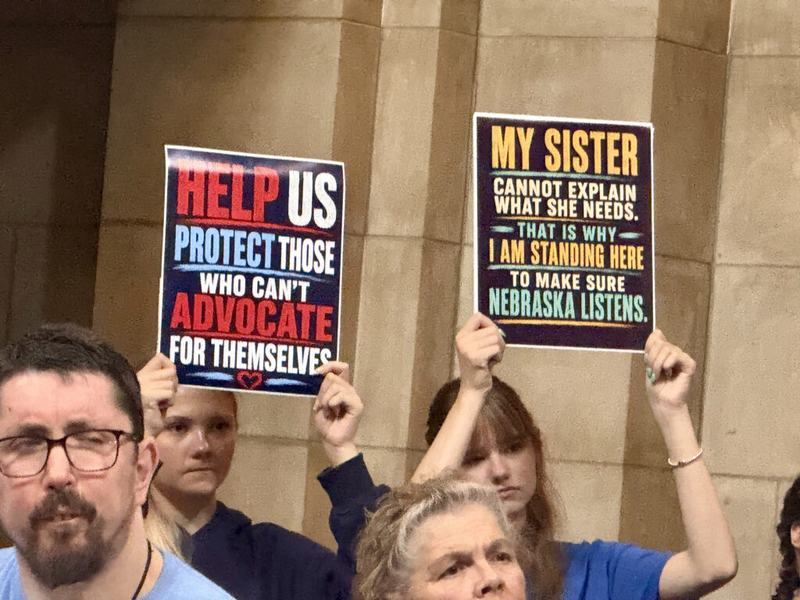
Advocates for people with disabilities hold signs and speak during an event Wednesday, Aug. 19, 2026, in the State Capitol. (Photo by Cindy Gonzalez/Nebraska Examiner)
Nebraska faces difficult financial decisions. Balancing the state budget requires fiscal discipline, responsible oversight and a willingness to examine how taxpayer dollars are spent.
But one question deserves far more attention:
What happens when the state’s efforts to reduce expenditures threaten the financial stability of the businesses and organizations delivering essential public services?
On Nov. 20, Nebraska’s Division of Disability and Aging announced a 4% reduction in developmental disability provider reimbursement rates beginning Jan. 1, 2027, followed by another 4% reduction in 2028.
These reductions come as providers continue navigating rising wages, insurance costs, transportation expenses and regulatory requirements.
As co-owner and president of Independent Horizons, a Lincoln-based disability services provider, I understand the financial challenges facing organizations responsible for supporting some of Nebraska’s most vulnerable citizens.
But this issue extends far beyond providers.
Reducing an expenditure is not necessarily the same as reducing a cost.
Consider what happens when reimbursement rates fall below the actual cost of delivering services.
Providers must maintain appropriate staffing, meet regulatory requirements, provide training, ensure participant safety and fulfill their responsibilities to the individuals they support.
When revenue decreases but these obligations remain, organizations face difficult decisions. They may freeze wages, reduce benefits, limit services or ultimately close their doors.
And when a provider closes, the individuals receiving services don’t suddenly stop needing support.
Their disabilities don’t disappear. Their need for assistance doesn’t diminish. Their right to live safely and independently remains unchanged.
Instead, those needs become someone else’s responsibility.
Families may be forced to reduce working hours or leave employment to provide care. Other providers may be asked to absorb additional individuals despite existing staffing shortages. People who depend on consistent services may experience disruptions affecting their health, safety and independence.
In some circumstances, unmet needs may result in more expensive crisis interventions, emergency medical care or institutional services.
The original budget reduction may appear successful on paper while additional expenses begin appearing elsewhere.
It becomes a game of whack-a-mole: solve one financial problem, only to create two more.
This is the difference between short-term budget savings and genuine long-term fiscal responsibility.
There is also a broader economic impact.
Community-based disability service providers are Nebraska businesses. They employ people, pay wages, rent facilities, purchase goods and services, and contribute to local economies.
When these businesses lose revenue, the consequences extend beyond Medicaid.
Employees facing reduced hours or layoffs have less money to spend locally. Families leaving the workforce to provide care may lose income and benefits. Communities may experience reduced economic activity and tax revenue.
These potential consequences deserve consideration even when they fall outside the original budget category.
Nebraska absolutely has a responsibility to identify waste, prevent fraud, improve efficiency and ensure taxpayer dollars are spent appropriately.
But across-the-board reductions are not the same as targeted reform.
A responsible approach would examine actual provider operating costs, strengthen financial oversight, identify unnecessary expenditures and develop efficiencies without compromising essential services.
It would also evaluate proposed changes to home modifications, vehicle modifications and assistive technology. These supports can help individuals remain in their homes, maintain independence and participate in their communities. Eliminating them may create additional expenses elsewhere.
Before implementing reductions of this magnitude, Nebraska should provide a comprehensive analysis of their potential effects on provider sustainability, workforce stability, participant safety, family caregivers and other public expenditures.
The public deserves to know not only how much the state expects to save, but what those savings may ultimately cost.
The individuals receiving these services did not create Nebraska’s budget challenges. Their needs should not be treated as avoidable expenses simply because the state faces financial difficulties.
This is not an argument against balancing the budget.
It is an argument for balancing the budget responsibly.
Nebraska needs solutions developed with the precision of a scalpel, not the sweeping force of a hatchet.
The true cost of a budget decision is not simply what the state stops spending. It is also what the state may have to spend as a consequence.
A budget can appear balanced while the costs of its decisions continue growing elsewhere.
And when that happens, we haven’t necessarily solved the problem.
We’ve simply moved it.
Lincoln, NE