SC’s food waste challenge: Lessons from our path to zero waste
Nov 25, 2026 | 6:00 am ET
Description
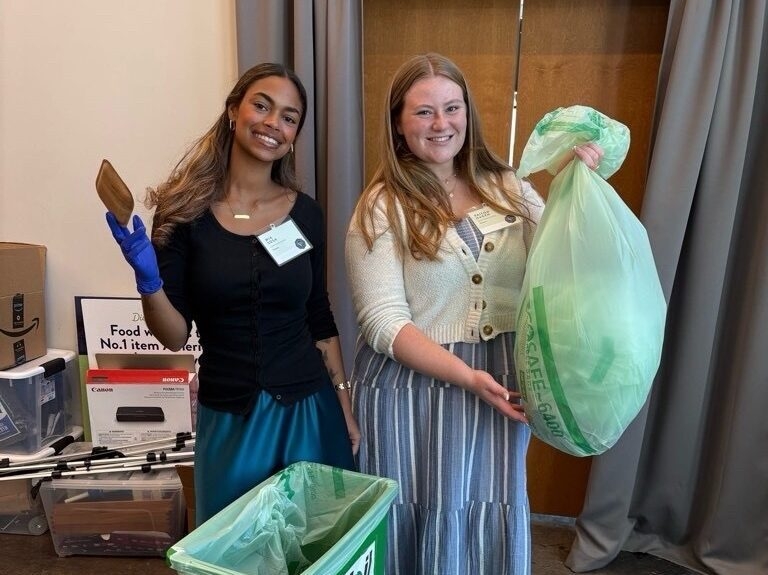
Coastal Carolina University student volunteers sort through compost bins to remove contaminants at the close of Sustain SC's fifth annual Sustainability Symposium in Columbia in October. (Photo by Savanna Schultz/Courtesy of Sustain SC)
What happens when you want to do the right thing with your waste, but the resources to do it are out of reach?
For many South Carolinians, that’s the reality every time they scrape a plate into the trash.
Where we put our food waste matters for many reasons, one of which is because we have limited landfill space. When landfills reach capacity, the cost won’t just show up on a spreadsheet. It will show up on our land.
The working forests, farms and natural places that make South Carolina special become candidates for the next landfill.
Food waste sits at the center of this challenge.
According to the South Carolina Department of Environmental Services’ Waste Characterization Study, food waste is the single largest material entering our municipal solid waste landfills: 26.2% of what we throw away, totaling an estimated 939,500 tons annually when combining loose waste and discarded food still in its packaging.
Recovering the recyclables and compostables we currently landfill would avoid 1.9 million metric tons of carbon dioxide, the equivalent of taking more than 400,000 passenger vehicles off the road annually, according to the report released in March.
Those materials aren’t waste. They’re a missed opportunity.
What we learned on our path to zero waste
Over the past year, Sustain SC put our principles to the test by attempting to host zero-waste events.
With help from our partners at Green Energy Biofuel and ReSoil, who provided bins, compostable liners, and sorting guidance, we diverted 265 pounds of food waste and 31 pounds of recyclables across nine of our events from our landfills.
That includes about 200 pounds of food waste at our annual Sustainability Symposium alone, which ReSoil will turn into compost for South Carolina farms and gardens.
South Carolina’s growth is not the question. How we respond is.
Recycling, while challenging, was relatively straightforward for us. Food waste was another story.
The problem was never willingness. It was finding somewhere for the scraps to go. At some events, we collected less than 10 pounds of food waste, far below what most haulers need to justify a pickup.
Without a composting facility nearby, our options were to drive a small amount of material a long way or send it to the landfill. And even among sustainability-minded attendees, contamination meant our team often sorted bins by hand.
If a sustainability organization with industry connections struggles to divert food waste, how can we expect everyday South Carolinians to do it?
A statewide gap
South Carolina has just four permitted large-scale composting facilities: one each in the Lowcountry, Grand Strand, Midlands and Upstate. Large commercial waste generators may have dedicated hauling, but smaller organizations and households often have no practical options.
As our state keeps growing, the pressure grows too.
At Sustain SC’s Circularity Summit in August, Ed Marr of the Horry County Solid Waste Authority noted that of South Carolina’s 17 Class Three municipal solid waste landfills (for household garbage), four have less than 20 years of capacity left without expansion.
Education helps.
The environmental agency’s Don’t Waste Food SC program offers valuable guides and tools for households, schools and businesses, and it deserves continued support.
But education alone isn’t enough.
Horry County’s residential food waste collection pilot offers a valuable case study. Since launching in December 2022, the program collected nearly 30 tons of food scraps but faced challenges with participation and rising hauling costs.
Last December, the recycling committee of the county’s Solid Waste Authority recommended continuing the program through 2026, demonstrating both the opportunities and economic realities of expanding community-based food waste diversion.
The lesson isn’t that composting can’t work. It’s that participation, access and cost must be solved together.
Building solutions that work
The Department of Environmental Services is exploring a regional hub-and-spoke approach that connects smaller collection points with larger processing facilities, helping communities pool food waste and reduce transportation barriers.
Making it work will take local governments, haulers, processors, businesses and residents working together.
As a state, we should prevent food waste first, donate edible surplus and make sure unavoidable scraps have somewhere productive to go, through accessible collection, regional partnerships and clear, consistent education.
South Carolinians shouldn’t need specialized knowledge, industry connections or a long drive to keep food waste out of landfills.
The willingness is there. Now we must build the systems that make participation possible, before more of that material, and our landfill capacity, are lost.
Columbia