What’s the matter with data centers?
Jun 04, 2026 | 3:30 am ET
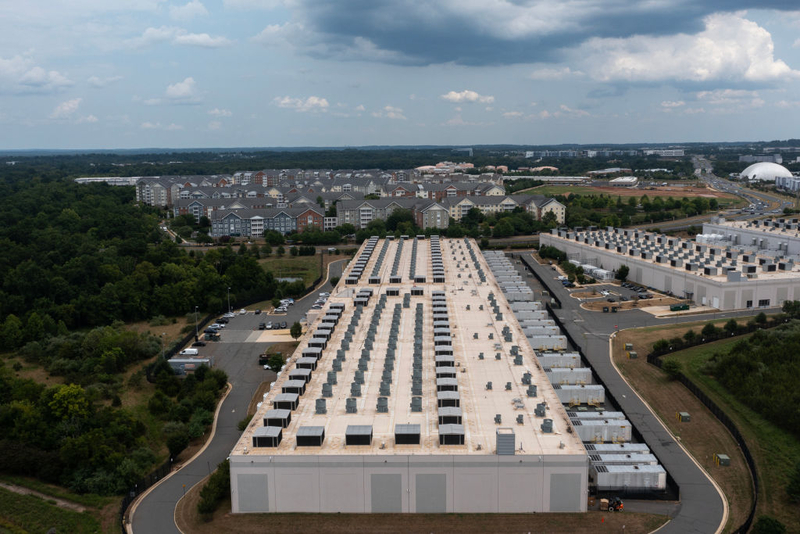
Description
An aerial view shows an Amazon data center. (Photo by Nathan Howard/Getty Images)
In the past year, data center development in the United States has transformed from a topic of excitement among economic development enthusiasts to a widespread issue of concern among regular members of the public.
Honestly, I can’t go half a day without someone bringing up data centers. A phrase that seems wonky and technical has captured public imagination in a surprising way in 2026.
This isn’t just my experience, either. Google Trends data shows the exponential growth in the search term “data centers” in Ohio over the past year. Ohio residents googled the term “data centers” 10 times more in May 2026 than they did a year earlier.
What is driving this rising interest in data centers in Ohio and beyond?
One explanation is environmental impact. Many are concerned about the impact of data centers on local water supply, a concern that has made a lot of headway in social media circles.
Another is electricity prices. Many fear the increased demand for electricity to power data centers will lead to higher prices for consumers. In an era of fears of growing problems with affordability and an economy that is still living in the shadow of 9% inflation in 2022, anything that could lead to higher prices still poses an area of concern for consumers.
Members of the public are also concerned about public investment in data centers. Ohio created a framework for economic development incentives for data centers over a decade ago in the Kasich administration’s first budget bill. Two years later, the incentive was expanded to more data centers. A recent story by Signal Ohio reported Ohio’s sales tax exemption for data centers ballooned from a projected $136 million in deferred sales taxes to $555 million in 2024 and $1.6 billion in 2025. A recent poll of Ohio economists conducted by my firm Scioto Analysis found only one of 14 economists believing tax incentives for data centers were an efficient strategy for job creation.
Another factor driving public interest in data centers is community change. Many of these arguments sound a lot like community opposition to solar panels or wind turbines, with people saying they are ugly or change the character or tenor of a neighborhood. For people who see a number of data centers crop up in their neighborhood in a short period of time, this sort of change can be shocking.
A final reason people are worried about the proliferation of data centers comes from a broader concern: social change. I was on a panel with social critic Michael Clune and tech consultant Nicole Jackson hosted by workforce strategy organization ASPYR last month. One thing that stuck with me that Clune said was that polling around adoption of the internet when it appeared in the 1990s was optimistic, even as few people were using it. This trend has been reversed with artificial intelligence: the technology is seeing rapid adoption, and the public is generally pessimistic about it. A viral speech from a Ravenna City Council meeting given against approval of a data center by a former programmer captures this sentiment well.
The truth is that each of these areas of concern for the public have shades of grey. Data centers impact the environment, but not nearly as much as agriculture or transportation. They impact energy prices, though these impacts can be mitigated by construction of new power generation projects to support them. Data centers and AI will change our communities and our society, but our communities and society are changing with these particular changes or without them.
But Ohio lawmakers can decide whether they want to spend billions of dollars on projects that are likely to happen without those incentives. Last week, Representative Tristan Rader and ten other members of the Ohio House of Representatives introduced legislation to phase out the data center subsidy starting later this year, leaving new data centers to the whims of market forces. While this change would not curtail all concerns with data center development in the state, it would at the very least give a chance for data center development to come a little closer to what an efficient market would provide.
Columbus, OH