What’s up with amendments A & B? Lawmakers are asking voters to change the Utah Constitution (again)
Oct 13, 2026 | 7:02 am ET
Description
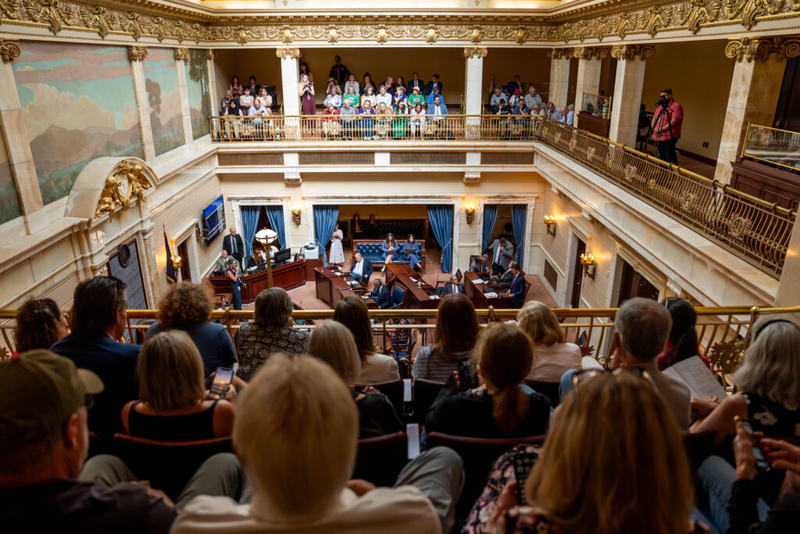
People watch from a packed gallery as the Senate discusses a proposed constitutional amendment related to citizen initiatives during a special legislative session at the Capitol in Salt Lake City on Wednesday, Aug. 21, 2024. (Photo by Spenser Heaps for Utah News Dispatch)
In addition to all the congressional, legislative and local races Utahns will need to sort through after they get their by-mail ballots starting this week, there are two wonky but important questions for them to answer.
The questions titled Amendment A and Amendment B, depending on what voters decide, will have long-term implications for the state’s foundational governing document: the Utah Constitution.
Amendment A will strip out the explicit requirement for all other future proposed constitutional amendments to be published in newspapers before the election, instead replacing it with a more flexible rule set by lawmakers.
Amendment D still void: Utah Supreme Court upholds district court decision
Amendment B — the more controversial of the two — would set a higher bar for Utahns to enact certain laws at the ballot box, requiring a 60% approval threshold for ballot initiatives that would come with a tax increase.
The amendments mark the Utah Legislature’s latest attempts to change the state Constitution — something that’s become fairly common.
Over Utah’s history, the Legislature has referred 192 measures to the ballot — nearly seven times the number of citizen-initiated measures, which have totaled 28 since 1895. Measures put on the ballot by the Legislature (which requires a two-thirds majority vote), have had a higher likelihood of passing — nearly 70% — compared to just 25% of citizen-led ballot initiatives, according to an analysis done by Ballotpedia.
Over the past 10 years, since 2016, Utah lawmakers have proposed 20 changes to the Utah Constitution. Most have passed at the ballot — but not all. And in 2024, two of those questions were voided by the courts, in part because state leaders failed to follow the newspaper publishing requirement and in part because they used misleading and inaccurate ballot language.
Here’s what you need to know about this year’s pair of proposed amendments and the debate around them:
Amendment A
Under this proposed constitutional amendment, newspapers would no longer be the required way for state officials to spread the word about all future proposed constitutional amendments.
If voters approve Amendment A, the Utah Constitution would be changed to remove its explicit requirement that state officials publish proposed constitutional amendments in “at least one newspaper in every county of the state, where a newspaper is published for two months” immediately before the election.
Instead, the constitution would require they be published “in a manner provided by statute, for 60 calendar days” immediately before the election.
If voters approve Amendment A, state law would be changed through HB481, which was approved during the 2025 legislative session, to require the lieutenant governor to publish the full text of all proposed constitutional amendments (and other ballot questions from the Legislature) on the state’s Public Notice Website and on the lieutenant governor’s website for 60 days before the election.
This proposed amendment was put on the ballot after a unanimous vote to approve it in the Utah House and Senate. There is no known organized effort to oppose the amendment.
However, it has a history that stems from controversy over previous constitutional amendments that were halted by the courts.
Utah lawmakers proposed it after two proposed constitutional amendments were voided from the 2024 ballot amid lawsuits, in part because the courts determined state leaders failed to meet the constitutional publication requirements and in part because lawmakers used misleading and inaccurate ballot language to describe their effects.
If voters approve Amendment A and HB481 takes effect, it could reduce state costs by up to $1.4 million every two years, according to a fiscal analysis included in the state’s voter information pamphlet.
Utah legislative leaders express regret over Amendment D’s ‘misleading’ ballot language
“The savings from changing the publication requirement for proposed constitutional amendments from newspapers to publicly operated websites would vary depending on the length of each proposed constitutional amendment and newspaper publication rates,” the analysis notes.
Proponents of the amendment have argued that in the digital age, print newspapers are becoming more scarce and not the primary way most Utahns get their information anymore.
“While that made sense when newspapers were the primary source of information, most Utahns now rely on digital sources, mobile devices, and online platforms to stay informed,” Rep. Anthony Loubet and Sen. Daniel McCay, both Republicans, wrote in an argument in favor of the amendment included in the voter information pamphlet.
They argued it would “modernize” Utah’s public notice practices and allow them to “adapt as technology evolves.”
“By modernizing an outdated constitutional requirement, Utah can maintain transparency, improve accessibility and save taxpayer dollars,” they wrote.
Because Amendment A was put on the ballot by a unanimous vote, no rebuttal to the argument in favor was included in the voter pamphlet.
Amendment B
This constitutional amendment would make it harder for certain statewide ballot initiatives — or laws approved by Utah voters — to pass at the ballot box.
Under Utah’s Constitution, currently most ballot initiatives need a simple majority (more than half, or 50%) to pass. The one exception is thanks to a constitutional amendment Utah voters passed in 1998, which requires two-thirds approval (66.67%) for voters to approve ballot initiatives related to the “taking of wildlife,” or hunting.
If approved by Utah voters this year, Amendment B would raise the bar to 60% for ballot initiatives that increase taxes, either by creating a new tax, expanding an existing tax, hiking an existing tax rate, or changing a property tax rate in a way that results in a smaller decrease in the property tax rate than would occur under existing law.
What would that mean for ballot initiatives? It helps to look back to 2018, when Utah saw a flurry of ballot initiative efforts.
Utah lawmakers want a higher bar for ballot initiatives that raise taxes. Will voters sign off?
That year, no initiative received more than 60% of the vote, though three passed and two increased taxes. An initiative for full Medicaid expansion passed with 53.3% of the vote, and an initiative to legalize medical marijuana passed with 52.7%. A Better Boundaries’ initiative to create an independent redistricting commission also passed, but by a slim 50.3%.
The Medicaid expansion and medical marijuana initiatives both created new revenue streams to pay for themselves, so if they were subject to the new 60% requirement in Amendment B, neither would have passed.
Proponents of Amendment B — including the Utah Taxpayers Association — have argued the change would help protect taxpayer money. The question’s sponsor, Sen. Lincoln Fillmore, R-South Jordan, argued during this year’s legislative session that voters should decide whether to set the higher threshold or not.
Critics, however, have launched a political issues committee, Utahns Protecting Our Constitution, to finance a campaign urging Utah voters to vote down Amendment B. They have argued the change would be an “unnecessary and permanent rewrite of Utah’s founding document that would weaken one of the most important tools citizens have to hold government accountable.”
Utahns Protecting Our Constitution argues that the Utah Constitution should only be changed when absolutely necessary, and if voters approve Amendment B, they’ll be taking away their own power “and giving politicians control over the rules.”
In arguments in favor of Amendment B included in the election’s voter information pamphlet, Fillmore and the question’s House sponsor, Rep. Jason Kyle, R-Huntsville, said with Amendment B, Utah voters will decide “how easy should it be for your neighbor to raise your taxes?”
“Any proposal that will take more money from Utah families, workers and businesses should have widespread agreement from the people who will pay for it,” Fillmore and Kyle wrote. “Amendment B provides that safeguard by requiring statewide tax-related ballot initiatives earn 60% voter approval before becoming law. The amendment does not prevent voters from approving tax hikes they support. It simply ensures proposals affecting taxpayers statewide have broad backing before they take effect.”
The Legislature’s top Democrat from Salt Lake City, Senate Minority Leader Luz Escamilla and House Minority Leader Angela Romero wrote the argument against, saying it really asks “should elected officials have more power than you?”
“Requiring 60% approval for tax-related initiatives does not create accountability,” Escamilla and Romero wrote. “It creates an unequal system where voters face stricter rules than the Legislature itself. Lawmakers can raise taxes with a simple majority. The people should have that same power.”
Fillmore and Kyle argued that taxes imposed by the Legislature “can be reversed by new legislators at any time, but statewide initiatives operate differently.” They contend they “cannot be revised or adjusted once passed, other than by another costly initiative.”
It’s worth noting, however, that Utah lawmakers repealed and replaced all three of the 2018 Medicaid expansion, medical marijuana and independent redistricting initiatives, making changes to the voter-approved laws. A lawsuit over the redistricting repeal and replacement led to a 2024 Utah Supreme Court ruling that made clear Utah lawmakers’ ability to change “government reform” ballot initiatives has limits.
Salt Lake City, UT