What the Oregon Education Association’s missing endorsement says about this year’s race for governor
Oct 01, 2026 | 6:09 pm ET
Description
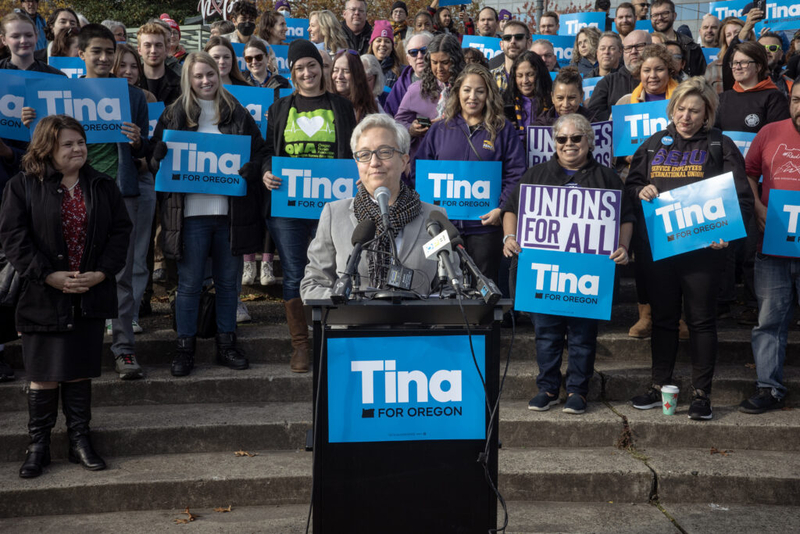
Gov.-elect Tina Kotek delivers a victory speech at Salmon Springs in downtown Portland, Oregon, on Nov. 10, 2022. Several supporters carried signs or wore shirts representing their unions. (Photo by Jordan Gale/Oregon Capital Chronicle)
One question people inside and outside Oregon ask about this year’s governor’s race is: Has incumbent Tina Kotek, who won four years ago, lost any of her then-successful coalition of voters and interests?
The basic answer has been no, but it has to come with an asterisk, which is the Oregon Education Association.
That’s an asterisk worth reviewing, since this year’s elections could carry implications for that large — and important in Oregon politics — organization, as well as for the governor’s race.
Facing for the second time Republican challenger Christine Drazan, Democrat Kotek’s roster of organizational support this time looks mostly similar to that of her last campaign. For a time this year, the Oregon Working Families Party, which cross-nominated her previously, didn’t appear to be doing so; but in August the party did cross-nominate and endorse her.
Labor organizations are, as usual, prominent in Kotek’s support base, including the Oregon AFL-CIO, SEIU Oregon, Oregon AFSCME, OSEA, Laborers International Union of North America Local 737, International Association of Machinists and Aerospace Workers, the Oregon State Council, Oregon State Fire Fighters Council UA Local 290 Plumbers and Steamfitters, International Brotherhood of Electrical Workers Local 48, Ironworkers Local 29, International Association of Painters and the Allied Trades District Council 5.
On her endorsements page, Drazan lists no labor organizations (though it did include a business group based around members who have worker contracts).
The OEA, which endorsed Kotek in 2022 and donated about $389,000 to her cause, decided in March this year it would not endorse anyone in the governor’s race. That’s not completely unprecedented but it is unusual: Democratic candidates for governor typically get the group support.
The decision, as the Capital Chronicle reported at the time, came at a meeting of the group’s political action committee, where about 75% were said to have decided against an endorsement. There’s been no apparent reversal of position since.
Oregon Working Families Party, state’s largest teachers union decline to endorse in governor’s race
The reasons were not made very clear, though the union and Kotek have been at odds over several issues, from school budgeting levels to rules surrounding instructional time at schools.
The Oregon Education Association is big among Oregon labor organizations, with about 41,000 members scattered all over the state. It contributes manpower and money, and has been an important part of the labor coalition helping Democrats to so many wins in recent years.
Just how great its individual impact is, though, is a question for which this election may be what sociologists would call a “natural experiment,” allowing for some clear analysis of a political factor that has been meshed with others in the past. The results could be disquieting to the teachers union.
If Kotek receives no money from the group, for example, that’s a diminishment of her campaign. But to date, according to the secretary of state’s office, Kotek’s campaign has received $10.4 million (to Drazan’s $9.9 million); outside groups also are operating in the race. The OEA contribution, while large, would be unlikely to be decisive.
While the organization formally is not involved in the campaign, many of its members may well participate or contribute on their own. The union has endorsed dozens of federal and legislative candidates in this election (nearly all Democrats), and most have backed Kotek.
How it will emerge as a power center after this election may be a more significant question.
If, for example, Kotek wins the race, it will be possible to argue that she didn’t need its backing. Not to mention that the OEA might not top her speed dial list next year.
If Kotek loses, on the other hand, the OEA’s role in the election would be much remarked on, and probably deeply criticized among its usual labor and other allies, weakening its overall position politically. That’s not to mention having to cope with a political and policy environment in which the new governor — Drazan — would be working to carry out an agenda far removed from the OEA’s.
In standing where it has in this election, the OEA made clear enough its displeasure with some of Kotek’s statements and actions. But did it think through the next steps: Where it and its members would be in 2027, once the implications, whatever the result of the election, become known.
They may have some explaining, and fast strategizing, to do.
Salem, OR